
Case Study
Growing Better Cotton
ISS Research Helps Unlock New Cotton Varieties for a Sustainable Future
ISS NATIONAL LAB OPPORTUNITY
In space, scientists can study the genetic mechanisms involved in plant regeneration without the masking effects of gravity.
Cotton is one of the world’s most valuable crops, but it faces mounting challenges from disease, drought, and climate stress. Traditional breeding cycles can take more than a decade to develop new varieties with improved traits. Clemson University scientists leveraged the ISSInternational Space Station to test whether cotton cells regenerate more quickly into whole plants in space, an essential step for applying advanced gene-editing tools. By studying plant growth and gene expression in microgravityThe condition of perceived weightlessness created when an object is in free fall, for example when an object is in orbital motion. Microgravity alters many observable phenomena within the physical and life sciences, allowing scientists to study things in ways not possible on Earth. The International Space Station provides access to a persistent microgravity environment., the team could identify new methods to accelerate cotton breeding and shorten the timeline for developing disease- and climate-resilient varieties.
Industries:
Agriculture, Biotechnology
Strategic Focus Area:
Fundamental Science
Research Area:
Plant Biology, Gene Editing
Institution:
Clemson University
IMPACTFUL OUTCOME
The researchers identified genetic “on-switches” that allow cotton cells to regenerate into whole plants.
This finding removes one of the biggest bottlenecks in applying advanced gene-editing tools. Cotton cells are notoriously stubborn to genetically edit, but these switches help flip them into a state where editing for traits like drought or disease resistance is possible. Insights from tissues grown in microgravity gave the team a clearer view of which genes drive regeneration, knowledge that could help turn a decade-long breeding cycle into a few years or less. In additional experiments on Earth, the team improved regeneration in upland cotton, and the results were published in the National Institutes of Health journal Plants (Basel). The investigation also successfully demonstrated that astronauts could manage complex tissue culture protocols in orbit without contamination, yielding viable samples for genomic analysis.

INVESTIGATOR
Chris Saski, Ph.D.
Professor of Genomics and Computational Biology,
Clemson University
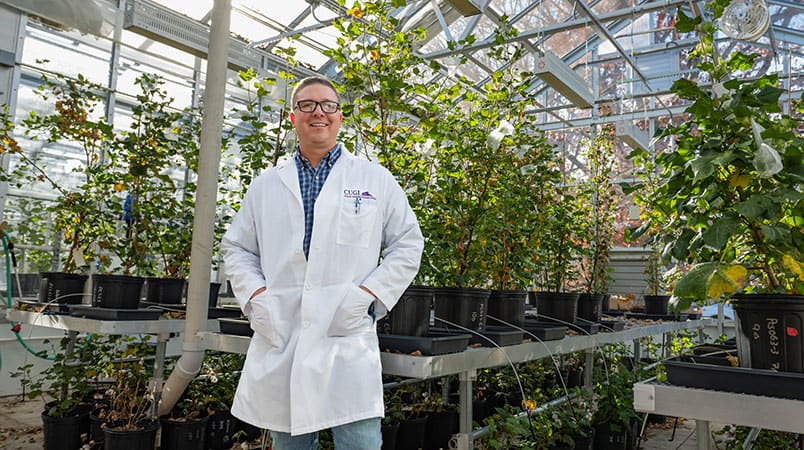
Chris Saski in a research greenhouse at Clemson University.
Media Credit: Clemson University
When we need to engineer drought resistance or resistance to a pathogen, we can use our new system from this project to directly modify an elite line, saving decades.
– Chris Saski, Clemson University
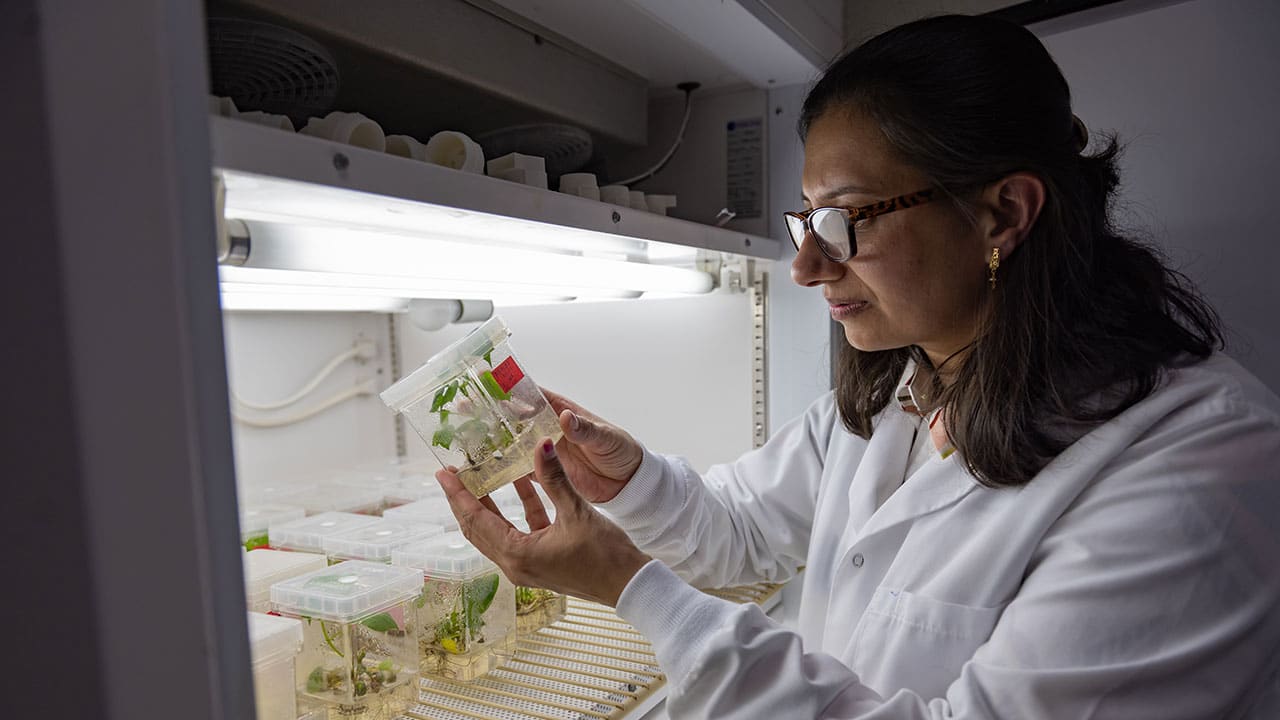
Soniki Kumar examines tiny cotton plants in the lab.
Media Credit: Clemson University
APPLICATION
New cotton lines could be engineered faster to withstand drought, resist disease, and deliver higher yields, reducing resource demands.
Agricultural companies are already expressing interest in licensing the Clemson team’s methods, reflecting a strong industry desire to apply gene-editing technology for crop improvement. Faster regeneration also enhances gene banks, collections of seeds and living plant cells that safeguard crop diversity for future generations, and may one day support efforts to grow crops beyond Earth. These methods pioneered in cotton may serve as a model for tackling regeneration barriers in other economically important species.
This content is abridged from an article originally published in Upward,
official magazine of the ISS National Lab.


