
« Back to Annual Report for Fiscal Year 2025
Executive Summary
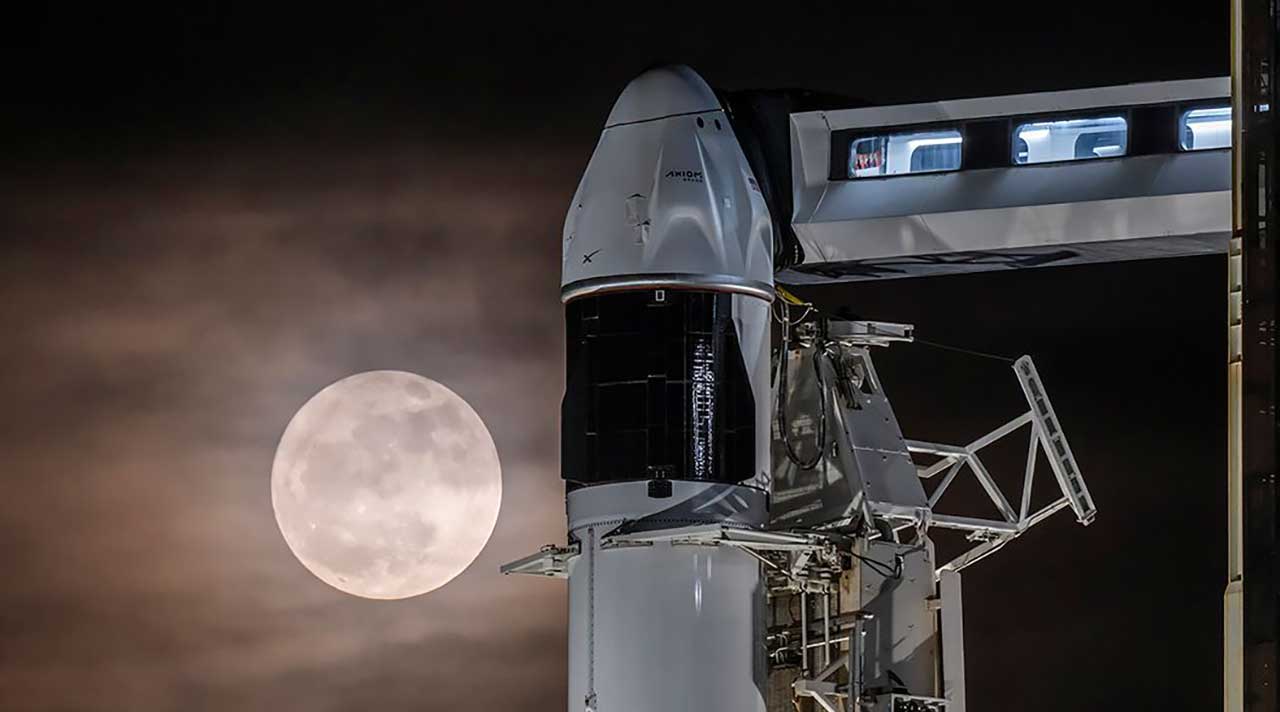
Axiom Mission 4 at the launch pad at NASA's Kennedy Space Center
Media Credit: SpaceX
Over the past 14 years, the Center for the Advancement of Science in Space® (CASIS®) has made remarkable progress in advancing the mission of the International Space Station (ISSInternational Space Station) National Laboratory—managing a premier research platform in space and providing the expertise, connection, and inspiration that fuel cross-disciplinary innovation. In fiscal year 2025 (FY25), the ISS National Lab continued its momentum in establishing a robust and sustainable low Earth orbit(Abbreviation: LEO) The orbit around the Earth that extends up to an altitude of 2,000 km (1,200 miles) from Earth’s surface. The International Space Station’s orbit is in LEO, at an altitude of approximately 250 miles. (LEO) economy by driving demand for space-based research, cultivating supply-side growth, and spurring increased investment by demonstrating the value of science in space.
However, FY25 also brought considerable challenges. Resource constraints affecting budget, launch allocation, and crew time led to a substantial reduction in the ISS National Lab’s statement of work. The resulting impacts are referenced throughout this report. Despite these challenges, the ISS National Lab achieved many notable accomplishments in FY25.
“NASANational Aeronautics and Space Administration and the ISS National Lab continue to maximize the International Space Station’s science throughput and impact. Our partnership is producing a record number of products, patents, and publications, all while increasing the number of commercial payloads being delivered to the space station and investments from startup companies using microgravityThe condition of perceived weightlessness created when an object is in free fall, for example when an object is in orbital motion. Microgravity alters many observable phenomena within the physical and life sciences, allowing scientists to study things in ways not possible on Earth. The International Space Station provides access to a persistent microgravity environment..”
– Robyn Gatens, Director of NASA’s International Space Station and Commercial Spaceflight Divisions
It was a landmark year for research and technology development (R&D) successes. Close to 80 peer-reviewed articles related to ISS National Lab-sponsored research were published, with 20% appearing in top-tier journals, indicating the high impact of the results. A testament to the growing translational value of LEO R&D, 13 patents and six products related to ISS National Lab-sponsored research were identified this year, setting a new record. Among these are Encapsulate’s tumor-on-a-chip system, MicroQuin’s revolutionary cancer therapeutic, Orbit Fab’s in-orbit refueling system, MIT’s impact-sensing spacecraft material, Orbital Sidekick’s hyperspectral imaging system for underground pipeline leak detection, and virtual educational tools from miniPCR and VRCORE Education.
“The International Space Station delivers research that benefits life on Earth, strengthens the low Earth orbit economy, and supports human exploration of the Moon and Mars. The research managed by the ISS National Lab through a Cooperative AgreementA cooperative agreement is Federal assistance that establishes a relationship between the U.S. Government and a recipient in which the principal purpose of the relationship is to accomplish a public purpose of support or stimulation. Since 2011, the Center for the Advancement of Science in Space™ (CASIS™) has managed the National Laboratory® through a Cooperative Agreement with NASA. with NASA ensures we support the highest-quality space science and technology demonstrations, leveraging the orbital complex’s unique microgravity environment.”
– Ken Bowersox, Associate Administrator of NASA’s Space Operations Mission Directorate
Outreach and engagement efforts also grew, bolstering support for space-based R&D from a diverse stakeholder community. Three robust issues of Upward® showcased cutting-edge results from research sponsored by the ISS National Lab to the magazine’s nearly 10,000 subscribers. The ISS National Lab also debuted its new podcast, Between a Rocket & a Hard Space, which has already gained more than 2,700 subscribers. In addition, CASIS(Abbreviation: CASIS™) The nonprofit organization that manages the ISS National Lab, which receives at least 50 percent of the U.S. research allocation on the International Space Station to facilitate research that benefits humanity (NASA manages the other 50% and focuses on research for space exploration purposes). partnered with the American Institute of Aeronautics and Astronautics to expand programming for its 2025 and 2026 ASCEND conferences to include content highlighting the ISS National Lab’s critical role in advancing R&D in LEO.
In FY25, a record-breaking 115 ISS National Lab-sponsored payloads were delivered to station, nearly 80% of which were commercial research projects. Furthermore, the ISS National Lab brought in more than $10 million in external, non-NASA funding, with 65% coming from commercial entities. These points serve as clear indicators of the private industry’s continued high demand to access space for R&D. Additionally, the ISS National Lab’s long-standing partnerships with the U.S. National Science Foundation (NSF) and the National Institutes of Health (NIH) continued to advance valuable fundamental science, laying a foundation for countless future applications. The ISS National Lab also continued to support supply-side Implementation Partners (IP(Abbreviation: IP) Commercial companies that work with the ISS National Lab to provide services related to payload development, including the translation of ground-based science to a space-based platform.) who provide critical payload development services, and more than 65% of ISS National Lab funding in FY25 went toward IP costs for projects.
This year, the ISS National Lab launched its Orbital Edge Accelerator program, bringing global investors and high-potential startups into the growing space economy. It was also a strong year for fundraising by startups within the ISS National Lab ecosystem. In FY25, startups that have completed an ISS National Lab-sponsored project cumulatively raised $251 million—an increase of more than 70% over last year—bringing the total amount of such funding to nearly $2.5 billion.
For a snapshot of all ISS National Lab activities in FY25, please see the map in Appendix D.
“In 2025, the CASIS User Advisory Committee focused on uniting ISS National Lab stakeholders to communicate the importance of our work—not just in research, but in developing the LEO economy—and to advocate for its continued growth. We helped build an understanding that Commercial Service Providers, Implementation Partners, NASA, and current and future researchers and customers all need a healthy ISS National Lab through 2030 to enable a thriving LEO economy now and in the future. We will continue this work to ensure there’s a solid foundation when the ISS reaches the end of its mission.”
– Mark Gittleman, Chair of the ISS National Lab User Advisory Committee(Abbreviation: UAC) A committee that provides CASIS with user input and perspective about the management of ISS National Lab resources. and of the Aegis Aerospace Board of Advisors
A Personal Note From Ramon Lugo, Principal Investigator and CEO of CASIS:
This past year has tested the resilience and ingenuity of the ISS National Lab, our user community, and our industry partners. I am proud to say that we did more than overcome these challenges—we emerged stronger, with a more robust program and deeper relationships that will serve us well into the future.
One of the most significant hurdles was the cancellation of the ISS Research and Development Conference, a cornerstone event for our community. Yet, through collaboration and determination, we developed an alternative for 2025 that allowed us to gather, share ideas, and continue the vital dialogue that drives progress in the LEO economy.
We also made strategic shifts in our approach. While we discontinued traditional ISS National Lab solicitations, we launched Orbital Edge, our accelerator program that connects the investment community with the LEO economy. The inaugural cohort was a success—six innovative startups were selected to fly projects in space, with the ultimate goal of creating new commercial ventures and expanding economic activity. We are now working closely with NASA to explore deploying another Orbital Edge Accelerator solicitation in 2026.
2025 was also a landmark year for collaboration with our User Advisory Committee (UAC). Under the leadership of the new UAC Chair, the committee provided critical guidance on a prioritization framework that will shape the remainder of the ISS Program. We recognize that such a change at this stage can feel disruptive, but with limited resources, it is essential. Our commitment is to monitor outcomes and adjust as needed. As the voice of our community, the UAC’s contributions were instrumental in ensuring this process is transparent and fair.
As we close the year, I want to express my gratitude to NASA, our government partners, our user community, our commercial partners, and, importantly, the CASIS team for their trust and collaboration. Together, we have navigated a challenging year and laid the foundation for an even brighter future.
Please take a few moments to review our Annual Report. It reflects the hard work and achievements of 2025—none of which came easily, but all of which move us forward.