
« Back to Annual Report for Fiscal Year 2025
LEO Economic Development: Supply
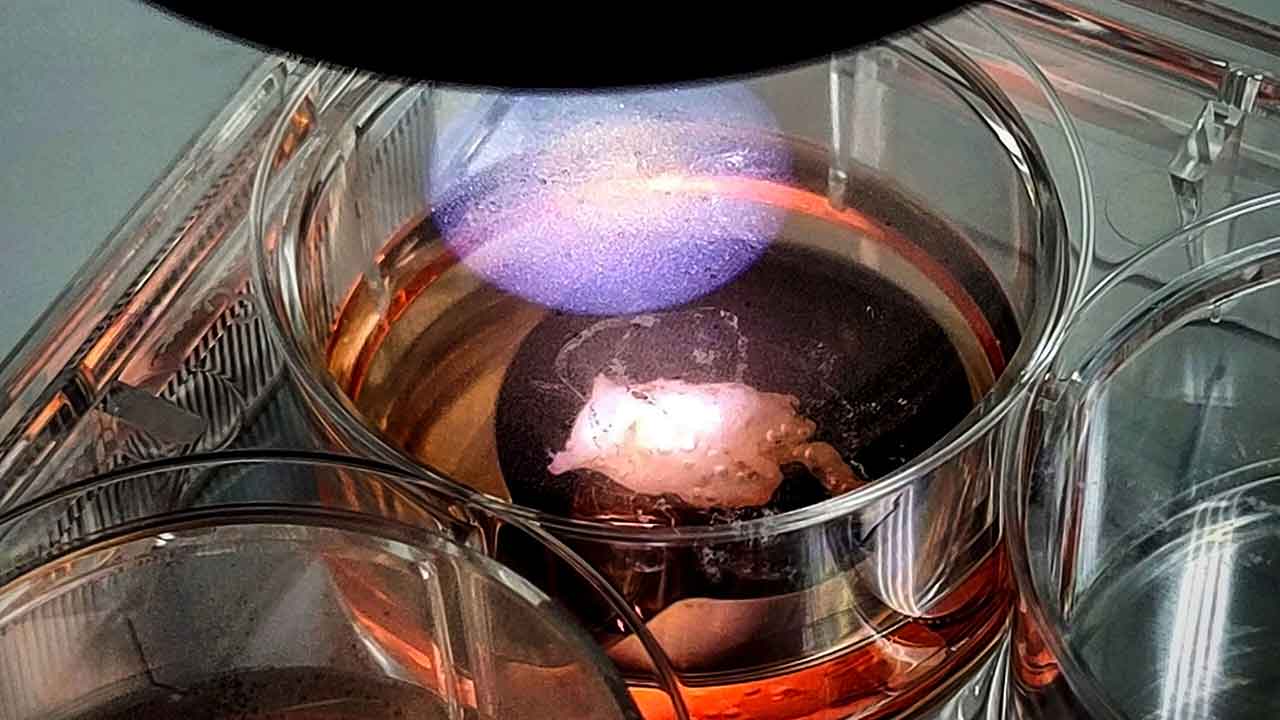
Live human heart tissue bioprinted with Redwire's BioFabrication Facility(Abbreviation: BFF) The BFF is a 3D bioprinter on the ISS capable of printing human tissue from bioinks mixed with living cells. This ISS National Lab commercial facility is owned and operated by Redwire Space. aboard the International Space Station. The tissue was successfully returned to Earth in April 2024. Results of the BFF-Cardiac investigation could advance technologies for producing organs and tissues in lieu of donated organs for transplant. The experiment also improves 3D printing, with the goal of giving crew the ability to print material like foods and medicines on demand for future long-duration space missions.
Media Credit: Redwire Space
The ISSInternational Space Station National Lab continues to bolster the supply side of the LEO(Abbreviation: LEO) The orbit around the Earth that extends up to an altitude of 2,000 km (1,200 miles) from Earth’s surface. The International Space Station’s orbit is in LEO, at an altitude of approximately 250 miles. economy by supporting a network of Implementation Partners (IP(Abbreviation: IP) Commercial companies that work with the ISS National Lab to provide services related to payload development, including the translation of ground-based science to a space-based platform.), organizations that provide hardware and services to translate ground-based science into successful spaceflight investigations. In FY25, the ISS National Lab collaborated with 32 IPs, 13 of which are Commercial Service Providers that own and operate facilities on the space station or are developing future facilities. Biannual IP workshops hosted by the ISS National Lab strengthened collaboration and advanced a shared mission to enhance supply-side capabilities for space-based R&D to meet the growing demand. For a full list of IPs, see the Implementation Partner Directory.
- Two new Commercial Service Providers were added in FY25: Vast and Tec-Masters. For a full list of commercial facilities, see Appendix B.
- More than 65% of ISS National Lab funding this year went toward IP costs for payload development services.
- More than 70% of ISS National Lab-sponsored payloads delivered this year were sourced by Commercial Service Providers, underscoring the ISS National Lab’s commitment to enabling customer access to commercial facilities on station.
- There are now 24 commercial ISS facilities, 17 permanently installed on station and seven launched as needed.
- The searchable ISS Research Facilities Directory of R&D capabilities available through NASANational Aeronautics and Space Administration and ISS National Lab commercial facilities had more than 7,100 website pageviews in FY25.
- One new commercial facility was added this year, Tec-Masters’ Microgravity Research for Versatile Investigations(MaRVIn) platform, which supports a wide range of physical science research with its interchangeable experiment modules.
- Redwire’s PIL-BOX pharmaceutical crystallization facility was updated with a new insert to better protect the hardware from harsh chemicals.
“Since 2019, Rhodium Scientific and the ISS National Laboratory have partnered to expand ISS access for first-time space researchers. This partnership has enabled Rhodium to establish itself as America’s first commercial space biotech company, accelerating R&D into marketable results by leading the largest in-space biomanufacturing program, generating new stem-cell IP, and advancing mission readiness for microgravityThe condition of perceived weightlessness created when an object is in free fall, for example when an object is in orbital motion. Microgravity alters many observable phenomena within the physical and life sciences, allowing scientists to study things in ways not possible on Earth. The International Space Station provides access to a persistent microgravity environment. programs spanning drug development to agricultural systems. Together, we streamline the end-to-end process to ensure every mission is executed seamlessly and with scientific excellence.”
– Olivia Gámez Holzhaus, Founder and CEO of Rhodium Scientific
Key IP milestones for FY25 include
- Aegis Aerospace
- Was awarded a $10 million grant from the Texas Space Commission’s Space Exploration and Aeronautics Research Fund program to develop an in-space manufacturing platform for advanced materials.
- Announced it will partner with Texas A&M University to develop a private flight facility on the ISS dedicated to university research.
- CEO Stephanie Murphy was named on Inc.’s 2025 Female Founders 500 List.
- BioServe Space Technologies supported its 100th space mission, marking more than three decades of enabling ISS research.
- Redwire Space
- Was awarded a $25 million NASA grant for in-space pharmaceutical manufacturing and launched SpaceMD, a new venture company that will use PIL-BOX to grow protein crystals in space for new and reformulated therapeutics on Earth.
- Chief Scientist Kenneth Savin was named to TIME’s 2025 Health 100 list for his leadership in pharmaceutical innovation and space biotech research.
- Space Tango supported the continuation of LambdaVision’s research to advance retinal implants to restore meaningful vision to those with macular degeneration.
- Vast completed production of the primary structure for its Haven-1 commercial space station, planned for launch in 2026, and is collaborating with SpaceX to solicit research to fly on it.
- Voyager Technologies (previously Voyager Space)
- Went public, raising $382.8 million and reaching a peak valuation of $3.8 billion.
- Acquired LEOcloud, a space-based cloud computing startup that is testing its Space Edge micro datacenter in an ISS National Lab-sponsored investigation.
- Announced the Starlab commercial space station, being developed in collaboration with Airbus, is moving into full-scale production.