
View From the Cupola: Cady Coleman
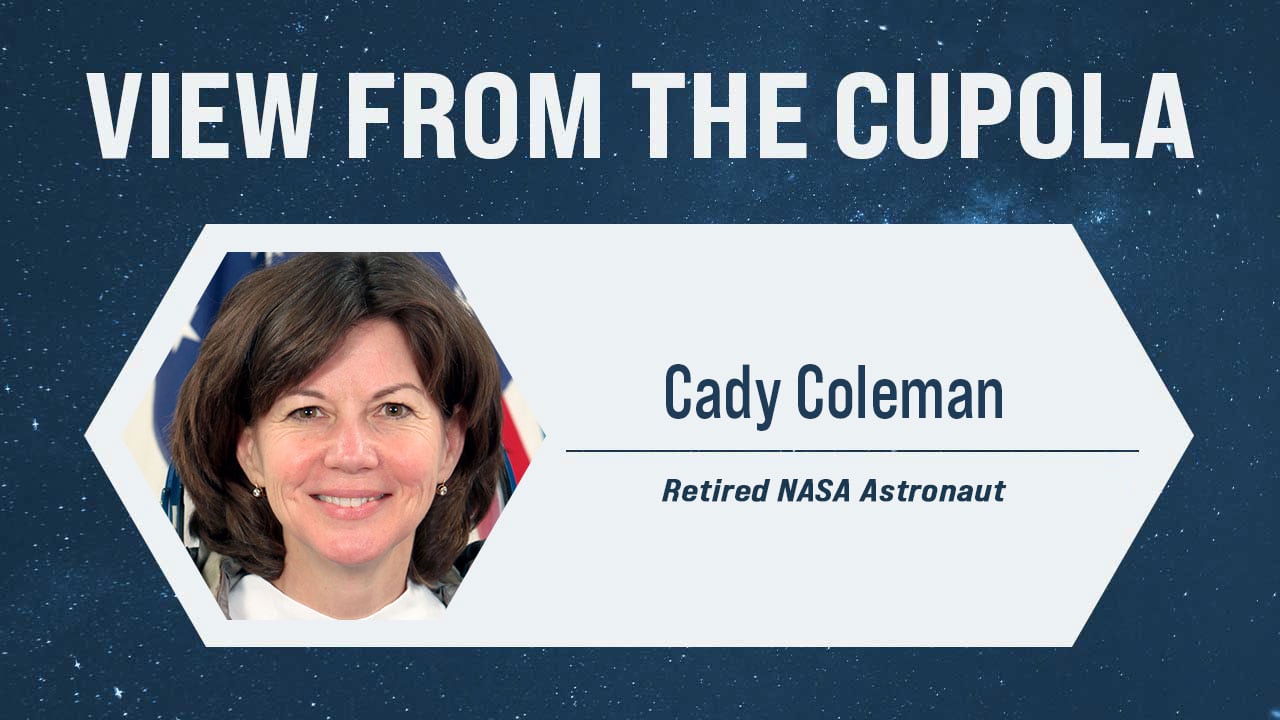
View from the Cupola - Cady Coleman
March 30, 2026 • By Cady Coleman, Retired NASA Astronaut
In 2010, the day after my 50th birthday, I got the best present imaginable. I climbed aboard a Russian Soyuz rocket with my two crewmates and launched to the International Space Station (ISSInternational Space Station). As a scientist-astronaut, it was the fulfillment of a long-held dream to live for almost six months on the ISS, where every day I worked with scientists on the ground to conduct unique experiments not possible on Earth.
As we celebrate a quarter century of continuous human presence on the ISS, I’m inspired to reflect on how we got here and the enormous impact our scientific and engineering research in space has made. I’m honored to contribute to this 10th anniversary issue of the ISS National Lab’s Upward magazine, a marvelous place to learn about those stories of discovery.
On my first space shuttle flight, our goal was to help ensure we were designing the ISS to operate successfully as a space laboratory. Routine operations on the space station today were big questions back then. How will scientists on the ground interface with astronauts? How and when will the scientists receive their data? What kind of equipment is needed to conduct state-of-the-art research in many disciplines? However, my biggest question at the end of our 16-day mission—the longest shuttle mission at that time—was: “Why are we coming home? We have so much work to do up here!”
Our scientific journey in space has greatly evolved since then. The orbiting laboratory has been the site of amazing discoveries, with each experiment and each set of results building on the ones that came before. In many realms, from combustion to biology, ISS science has deepened our understanding of fundamental processes, giving us the building blocks to produce new materials, design new drugs and medical devices, and expand options for growing food, even in inhospitable environments.
As astronauts, we serve as the scientists’ partners in space, always aware that our efforts are part of a broader mission of discovery. It is a privilege to be part of a family that includes not only our astronaut crewmates but the engineers and scientists who design the experiments we conduct. The family also includes the people who tell the stories of those discoveries, which is so important to sustaining the work we do and inspiring others to join our efforts. As you read the three features in this issue highlighting remarkable innovations from ISS National Lab-sponsored research, imagine all the people and work that led us here.
This issue’s cover story showcases LambdaVision’s research on manufacturing artificial retinas for those blinded by retinitis pigmentosa and age-related macular degeneration. In collaboration with the ISS National Lab, NASANational Aeronautics and Space Administration, and Space Tango, LambdaVision has successfully produced several high-quality artificial retinas on the ISS. MicrogravityThe condition of perceived weightlessness created when an object is in free fall, for example when an object is in orbital motion. Microgravity alters many observable phenomena within the physical and life sciences, allowing scientists to study things in ways not possible on Earth. The International Space Station provides access to a persistent microgravity environment. facilitates the production of these highly uniform, 200-layer protein-based thin films without the sedimentation issues that limit manufacturing on Earth. Now the startup is working to refine processes and lay the groundwork for scalable in-space production and future clinical trials.
As the second astronaut ever to capture a free-flying object from the ISS using the CANADARM2 robotic arm, I was intrigued by this issue’s feature on Kall Morris Inc. (KMI). The startup is advancing technology that could help with space debris removal, a difficult and growing challenge. KMI leveraged the ISS National Lab to successfully test its REACCH (Responsive Engaging Arms for Captive Care and Handling) system. REACCH unfurls its tentacle-like arms to capture free-floating objects, gripping them with technology that mimics the way a gecko’s feet enable it to walk up walls. After further refinement, REACCH will progress to capturing space objects in low Earth orbit(Abbreviation: LEO) The orbit around the Earth that extends up to an altitude of 2,000 km (1,200 miles) from Earth’s surface. The International Space Station’s orbit is in LEO, at an altitude of approximately 250 miles. (LEO).
Given my early materials work as a polymer chemist, I’m particularly excited about the feature on the U.S. Naval Research Laboratory’s investigation into microbes that produce melanin, a natural pigment. Among other fascinating properties, melanin is known to protect cells against radiation and oxidative stress and can also bind to environmental toxins, properties that matter both to astronauts in space and those of us here on the ground. Studying melanized microbes in microgravity could generate valuable insights into how these organisms produce protective compounds, informing the development of advanced biomaterials and potentially new therapeutics.
As an astronaut, there is no greater satisfaction than being part of an experiment that leads to a leap forward in our understanding. Looking back at the full scope of what has been accomplished on the ISS and the thousands of people responsible for its success, I know that satisfaction is shared widely. Our cumulative experience operating an international scientific outpost in space has built invaluable capabilities, infrastructure, and collaborative models—both scientific and international—that will be pivotal as we continue to explore in LEO and beyond. This milestone and the legacy of our space station aren’t endpoints; they are bridges to an exciting future.
Want to share this feature with a colleague or save it for later? Download a PDF version of this feature.

Amelia Williamson Smith, Upward Managing Editor
Letter From the Editor
Ten years ago, I sat at my computer brainstorming how best to share the amazing science enabled by the ISS National Lab. It was then that Upward was born.
We chose the magazine’s name for many reasons. We look upward to the ISS—our nation’s only orbiting laboratory—to solve some of humanity’s greatest challenges and to create things not possible on the ground. We endeavor upward in our pursuit of advancing science and technology in space to improve life on Earth. And we raise our aspirations upward beyond the ISS to a future where commercial space stations operate in a robust low Earth orbit (LEO) economy.
I hope you enjoy this 10th anniversary edition, in which we highlight how the idea of manufacturing products in space for use on Earth is no longer confined to science fiction. Studies enabled by the ISS National Lab over the past decade have shown that not only is this vision possible—it’s right around the corner.
As we look ahead to this exciting future, we also take a moment to look back on the road that brought us here. The ISS has served as an invaluable testbed for in-orbit production. It’s a place where companies can validate systems and facilities, refine and optimize production processes, and uncover ways to scale their manufacturing on future LEO platforms. It remains a critical step toward the next industrial revolution—in space.
I am so proud of how far Upward has come over the last 10 years and all the stories we’ve shared that showcase the value of conducting research and technology development in space. I am thankful for our amazing team that helped bring the idea of the magazine to life. And I am grateful to you, our readers, for joining us on this incredible journey of discovery. We hope you continue to follow along as we forever strive upward.