Continuity in Low Earth Orbit: The Foundation of a Thriving Space Economy
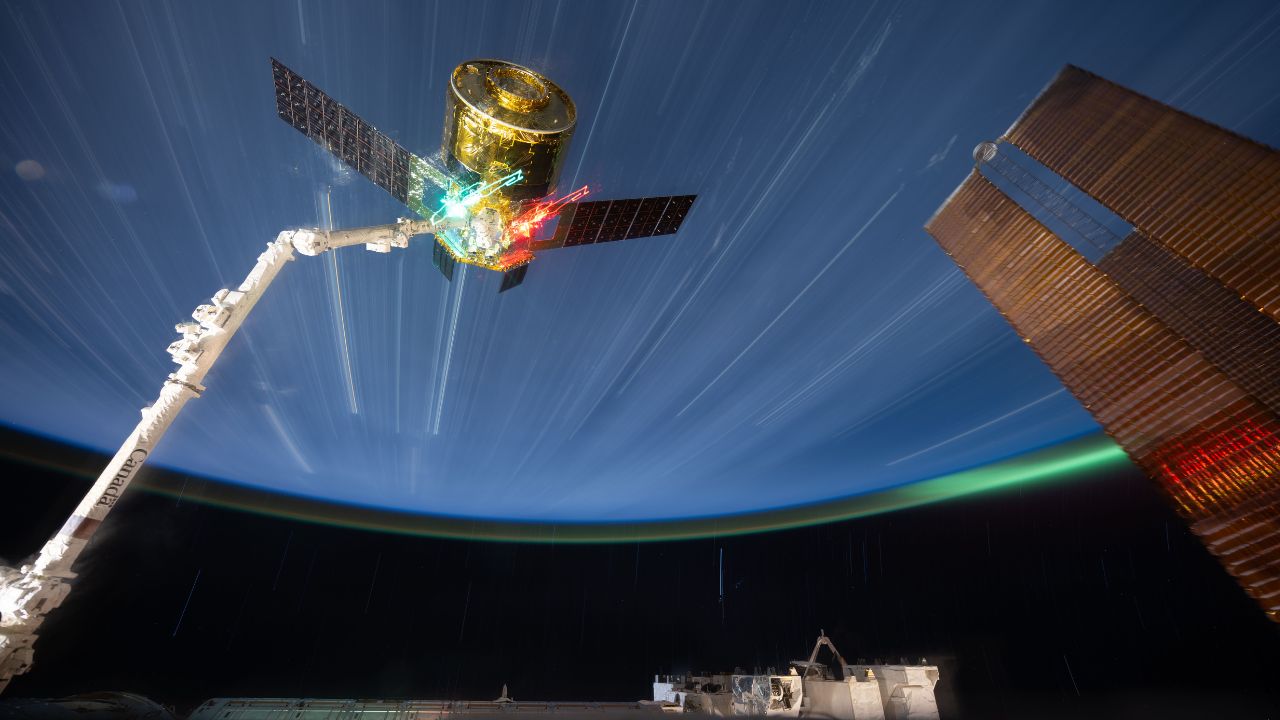
View from the ISS
Media Credit: NASA
By Francisco Córdova, Chief Operating Officer for the ISS National Lab
March 26, 2026
This piece is part of our Forging the Path series in which CASIS® experts and partners share knowledge and insight on managing a national lab in space.
Francisco Córdova serves as Chief Operating Officer for the ISSInternational Space Station National Laboratory, the world’s premier space-based research facility, where he leads a team that is shaping the future of research in space and is working with commercial partners to establish a robust and sustainable low Earth orbit(Abbreviation: LEO) The orbit around the Earth that extends up to an altitude of 2,000 km (1,200 miles) from Earth’s surface. The International Space Station’s orbit is in LEO, at an altitude of approximately 250 miles. economy.

Let’s go back 15 years. It’s 2011. The International Space Station (ISS) has just been completed. SpaceX is in its infancy, testing rockets with more ambition than certainty. Launch costs are extraordinarily high, satellites are expensive, and access to space is limited to a handful of government-led missions. The space shuttle has just been retired, and with it, a sense of routine human activity in orbit disappears.
At that moment, the low Earth orbit (LEO) research ecosystem is effectively near zero.
For decades, activity in space had been driven almost entirely by government priorities (primarily NASANational Aeronautics and Space Administration), with a focus on exploration and the technologies required to sustain human life beyond Earth. Research was conducted for space, not for Earth. The ISS, while remarkable, risked becoming a symbol of achievement rather than a platform for continuous innovation.
Then something changed.
We changed the paradigm.
We stopped treating the ISS as a rare, inaccessible asset and began to see it for what it could truly be: a national laboratory. A place not just for astronauts and government experiments, but for researchers, startups, and industries seeking answers to problems that cannot be solved on Earth alone.
We opened access.
We equipped the space station with cutting-edge facilities.
We enabled companies to send payloads, develop technologies, and build capabilities in microgravityThe condition of perceived weightlessness created when an object is in free fall, for example when an object is in orbital motion. Microgravity alters many observable phenomena within the physical and life sciences, allowing scientists to study things in ways not possible on Earth. The International Space Station provides access to a persistent microgravity environment..
And most importantly, we shifted the purpose of research in orbit.
Instead of focusing solely on how to live in space, we began asking: how can space improve life on Earth? That shift has been transformative.
Today, more than 60% of the research conducted on the ISS is focused on delivering tangible benefits back to Earth. Researchers are leveraging the unique space environment to advance pharmaceuticals, materials science, biotechnology, and manufacturing processes in ways not possible on the ground.
But the evolution didn’t stop there.
We took it a step further, recognizing that scientific discovery alone is not enough. For a sustainable LEO economy, research must be paired with commercial viability. Companies must not only innovate in space but also survive and scale on Earth.
This has led to a critical insight: The companies that have most successfully leveraged microgravity are those built on strong terrestrial business models.
Space can accelerate discovery, but Earth remains the primary market. Companies that understand this (those that design solutions with clear commercial pathways) are far more likely to thrive in orbit and beyond.
And this is where continuity becomes essential.
The progress we’ve made over the past decade did not happen overnight. It required sustained investment, consistent access, reliable launch capabilities, and a stable platform for research and development. The ISS has provided that continuity. It has allowed ideas to mature, companies to iterate, and an ecosystem to take root. To date, the ISS National Lab has flown nearly 1,000 research payloads, becoming the single most prolific space research entity in the world.
But continuity is not just about infrastructure, it is about demand.
As we approach the transition from the ISS to commercial LEO destinations (CLDs), we face a critical inflection point. It is not enough to build the next generation of platforms; we must ensure there is a robust, sustained pipeline of research and development ready to utilize them from day one.
CLDs should not come online and then scramble to find customers.
They must launch into an environment where demand is already strong, where companies are already investing, and where research programs are already in motion. That continuity of demand is what will enable a seamless transition from a government-led model to a commercially driven ecosystem.
Maintaining that demand requires intentional action.
We must continue to fund and support space-based R&D. We must keep the pipeline full, ensuring that startups, academic institutions, and industry players are actively developing experiments, technologies, and products destined for orbit.
And we must be pragmatic about how we bridge the gap. Because a gap in demand is just as dangerous as a gap in capability.
Engaging other existing platforms will play a critical role in this transition. Commercial “free flyers” can absorb some of the near-term demand, provide additional access points, and help ensure that momentum is not lost as the ISS eventually sunsets and CLDs come online.
Without sustained utilization, the business case for CLDs weakens. Investors hesitate. Operators struggle. And the fragile ecosystem we have spent more than a decade building risks contraction at precisely the moment it should be expanding.
Innovation does not thrive in uncertainty.
Markets do not grow without stability.
And ecosystems do not survive without continuity, of both capability and demand.
Low Earth orbit is no longer just a destination for exploration; it is an emerging economic domain. To fully realize its potential, we must treat it as such: with long-term vision, sustained commitment, and uninterrupted access.
Because the lessons of the past 15 years are clear: When you provide continuity in space, innovation follows. When you sustain demand, markets emerge. And when both are aligned, impact—both in orbit and on Earth—is inevitable.