
March 2026
Welcome to Space Station Spotlight, the monthly newsletter of the ISS National Laboratory®.

What’s new at the ISS National Lab?
Entering its second year, the program is designed for early-stage startups leveraging space to develop innovative products. Global investors Cook Inlet Region, Inc., E2MC, and Stellar Ventures are once again partnering with the ISS National Lab on the program, which expands access to flight opportunities, venture capital, and business mentorship. Learn more.
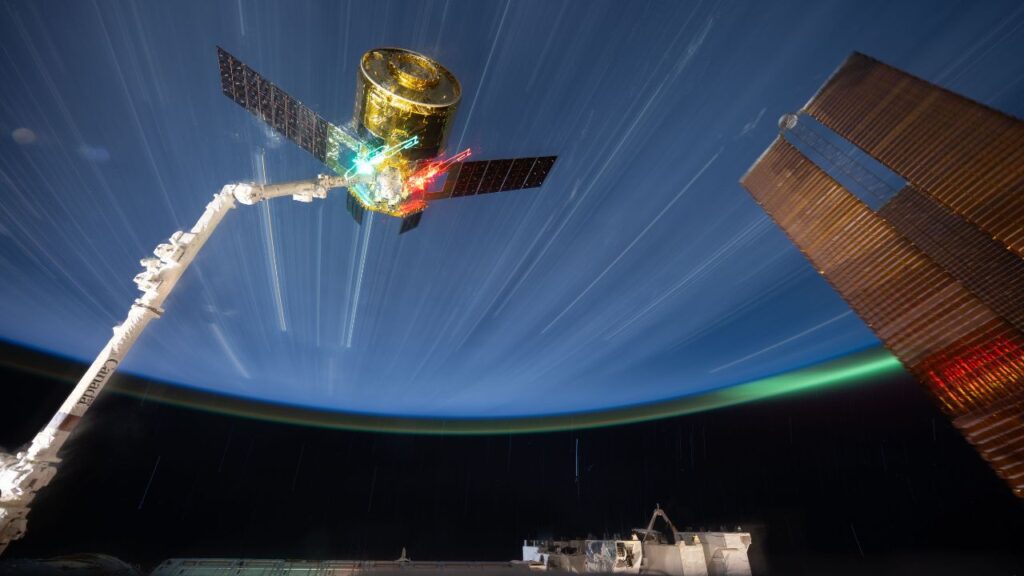
ISS National Lab chief operating officer Francisco Córdova discusses how sustained access to the ISS transformed space-based R&D from a government‑led endeavor into a catalyst for commercial innovation. Read the piece to see why maintaining infrastructure and demand are critical to the success of future commercial space stations.
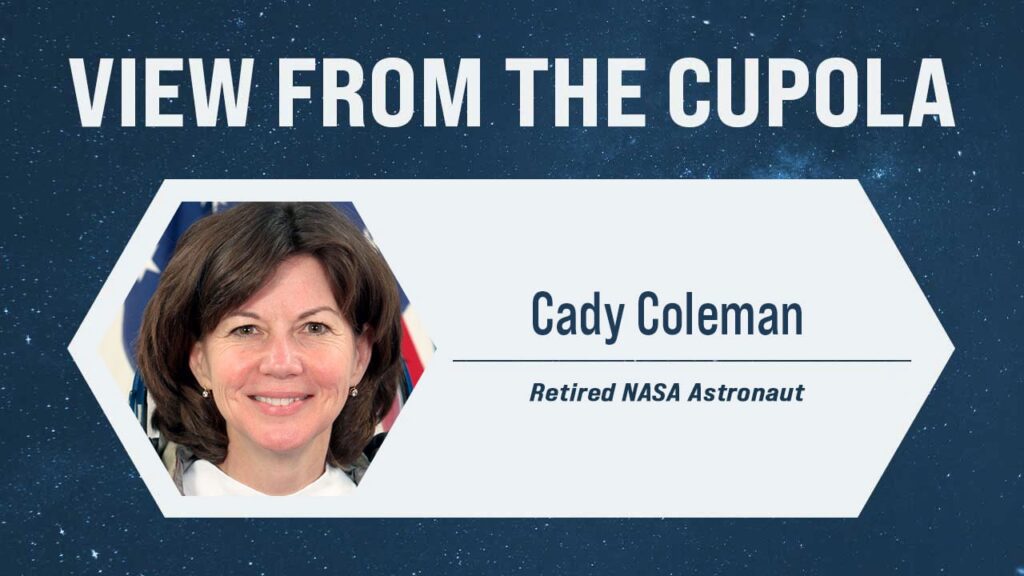
For the past decade, Upward has showcased valuable results from ISS National Lab-sponsored research and technology development. Hear from retired NASA astronaut Cady Coleman in her “View From the Cupola” piece introducing this special 10-year edition.
Partner News
Congress may push ISS retirement from 2030 to 2032. A new NASA Authorization bill could extend the life of the ISS by an additional two years. The extension would provide more time to complete commercial space stations, reducing the chances of a gap in continuous human presence in LEO.
NASA astronauts completed a spacewalk to prepare for ISS solar array installation. Jessica Meir and Chris Williams assembled and attached the bracket structure for a new ISS Roll-Out Array (iROSA) to be installed on a future spacewalk. This will be the seventh of eight iROSAs replacing the original ISS solar arrays.
NASA awarded Redwire $4 million to support drug development projects on the ISS. The additional funds, which expand an existing task order under a $250 million contract through NASA’s In-Space Production Applications program, will support new investigations using Redwire’s Pharmaceutical In-Space Laboratory (PIL-BOX) on the ISS.
Commercial payload space on the future Starlab private space station is fully booked. Starlab Space, a joint venture between Voyager Technologies, Airbus, Mitsubishi, and MDA Space, received significant support through Phase 1 of NASA’s Commercial LEO Destinations program and recently passed its Commercial Critical Design Review.
Vast raised $500 million to continue developing its line of commercial space stations. The company plans to launch its Haven-1 space station next year and Haven-2 in 2028. Vast was also recently selected to send astronauts to the ISS on NASA’s sixth private astronaut mission next year.
Voyager Technologies was awarded a multi-million-dollar follow-on NASA contract. The contract, awarded under NASA’s Expendable Launch Vehicle Integrated Support 3 (ELVIS 3) program, extends Voyager’s multiyear support of NASA’s Launch Services Program through the end of the fiscal year.
Sierra Space raised $550 million in Series C funding. The new equity investment, led by LuminArx Capital Management, brings the total capital investment in the company to more than $2 billion since 2021. Sierra Space also recently named Dan Jablonsky as its new CEO.
Results
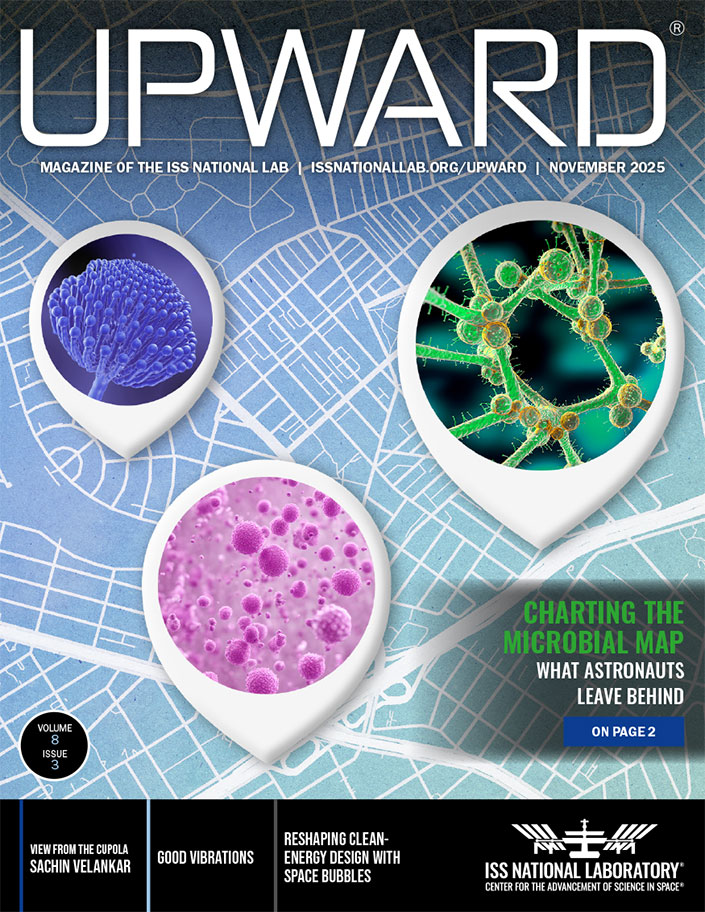
The most recent issue of Upward, official magazine of the ISS National Lab, is online. Explore valuable findings from space-based R&D—download the current and past issues here.
Artificial retinas made in space could one day restore vision in patients with macular degeneration. LambdaVision developed an artificial retina made from hundreds of layers of a light‑activated protein. On Earth, gravity‑driven forces can cause uneven layers, leading to significant material waste and limiting scalability. To improve production, the company turned to space. Read the Upward feature “Manufacturing Artificial Retinas in Space,” to see how LambdaVision’s nine ISS investigations have paved the way for production on future commercial LEO platforms.
UC San Diego scientists published results from brain organoid research on the ISS. The team found that spaceflight changed the types and amounts of certain proteins in the brain organoids, affecting how brain cells communicate, develop, and maintain normal function. The findings, published in the Nature journal Scientific Data, could help researchers better understand the mechanisms behind neurological conditions, identify new potential drug targets, and improve models of brain disease.
Boise State University researchers published a study that builds on ISS National Lab-sponsored research. Previous work found that microgravity causes stem cells to lose mechanical signals that help regulate pathways involved in bone formation. The team’s ISS research revealed that steady, unchanging pressure does not activate these pathways, but changing, repeated motion does. In this new study, the team examined how stem cells distinguish between steady pressure and repeated movement. The results, published in the Journal of Biomechanics, could lead to new ways to improve recovery after bone fractures, help prevent osteoporosis, and protect bone health in people unable to exercise.
Education and Outreach

Media Credit: NASA
The Choctaw Nation of Oklahoma conducted a student-led project on heirloom seeds exposed to spaceflight through the ISS National Lab. Students at Jones Academy, founded in 1891 by the Choctaw Nation, compared gardens grown from space-exposed seeds with those grown from Earth-kept controls as part of a project to study controlled-environment agriculture and sustainable food systems. The space-exposed garden produced more than 1,500 pounds of food, outperforming an Earth-based garden and highlighting the scalability of the Indigenous Three Sisters method, an agricultural practice that involves the planting of corn, beans, and squash together.