The New Alchemy of Space: Why We Cannot Leave Public Private Partnerships Behind
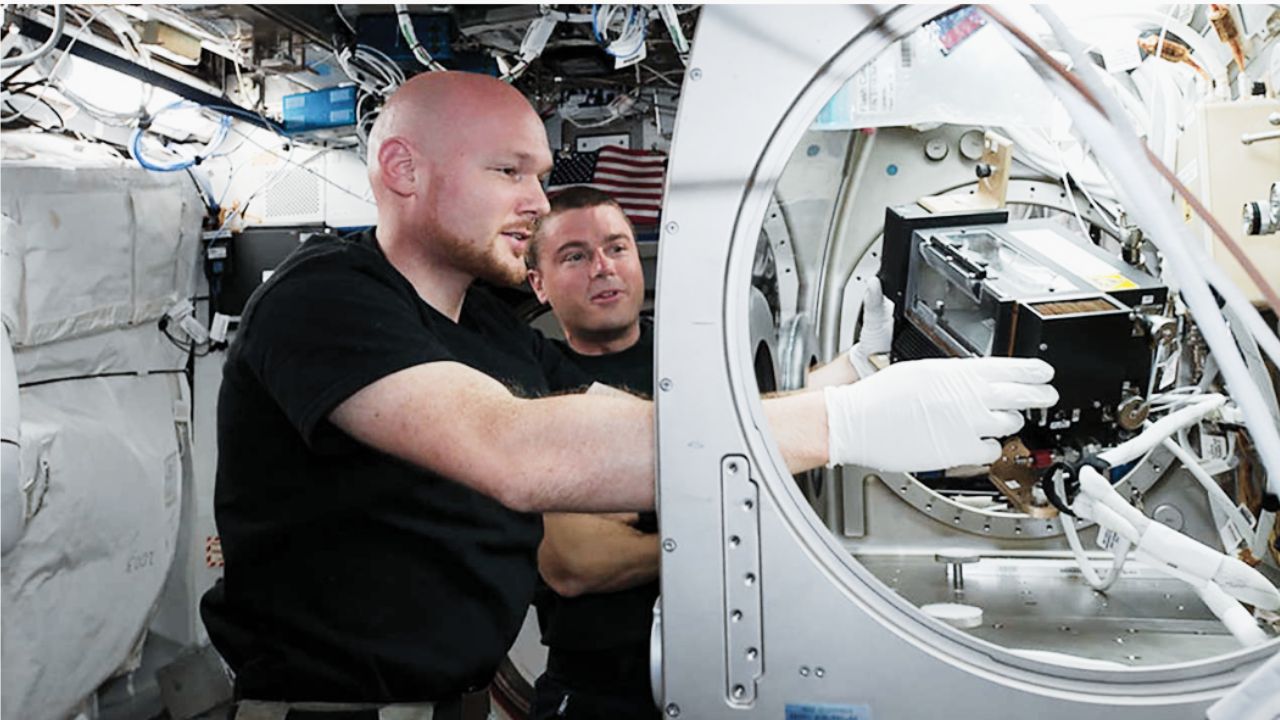
ESA astronaut Alexander Gerst and NASA astronaut Reid Wiseman work on a combustion experiment on the ISS, one of many projects funded by the U.S. National Science Foundation.
April 30, 2026 • By Dr. Michael Roberts
This piece is part of our Forging the Path series in which CASIS(Abbreviation: CASIS™) The nonprofit organization that manages the ISS National Lab, which receives at least 50 percent of the U.S. research allocation on the International Space Station to facilitate research that benefits humanity (NASA manages the other 50% and focuses on research for space exploration purposes). experts share knowledge and insight from their experience managing a national lab in space.
Michael Roberts, Ph.D., is Chief Scientific Officer for the ISSInternational Space Station National Laboratory, managed by CASIS in partnership with NASANational Aeronautics and Space Administration, where he works with the best team on Earth to launch science to space for the benefit of humanity.
In the ancient world, humans across China, India, the Middle East, and Europe developed a natural philosophy that they believed would change the world. Their goal was to create a Philosopher’s Stone capable of transmuting physical matter, turning lead into gold and mercury into silver. Or, if they were of a more biological bent, they sought to develop an Elixir of Life able to cure any disease and grant eternal youth. Today, we recognize this as alchemy.
Unfortunately, the lofty goals of alchemists were never realized, and the most common reward for their efforts was only to be poisoned by the fruits of their labor. Likewise, the visionary benefactors who backed them were perversely rewarded by experiencing the indignity of writing off a bad investment.
The alchemists did, however, succeed in changing the world, just not in the way they intended. Their work did not result in any gold produced from lead. Instead, their collective efforts across societies, continents, and time led to something arguably far shinier and more valuable than gold—knowledge.
Alchemy forged a fundamental understanding of the basic tenets of astronomy, chemistry, physics, and even some biology and medicine. This knowledge, derived from experimentation and observation, developed into a science capable of transmuting our primitive understanding of the natural world into a pragmatic understanding of physics and chemistry, with countless applications.
But what does this have to do with space? Space-enabled research is the new alchemy, a risky business with noble intentions to change our world. It may not deliver immediate, dramatic breakthroughs, but like alchemy, it offers something more valuable: transformative knowledge and innovation fueled by public-private partnerships.
For nearly 15 years, the International Space Station (ISS) National Laboratory, managed by the Center for the Advancement of Science in Space® (CASIS®), has forged the path for public-private partnerships as the primary drivers of commercial research and technology development (R&D) in space. Through these partnerships, the ISS National Lab is transforming space into a powerful engine of scientific discovery, economic growth, and human benefit.
Under a Cooperative AgreementA cooperative agreement is Federal assistance that establishes a relationship between the U.S. Government and a recipient in which the principal purpose of the relationship is to accomplish a public purpose of support or stimulation. Since 2011, the Center for the Advancement of Science in Space™ (CASIS™) has managed the National Laboratory® through a Cooperative Agreement with NASA. with NASA, CASIS manages the ISS National Lab’s half of the U.S. research allocation on the ISS. This allocation is reserved for non-NASA entities, including commercial companies, academic institutions, and other U.S. government agencies. But most importantly, the ISS National Lab’s allocation seeks to improve the lives of people back on Earth.
The Power of Partnerships
The ISS National Lab utilizes several specific models to engage partners. Through ISS National Lab sponsored programs, organizations can provide funding to target specific scientific and human health challenges, leveraging the space environment for innovation. Successful examples include partnerships with the U.S. National Science Foundation (NSF) and the National Institutes of Health (NIH) on research in fluid dynamics, tissue engineering, and tissue chips on the ISS. The ISS National Lab has also partnered with corporations like Target to advance research in focused areas.
To enable space-based R&D, the ISS National Lab works closely with Implementation Partners, a network of commercial, for-profit organizations that provide technical expertise for spaceflight research, helping researchers and entrepreneurs translate their Earth-based experiments into flight-ready payloads. A subset of these partners also act as Commercial Service Providers, private for-profit companies that own and operate more than 25 commercial research facilities on the ISS, providing hardware and technical services to users.
The ISS National Lab also partners on accelerator programs that provide funding and launch opportunities to support innovative startups building space-enabled businesses. For more than a decade, CASIS co-funded the Technology in Space PrizeA prize that provides grant funding for business startups participating in the MassChallenge startup accelerator program to conduct innovative research and technology development utilizing the ISS National Lab. The prize is funded by the Center for the Advancement of Science in Space, which manages the ISS National Lab, and Boeing. with Boeing in partnership with the MassChallenge accelerator program. In 2025, the ISS National Lab debuted its own Orbital Edge Accelerator program in collaboration with global investors, and the 2026 program will continue the Technology in Space Prize, funded by Boeing. Through Orbital Edge, the ISS National Lab connects startups with private capital, access to space, and experts to accelerate their businesses in low Earth orbit(Abbreviation: LEO) The orbit around the Earth that extends up to an altitude of 2,000 km (1,200 miles) from Earth’s surface. The International Space Station’s orbit is in LEO, at an altitude of approximately 250 miles. (LEO).
Solicitations issued by the ISS National Lab have driven advances across multiple fields. The $7 million Igniting Innovation solicitation in partnership with NASA’s Biological and Physical Sciences division is enabling critical cancer and disease research that isn’t possible on Earth. The ISS National Lab also partnered with NASA to advance in-space production applications(Abbreviation: InSPA) InSPA is an applied research and development program sponsored by NASA and the ISS National Lab aimed at demonstrating space-based manufacturing and production activities by using the unique space environment to develop, test, or mature products and processes that could have an economic impact. (InSPA), and solicitations in this area have led to exciting innovations in space-based manufacturing. The Tissue Chips in Space initiative with NIH has enabled valuable advances in accelerated disease modeling, and solicitations with NSF have led to key findings in tissue engineering and advanced materials.
These public-private partnerships forged by the ISS National Lab have produced significant scientific results and economic benefits for the nation and for humanity.
- Commercial Volume: Nearly 60% of ISS National Lab-sponsored payloads that launched to the space station have been from private-sector entities.
- Funding Success: Startups that conducted research through the ISS National Lab have collectively raised more than $2.7 billion in funding after completing their flight projects.
- Research Output: More than 940 payloads have launched, and more than 630 peer-reviewed studies have been published since the start of CASIS management.
Looking Back to Move Forward
Without the alchemy of public-private partnerships creating a new space ecosystem, none of these successes would have been realized. NASA built the launchpad for these accomplishments by seeking new approaches to fulfill its mission “to explore the unknown in air and space, innovate for the benefit of humanity, and inspire the world through discovery.” NASA’s Commercial Cargo and Crew programs revolutionized space access by partnering with American private industry to deliver supplies and astronauts to the ISS.
By adopting a fixed-price commercial model where companies own and operate their own spacecraft for transportation services and their own platforms to meet the diverse needs of NASA and other customers, access to space has been democratized. Significant reductions in transportation costs and the increased frequency of missions to LEO not only foster innovation in commercial space capabilities but also create new markets for companies seeking to support space as a service.
Just as importantly, the creation of the ISS National Lab by Congress to maximize use of the ISS for non-NASA research—fostering scientific innovation, advancing commercial space development, and benefiting life on Earth—has fueled the growth of an emergent, space-enabled research and manufacturing ecosystem. The ISS National Lab enables academic and private sector access to LEO for research in the life and physical sciences, technology development, and in-space production, accelerating the pace of discovery and innovation on Earth.
Without the ISS National Lab and the success of its focused efforts establishing public-private partnerships to sustain space-enabled research, the alchemy of space as a service for the benefit of humanity would not have been realized. As we transition from the ISS to a new constellation of commercial platforms operating in LEO, it is critical not to lose the value created by the ISS National Lab model. We must continue to focus on building partnerships across government agencies and industry to serve the nation’s needs and fuel the new space economy.