
Looking to the Future from a Space-based Lab
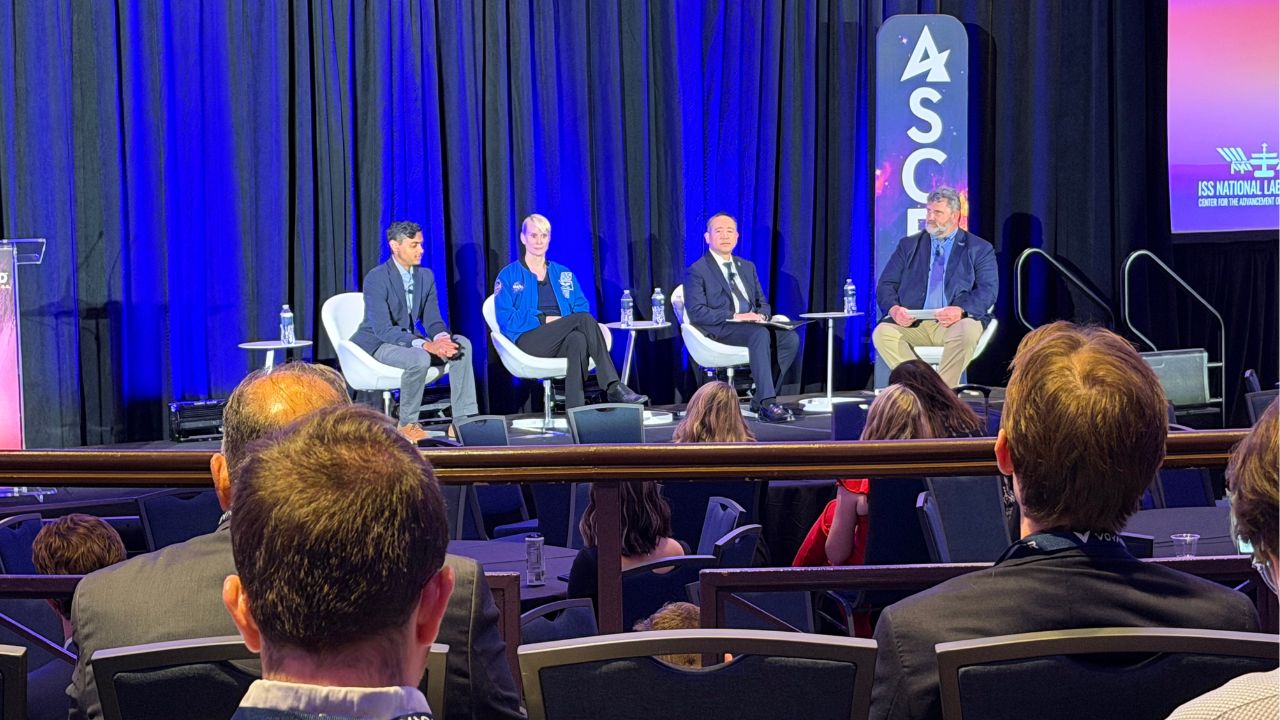
ISS National Lab panel, "Space Research for a Healthy Future," at ASCEND 2026 in Washington, D.C., May 19.
ISS National Lab highlights space R&D and growing low Earth orbit economy at ASCEND 2026
May 29, 2026
KENNEDY SPACE CENTER (FL), May 29, 2026 – The International Space Station (ISSInternational Space Station) National Laboratory track at the 2026 ASCEND conference in Washington, D.C., featured a full day of sessions showcasing valuable research and technology development in space, the expanding low Earth orbit(Abbreviation: LEO) The orbit around the Earth that extends up to an altitude of 2,000 km (1,200 miles) from Earth’s surface. The International Space Station’s orbit is in LEO, at an altitude of approximately 250 miles. (LEO) economy, and the future of space-based innovation.
The day opened with a panel on “The State of MicrogravityThe condition of perceived weightlessness created when an object is in free fall, for example when an object is in orbital motion. Microgravity alters many observable phenomena within the physical and life sciences, allowing scientists to study things in ways not possible on Earth. The International Space Station provides access to a persistent microgravity environment. Research,” where leaders from the ISS National Lab and NASANational Aeronautics and Space Administration discussed how science in space is driving advances in areas such as disease modeling, tissue engineering, therapeutic development, and materials production, opening the gateway to LEO commercialization.
“We’ve been able to transform our exploration of space into real-world applications here on Earth,” said ISS National Lab Chief Scientific Officer Michael Roberts. “Through public-private partnerships…we’ve seen significant increases in the amount of funding going to support fundamental research leading to applications that have direct benefit on health outcomes on Earth and improvements in the manufacture of materials.”
The ISS National Lab also highlighted its role in accelerating commercial innovation during a session on the Orbital Edge Accelerator. A panel of industry leaders discussed the program’s success in connecting startups with private capital and access to space, paving the way for new technologies and market growth in LEO.
Encapsulate CEO Armin Rad further underscored the value of startups having access to space for R&D. In his lightning talk, “Using the ISS to Outwit Cancer,” Rad explained that research in space is unlocking new insights into cancer progression, drug resistance, and early detection of metastasis—offering promising pathways to improve patient outcomes on Earth.
The afternoon kicked off with a session on “Space Research for a Healthy Future,” bringing together leaders from three newly established space medicine centers to discuss how microgravity research is shaping next-generation biomedical breakthroughs. Panelists, including retired NASA astronaut Kate Rubins, discussed how insights from studies on the ISS inspired the creation of these dedicated institutions that harness space to advance medicine.
Rubins, who is now director of the Trivedi Institute for Space and Global Medicine, said, “When I left NASA last year, I wanted to build an institute that would fill what I saw was a gap in terms of being able to translate these amazing discoveries that we’re making…and all of this fantastic work the ISS National Lab is doing, and to really think about how that would affect human populations on Earth.”
Looking beyond the ISS, a session on “A Microgravity Laboratory of the Future” explored what comes next, the role of a national laboratory in space, and how to ensure continued scientific and economic leadership in LEO. The day also included a “By the Numbers” talk by ISS National Lab Chief Operating Officer Francisco Córdova, offering a data-driven look at the ISS National Lab’s impact over the last 15 years.
Collectively, the sessions underscored the pivotal role the orbiting laboratory has played in advancing science, enabling innovation, and preparing for the next era of space-based discovery that benefits life on Earth.
Download a high-resolution image for this release: ISS at ASCEND 2026
Media Contact: Amy Elkavich
Email: aelkavich@ISSNationalLab.org