
Case Study
Clearing Space Debris
ISS testing validated a new system to capture and relocate objects in orbit
ISS NATIONAL LAB OPPORTUNITY
Kall Morris Inc needed a way to conduct multiple in-space tests to advance its REACCH capture system, and the ISSInternational Space Station provided the ideal platform.
REACCH, a system that deploys tentacle-like arms to capture free-floating objects and grip them with gecko-inspired adhesion, could help address the growing challenge of space debris. However, the system required rigorous testing in the space environment. While launching a small satellite was an option, it would have been costly and allowed for only a single test. KMI needed a space based platform capable of supporting multiple test runs—a capability made possible through the ISS National Lab.
Industries:
Aerospace, Satellite
Strategic Focus Area:
Technology Development
Research Area:
In Orbit Servicing, Assembly,
and Manufacturing
Institution:
Kall Morris, Inc. (KMI)
IMPACTFUL OUTCOME
The team conducted 172 tests onboard the ISS, validating the REACCH system and generating critical insights to refine its design.
REACCH was mounted on Astrobee, a free-flying robot on the ISS, which served as a proxy for KMI’s future carrier spacecraft. The test target was a 28 centimeter cube outfitted with six interchangeable faceplates made of different materials. ISS crew members ran capture tests using stationary, tumbling, and approaching targets, while varying the approach angle and speed. REACCH demonstrated strong capture performance across most scenarios, with material type emerging as a key factor affecting performance. Importantly, the experiments provided the data needed to confirm that KMI’s simulation models accurately reflect real world performance in microgravityThe condition of perceived weightlessness created when an object is in free fall, for example when an object is in orbital motion. Microgravity alters many observable phenomena within the physical and life sciences, allowing scientists to study things in ways not possible on Earth. The International Space Station provides access to a persistent microgravity environment.. With this validation, the company can now rely on simulations to assess larger scale mission concepts—reducing risk and eliminating the need for additional in space testing.

INVESTIGATORS
Adam Kall
Co-Founder and Chief Strategy Officer, KMI
Austin Morris
Co-Founder and Chief Technology Officer, KMI
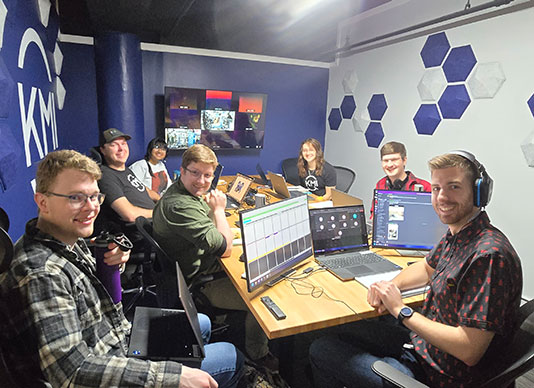
The KMI technical team set up to conduct REACCH testing on the ISS from their Michigan office (left to right: Tom Ziegler, Sam Cassidy, Preksha Madhva, Zachery Champion, Rose Schopfer, Adam Kall, Austin Morris).
Media Credit: KMI
On the ISS, we got multiple repetitions, the astronauts giving us ideas, making adjustments, changing materials. That would have been 172 CubeSatSmall satellites that use a standard size and form factor, traditionally measuring 10 cm x 10 cm x 10 cm in size that may be deployed from the space station to conduct research and technology development. launches, and we got it all done in 200 days through a single launch to the space station. It’s hard to express the value because without it, we wouldn’t have been able to do this.
– Adam Kall, Kall Morris Inc
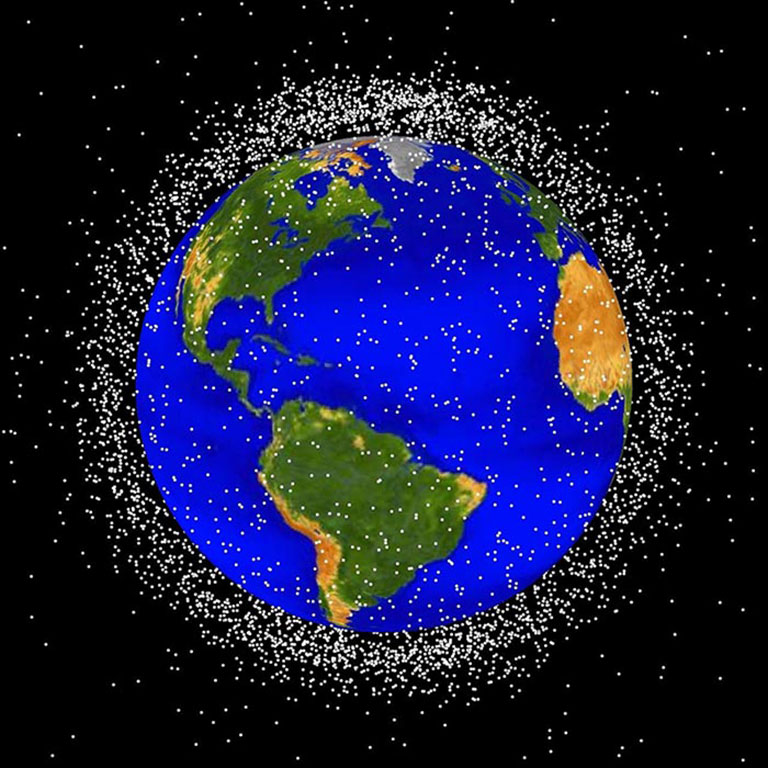
Low Earth orbit(Abbreviation: LEO) The orbit around the Earth that extends up to an altitude of 2,000 km (1,200 miles) from Earth’s surface. The International Space Station’s orbit is in LEO, at an altitude of approximately 250 miles. (LEO), the region of space within 2,000 km of the Earth’s surface, is the most concentrated area for orbital debris.
Media Credit: NASANational Aeronautics and Space Administration
APPLICATION
By safely removing debris or maneuvering satellites to avoid collisions, REACCH could help keep Earth’s orbit safe and operational.
Space debris is a growing threat that could one day lead to congestion—or even gridlock—in Earth’s orbit, rendering large regions of space unusable. The consequences would be far reaching: space station operations could be disrupted, and essential satellite services such as weather forecasting, communications, GPS, and national security systems could be lost. Recovery from such a scenario could take years, or even decades. Addressing this challenge now is critical, and REACCH could provide a viable solution. Because the system does not require a dedicated docking port, it can capture and maneuver a wide range of objects. REACCH only needs to attach to an object and apply force, allowing it to relocate objects much larger than itself. Beyond debris mitigation, REACCH offers a range of other valuable in orbit applications, including supporting satellite end of life operations, transporting spacecraft to and from refueling hubs, and distributing supplies for in space manufacturing facilities.
This content is abridged from an article originally published in Upward,
official magazine of the ISS National Lab.


