Orbital “Tow Truck” Could Tackle Space Debris Problem
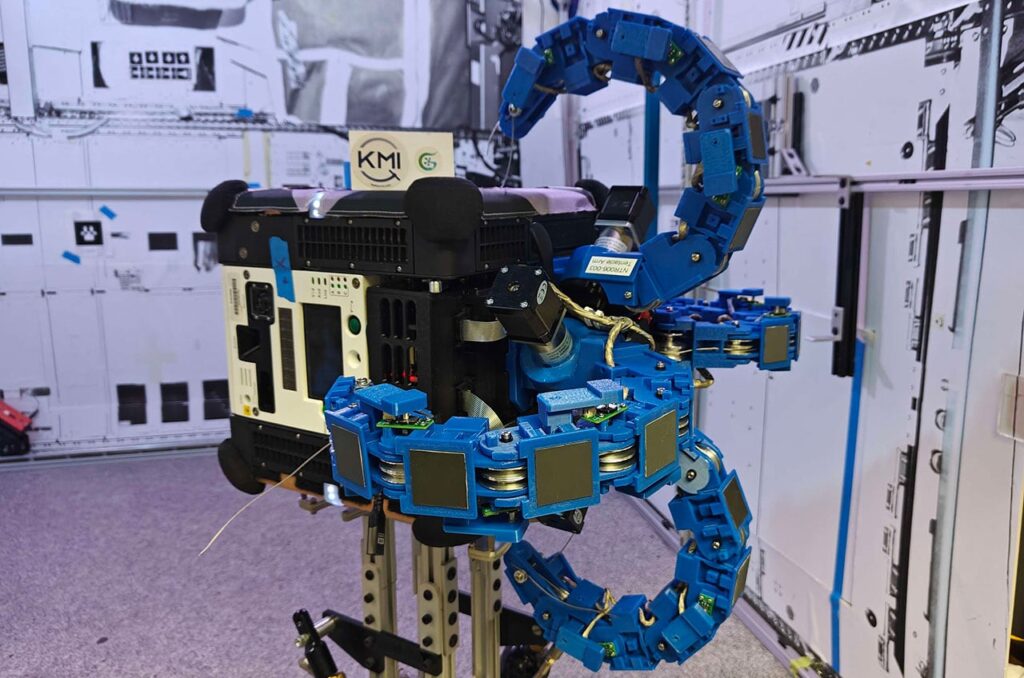
The REACCH system at NASA's Ames Research Center for preflight testing.
Media Credit: KMI
ISS testing validated new technology to enable the safe maneuvering of objects in Earth’s orbit
July 16, 2026
KENNEDY SPACE CENTER (FL), July 16, 2026 — Space debris—the millions of nonfunctional human-made objects orbiting Earth—is a growing problem. These objects, hurtling around our planet at speeds up to 10 times that of a speeding bullet, threaten critical satellite services, space station operations, and future space missions. New technology from Kall Morris Inc (KMI), tested through the International Space Station (ISSInternational Space Station) National Laboratory, may offer a solution. The startup used the ISS to successfully demonstrate its REACCH system—an orbital “tow truck” designed to safely capture and maneuver unprepared objects in space. The technology supports applications ranging from satellite servicing and orbital mobility to debris management.
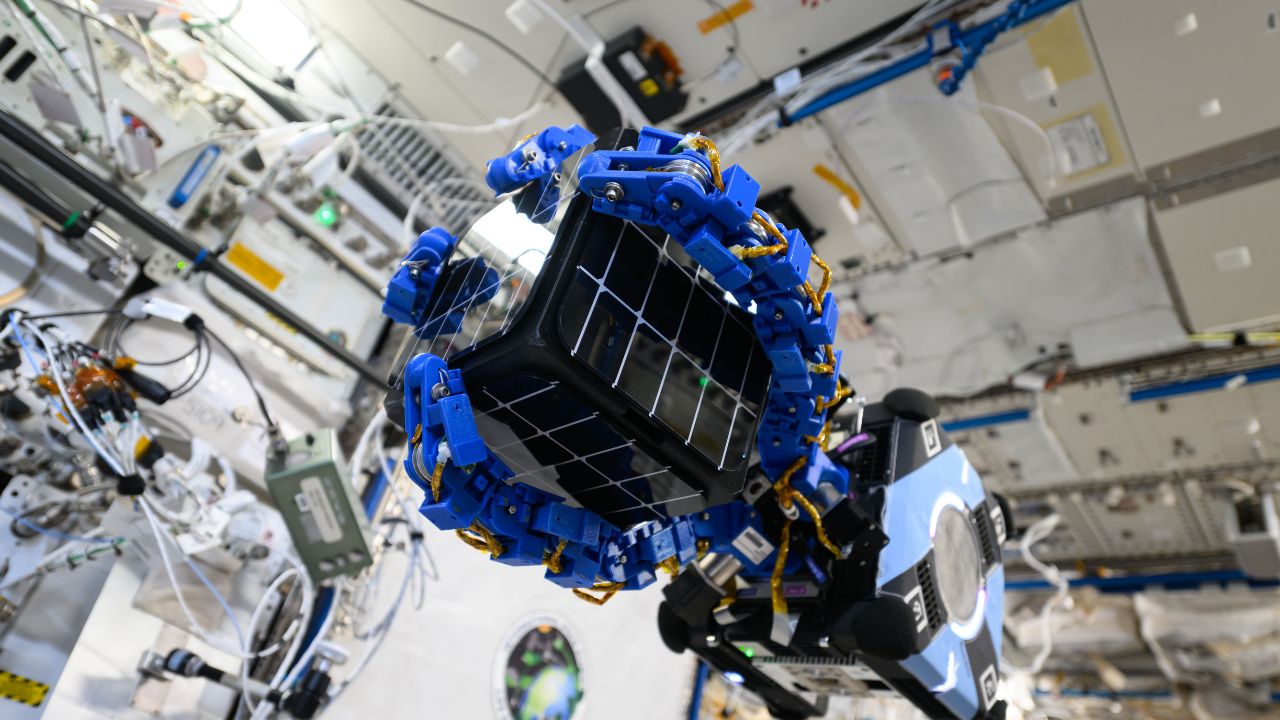
REACCH, short for Responsive Engaging Arms for Captive Care and Handling, uses tentacle-like arms with gecko-inspired adhesive pads to capture objects of various shapes, sizes, and materials. REACCH does not need to wrap around an object but merely attach to it and push, allowing the system to move objects much larger than itself. Once secured, REACCH can steer objects away from collision paths, reposition satellites to optimal orbits, support satellite servicing and life-extension missions, or guide debris toward safe deorbiting.
KMI extensively tested the system on the space station, where astronauts conducted more than 170 capture trials. The experiments gave KMI engineers valuable insight into how REACCH performs across different surface types and motion scenarios. Such data would have been prohibitively expensive to obtain through single-run tests using small satellites, said KMI Co-Founder & Chief Strategy Officer Adam Kall in the latest issue of Upward, the official magazine of the ISS National Lab.
“On the ISS, we got multiple repetitions, the astronauts giving us ideas, making adjustments, changing materials. It’s hard to express the value because without it, we wouldn’t have been able to do this,” Kall explained.
Beyond debris removal, the REACCH system will support satellite servicing, relocation, and end-of-life management—capabilities that are increasingly important for maintaining a safe, sustainable economy in low Earth orbit(Abbreviation: LEO) The orbit around the Earth that extends up to an altitude of 2,000 km (1,200 miles) from Earth’s surface. The International Space Station’s orbit is in LEO, at an altitude of approximately 250 miles.. KMI is preparing for additional tests beyond the ISS, with long-term plans to deploy REACCH on operational life extension and debris-removal missions.
Read the full story in Upward. In your coverage, please link to the original story and credit the ISS National Laboratory® as the research sponsor.
Download a high-resolution image for this release: Space Debris System