Biomedical Studies, NSF-Funded Science, Student-Led Projects, and More on NASA’s SpaceX CRS-35
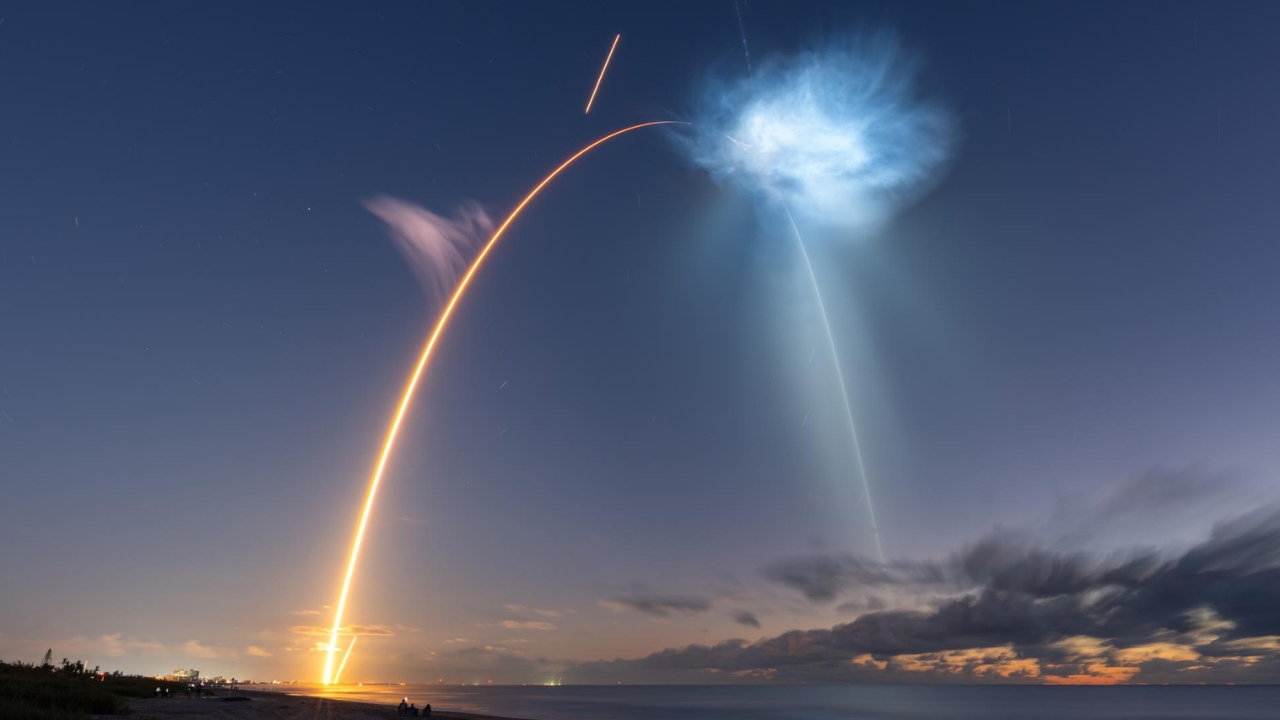
Long-exposure view of SpaceX CRS-35 launching to the International Space Station, with the Falcon 9’s sunlit exhaust plume streaking across the predawn sky as the booster returns to land.
Media Credit: NASA
ISS National Lab-sponsored research aims to advance regenerative medicine, improve understanding of natural hazards, and inspire the next generation of scientists and explorers
October 13, 2026
KENNEDY SPACE CENTER (FL), October 13, 2026 – More than two dozen payloads sponsored by the International Space Station (ISSInternational Space Station) National Laboratory launched onboard the 35th SpaceX Commercial Resupply Services mission(Abbreviation: CRS mission) A CRS mission is a cargo resupply mission contracted by NASA to deliver supplies and research to the International Space Station on commercial spacecraft as part of the CRS contract with three commercial companies. As part of CRS missions, experiments currently return to Earth on SpaceX Dragon spacecraft that splash down in the ocean. for NASANational Aeronautics and Space Administration. Lift off occurred at 6:33 a.m. EDT on October 13 from Space Launch Complex 40 at Cape Canaveral Space Force Station in Florida, this mission will deliver a diverse portfolio of investigations seeking to benefit humanity and help build a sustainable economy in low Earth orbit(Abbreviation: LEO) The orbit around the Earth that extends up to an altitude of 2,000 km (1,200 miles) from Earth’s surface. The International Space Station’s orbit is in LEO, at an altitude of approximately 250 miles.. SpaceX’s Dragon spacecraft intends to dock with the space station on Thursday, October 15.
Below are highlights of some of the ISS National Lab-sponsored investigations on this mission.
Advancing Regenerative Medicine and Human Health
Two investigations on this mission were selected through the Igniting Innovation collaboration with NASA’s Biological and Physical Sciences Division, which supports high-risk, high-reward research that leverages the space environment to address critical challenges in human health.
Researchers from Cedars-Sinai Medical Center aim to grow vascularized cardiac spheroids derived from human stem cells to create more advanced models of cardiovascular disease and evaluate how cancer therapies can affect heart function. By incorporating blood vessel networks into these tissue models, the team seeks to better replicate human physiology and improve understanding of drug-induced cardiac toxicity.
The Wake Forest Institute for Regenerative Medicine will use organoids created from patient-donated colorectal cancer cells to evaluate chemotherapy responses and identify potential targets for new cancer therapeutics. Results could support more effective personalized treatment strategies and improve outcomes for patients with colorectal cancer.
Also on this mission, a project from the National Stem Cell Foundation is using human neural organoid models to better understand neuroinflammation associated with neurodegenerative diseases such as Parkinson’s disease. The team will evaluate potential therapies while leveraging microgravity’s ability to support the development of complex three-dimensional tissue models that more closely resemble human biology.
Unlocking Insights Through Fundamental Science
Four of the projects launching are funded by the U.S. National Science Foundation (NSF), continuing a partnership that has supported critical fundamental science through the ISS National Lab for more than a decade. Since the partnership began, NSF has funded nearly 100 ISS National Lab-sponsored investigations in biotechnology, fluid dynamics, transport phenomena, combustion science related to safety and wildfire behavior, and other fundamental research areas.
One of the projects on this mission, led by researchers at the University of California San Diego, will study the underlying forces that contribute to catastrophic mudflows and debris flows that often occur after wildfires. By removing gravity-driven effects that complicate terrestrial experiments, researchers can gain new insights into particle behavior and flow dynamics, potentially improving predictive models and mitigation strategies for communities vulnerable to these devastating natural hazards.
Inspiring Future Scientists and Explorers
The mission also includes a student-led project from the Genes in Space program, founded by Boeing and miniPCR bio and supported by the ISS National Lab. This year’s winning experiment focuses on in-space protein production, a capability that could prove critical for future long-duration exploration missions. The student team will test multiple DNA sequences that encode the same protein to determine which configurations most efficiently produce proteins in microgravityThe condition of perceived weightlessness created when an object is in free fall, for example when an object is in orbital motion. Microgravity alters many observable phenomena within the physical and life sciences, allowing scientists to study things in ways not possible on Earth. The International Space Station provides access to a persistent microgravity environment.. Findings could help researchers optimize protein manufacturing systems for future applications ranging from therapeutics and biotechnology to food production on missions to the Moon, Mars, and beyond.
To learn more about how space-based research is improving the lives of people on Earth, subscribe to Upward, official magazine of the ISS National Lab.
Download a high-resolution image for this release: CRS-35 Launch