
View From the Cupola: Afshin Beheshti
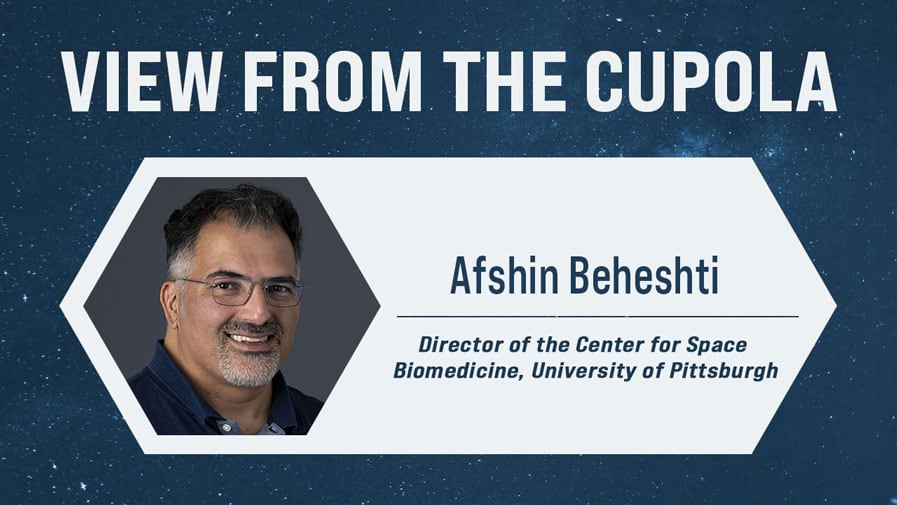
November 20, 2026 • By Afshin Beheshti, Director of the Center for Space Biomedicine, University of Pittsburgh
Humans have always been explorers. Somewhere at the dawn of our species, someone looked over the next hill and wondered what was on the other side, and we have wondered ever since. Each discovery fuels more curiosity, and the first space race of the 1950s and ‘60s took that curiosity to a new altitude. More than half a century after the first Moon landing, it still lives in the memories of those who watched it and in the history books of those who did not.
Of course, not everyone shares the same enthusiasm for space exploration. A fair question I hear often is why we devote so many resources to sending people to space when we face climate issues, disease, and other urgent problems down here on Earth. It’s a legitimate question, and the answer is that we have been cashing in on space exploration without noticing. Scratch-resistant lenses in eyeglasses, for example, trace back to coatings developed for astronaut helmet visors. More consequentially, water purification technology developed for spaceflight has been adapted to provide clean drinking water in communities where it is scarce. These are just a couple of examples of how space technology can find applications on Earth.
That brings us to the second space age. The Space Shuttle Program planted its seeds in the 1980s, and the International Space Station (ISSInternational Space Station) expanded it, welcoming its first crew in November 2000. The ISS is an astonishing science laboratory in low Earth orbit(Abbreviation: LEO) The orbit around the Earth that extends up to an altitude of 2,000 km (1,200 miles) from Earth’s surface. The International Space Station’s orbit is in LEO, at an altitude of approximately 250 miles. (LEO). As it approaches retirement, companies are developing commercial space stations that could expand opportunities and lower barriers for research in space.
Much of the biomedical research happening up there aims to keep astronauts healthy in an unforgiving environment that presents unusual physiological challenges. We often say space “accelerates aging,” but that can mislead people outside our field. Astronauts do not simply age faster. Rather, the health risks associated with spaceflight emerge on a compressed timeline. In my own mitochondrial research, damage that may take months or years to unfold in human disease can appear within weeks or even days in space. This creates opportunities to test countermeasures quickly, and fast answers can become new therapies for patients on Earth.
Nowhere is this clearer than in this issue’s cover story. Catriona Jamieson and her team at the University of California San Diego and Aspera Biomedicines used tumor organoids on the ISS to study cancer stem cells, the stubborn culprits often behind treatment resistance and cancer recurrence. In space, the organoids showed in about 10 days what could take years to develop in patients on Earth. That speed allowed the team to rapidly evaluate Aspera’s investigational drug, which has since entered clinical trials, and the results are guiding the next phase to include additional cancer types. In cancer care, time is the one thing patients cannot spare.
Discoveries like these have fueled the evolution of space biomedicine from a specialized research field into a rapidly expanding multidisciplinary one, and the issue’s second feature tells that story. I had the honor of being recruited to the University of Pittsburgh in the fall of 2024 to start a Center for Space Biomedicine. In January 2026, the university launched the Trivedi Institute for Space and Global Biomedicine, directed by Kate Rubins and co-directed by Chris Mason, where my center now resides alongside a sister center focused on space biomanufacturing, synthetic biology, and digital health run by Sylvain Costes. We are in good company, and the Cedars-Sinai Center for Space Medicine Research and the Cleveland Clinic Space Health Center are also part of this growing ecosystem dedicated to translating insights from space research into better health for people on Earth as well as astronauts. I would love to see even closer collaboration between these efforts and the aerospace medicine community. Keeping astronauts safe and improving life on Earth turns out to be the same project.
Space research also reaches the dinner table. Another feature follows students at Jones Academy in Oklahoma, who planted Choctaw heirloom seeds that had traveled to the ISS alongside seeds that remained on Earth to compare their growth. Do seeds exposed to space have more built-in resilience? Beyond exploring questions like this one, the project links seeds that survived the Trail of Tears to the future of space exploration, showing students that their ancestors’ resilience and their own curiosity both belong in orbit. As our climate changes, understanding how to grow resilient crops matters for everyone.
Together, these stories show how space is already improving life for millions of people on Earth, from speeding up therapeutics to inspiring the next generation. Education is key to keeping that momentum. At Pitt, I’m establishing programs like the Global Space Biomedicine Certificate to train scientists who will carry this field, and our future, forward. Meanwhile, companies like Axiom Space, Vast, and Voyager are building the next generation of orbital platforms that could make access to space easier than ever. Even as ambitions extend to the Moon and Mars, the work being done in LEO has important questions to answer here at home.
Exploring the universe and perhaps finding life elsewhere is thrilling enough. But the real payoff of the second space age may be found right here on Earth: in healthier lives and a more resilient civilization. So the next time someone asks what space has ever done for us, hand them a menu of better cancer treatments, smarter therapies for mitochondrial disease, and tougher crops.