
The Rise of Space Biomedicine: How Discoveries in Space Are Advancing Healthcare
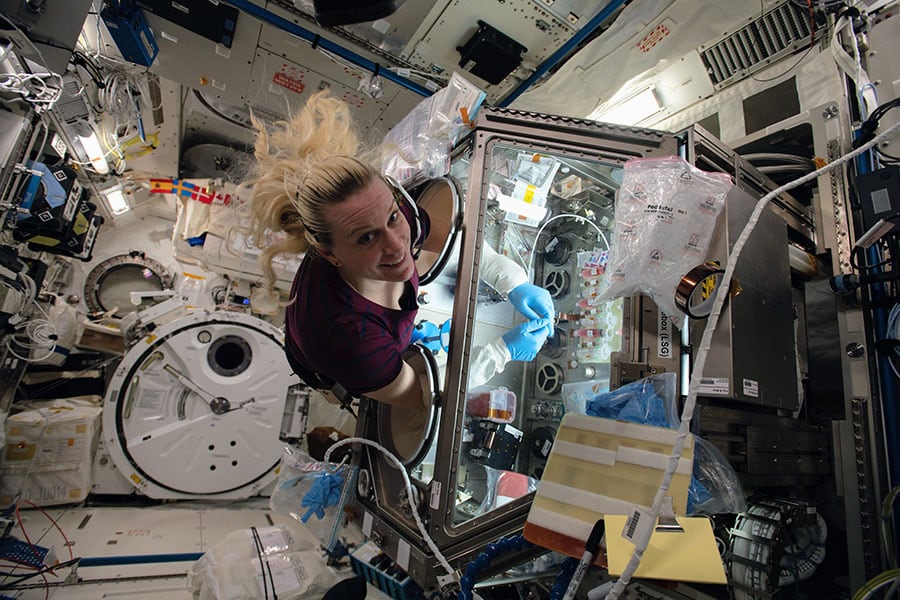
Retired NASA astronaut Kate Rubins works inside the Life Sciences Glovebox on the ISS for the Cardinal Heart study.
Media Credit: NASA
November 19, 2026 • By Amelia Williamson Smith, Upward Managing Editor
The International Space Station (ISSInternational Space Station) was created to serve as the world’s premier laboratory in space. Since the first crew arrived in November 2000, astronauts have conducted more than 4,000 scientific investigations onboard the orbiting laboratory.
Perhaps the biggest experiment, however, was the ISS itself.
Scientists knew research and technology development on the space station would be critical for future crewed missions to the Moon and Mars. But the ISS National Laboratory® was tasked with answering a different question: Is there value in having a laboratory in space dedicated not to exploration, but to advancing science that benefits people on Earth?
After 26 years of crewed ISS operations, the answer from the biomedical community is a resounding yes.
While space biomedicine traces its roots to the earliest years of NASA’s spaceflight program, research on the ISS dramatically expanded the field. The orbiting laboratory redefined the boundaries of space biomedicine, demonstrating how space-based studies can accelerate our understanding of disease and improve patient outcomes on Earth. In doing so, it inspired a new generation of institutes and centers dedicated to translating space discoveries into advances in human healthcare.
What do a former NASANational Aeronautics and Space Administration astronaut, a stem cell biologist, and a cardiologist have in common? They are all leading newly established space biomedicine institutions across the U.S.
Kate Rubins, a microbiologist and retired astronaut who spent 300 days in space across two ISS missions, now directs the Trivedi Institute for Space and Global Biomedicine at the University of Pittsburgh. Arun Sharma, whose space-based stem cell and regenerative medicine research spans more than a decade, leads the Cedars-Sinai Center for Space Medicine Research in Los Angeles. And Kenneth Mayuga, a cardiac electrophysiologist who specializes in heart rhythm disorders, heads the Cleveland Clinic Space Health Center.
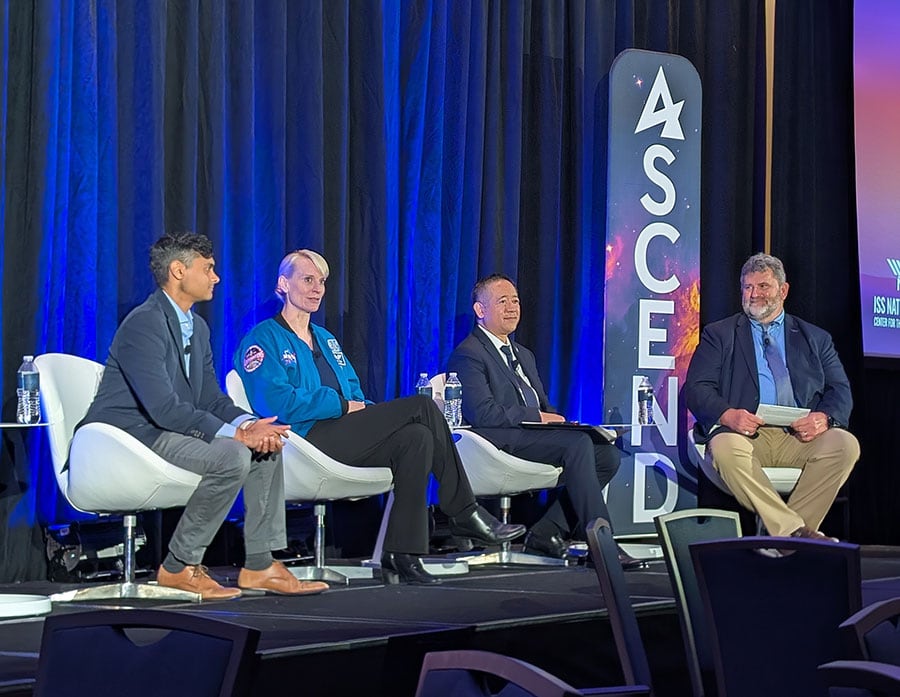
Arun Sharma, Kate Rubins, and Kenneth Mayuga (left to right) discuss the growing field of space biomedicine with ISS National Lab Chief Scientist Michael Roberts at the 2026 ASCEND conference.
Media Credit: ISS National Lab
Together, these institutions are helping define the future of space biomedicine by building on ISS discoveries and carrying the field into the next era of commercial space stations.
“This is the most exciting time because we’re just starting to see the incredible things coming out of space research,” Rubins said. “There’s a lot of promise there for helping human health, and we want to take advantage of that, but the key is to not lose momentum.”
Removing the Constant of Gravity
Many physiological changes happen when you send humans into space. This is something Rubins has experienced firsthand. “I felt like an 80-year-old when I came home,” she recalls. “After six months in space, you can’t walk very well, you’ve kind of lost your balance, and your back hurts like crazy.”
But spaceflight has other significant effects on the human body as well. It causes muscle and bone loss, cardiovascular system changes, immune dysfunction, vision changes, virus reactivation, and other changes that resemble accelerated aging.
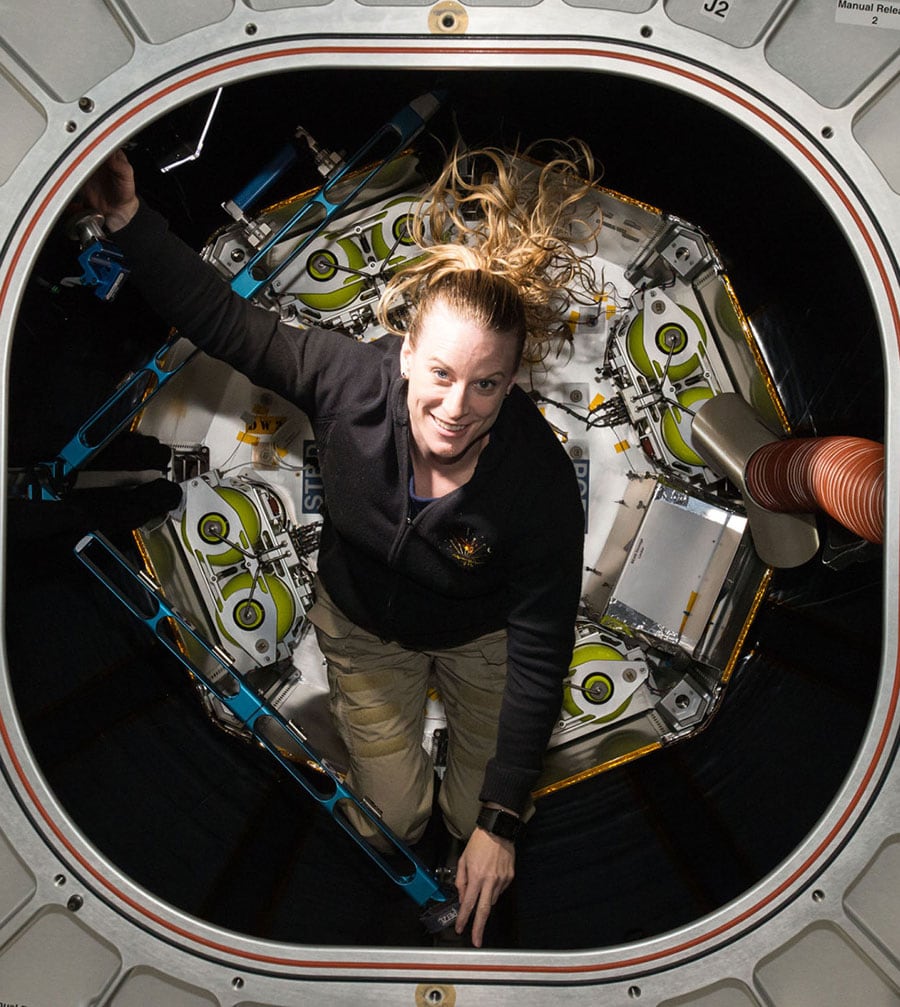
Retired NASA astronaut Kate Rubins on the ISS.
Media Credit: NASA
“Humans have evolved with gravity as a constant, so space acts as this really interesting perturbation to the human system,” Rubins explained. “One of the things we can do with space biomedicine is to study the physiological changes that happen during spaceflight and try to relate them to aging and chronic disease on Earth.”
Over the last two decades, a wide variety of research on the ISS has focused on just this—from cell biology to tissue chipA tissue chip, or organ-on-a-chip or microphysiological system, is a small engineered device containing human cells and growth media to model the structure and function of human tissues and/or organs. Using tissue chips in microgravity, researchers can study the mechanisms behind disease and test new treatments for patients on Earth. The National Institutes of Health (NIH) has a multiyear partnership with the ISS National Laboratory® to fund tissue chip research on the space station. experiments, organoid investigations, and astronaut studies. During her time on station, Rubins worked on many of these projects, including one that earned her the title of the first person to sequence DNA in space. A microbiologist at heart, Rubins was fascinated by biomedical science in space, but what really caught her attention were the findings and their potential to improve human health.
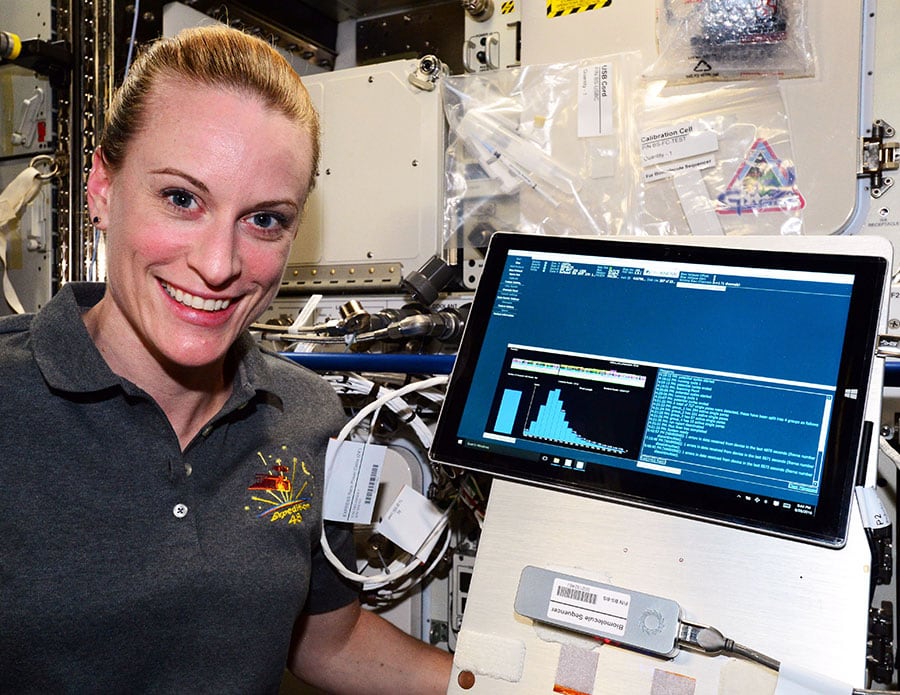
Retired NASA astronaut and biologist Kate Rubins successfully sequenced DNA on the ISS for the first time using a small device called MinION.
Media Credit: NASA
“It’s amazing to go to space. It’s amazing to see the planet. But it’s equally amazing to work with scientists in real time and be a part of these exciting discoveries,” she said.
After retiring from NASA, Rubins set out to translate valuable insights from space-based research into healthcare advances on Earth. In January 2026, the University of Pittsburgh launched the Trivedi Institute for Space and Global Biomedicine with Rubins as founding director. The institute has two centers, one focused on space biomedicine and the other on space biomanufacturing, synthetic biology, and digital health.
In addition to building on progress from ISS research, the Institute aims to advance the biomedical research capabilities on future commercial platforms in low Earth orbit(Abbreviation: LEO) The orbit around the Earth that extends up to an altitude of 2,000 km (1,200 miles) from Earth’s surface. The International Space Station’s orbit is in LEO, at an altitude of approximately 250 miles. (LEO). “We’re particularly interested in how we do research in a more automated and high-throughput way,” Rubins said. “The work we’ve done on the space station is incredible—it’s been groundbreaking, but how do we expand that? We should be able to process hundreds or thousands of samples at a time.”
Beyond the research, Rubins says taking the next step to commercialize findings is key, and the institute is eager to partner with business ventures to transform breakthroughs into applications. “Our goal, at the end of the day, is to develop something that’s going to help patients on Earth, whether that’s a device, a therapy, or a new understanding of disease.”
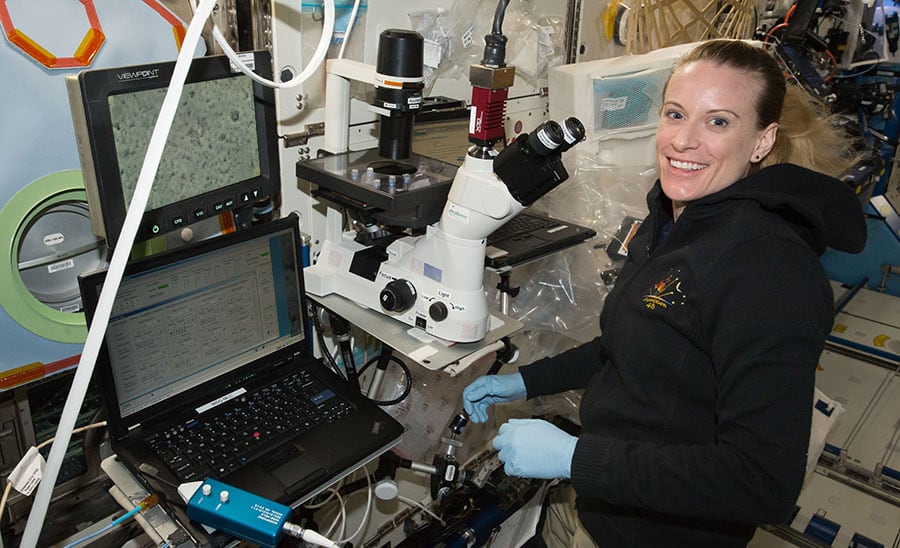
NASA astronaut Kate Rubins examines heart cells onboard the ISS as part of the Effects of MicrogravityThe condition of perceived weightlessness created when an object is in free fall, for example when an object is in orbital motion. Microgravity alters many observable phenomena within the physical and life sciences, allowing scientists to study things in ways not possible on Earth. The International Space Station provides access to a persistent microgravity environment. on Stem Cell-Derived Heart Cells investigation.
Media Credit: NASA
Pioneering a New Field
Sharma and Rubins have more in common than leading two of the country’s earliest space biomedicine institutions. Their paths first crossed in 2016. Rubins was an astronaut working on what she would later recall as one of her favorite ISS experiments. Peering into a microscope on the space station, she saw something incredible: beating heart cells. This ISS National Lab-sponsored project was the first long-duration cell culture experiment in space and was developed by a Stanford research team that included Sharma.
After more than 10 years and multiple ISS investigations, Sharma remains at the forefront of space-based biomedical research. He is now at Cedars-Sinai Medical Center, where he founded the Center for Space Medicine Research in 2025. The center aims to bridge discoveries in orbit with tangible benefits for patients on Earth. Its work spans four areas: advancing space-based biomedical research, forging partnerships with industry, expanding the future workforce, and eventually providing clinical care for commercial astronauts.

Arun Sharma, director of the Cedars-Sinai Center for Space Medicine Research in Los Angeles.
Media Credit: Cedars-Sinai
“The thing that really excites me is being able to harness microgravity to make cell-based products, organoids, and stem cells that we may not be able to do on the ground,” Sharma said. “We want to take what we’ve learned on the ISS and extend that into the future on commercial space stations.”
The center already has formal agreements with multiple companies. Cedars-Sinai researchers will use Exobiosphere’s automated research hardware to conduct organoid experiments on Vast’s Haven-1 space station, expected to launch in 2027. The Center also has longstanding partnerships with Axiom Space and BioServe Space Technologies to continue stem cell and organoid studies on the ISS.
“We’re not just doing research for the sake of discovery in space,” Sharma said. “We want the work that we do to have true commercial and clinical applications for people here on Earth.”
Space biomedicine has evolved a lot over the last decade and is garnering attention at key scientific conferences, he said. For example, the International Society for Stem Cell Research annual meeting now includes dedicated sessions for stem cell research in space. “It’s a really exciting reflection on the growth of the field that prominent researchers from across the world are getting involved.”
The center also aims to one day play a role in the healthcare of commercial astronauts and other space travelers, Sharma said. “We’re a world-class hospital, and we want to lend our clinical expertise to taking care of astronauts before, during, and after their missions.”
Patient Care Beyond Our Planet
Although science is what first drew Mayuga to medicine, caring for people has become his passion. “It’s a unique profession because it combines logical thinking and science with the art of medicine and taking care of patients,” he said. “It’s about meeting people where they are at and helping them.” Now, Mayuga is taking patient care to another level—beyond Earth.
As the inaugural director of Cleveland Clinic’s Space Health Center, which was established in April 2026, he helped shape the organization around the institution’s mission of caring for life, researching for health, and educating those who serve. The center strives to better understand how spaceflight affects human health and find ways to mitigate health challenges associated with space travel. It also aims to apply insights from research in space to better serve patients on Earth and introduce the next generation of doctors and scientists to the growing field of space biomedicine.
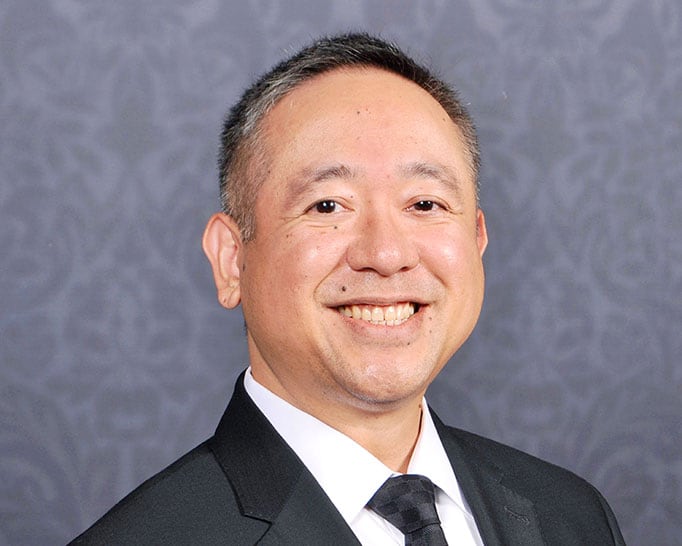
Kenneth Mayuga, director of the Cleveland Clinic Space Health Center.
Media Credit: Royal College of Physicians - London
The center is led by a team of physician-scientists who are extending their knowledge of human health on Earth to space. Their research addresses questions such as: Does exposure to space change the size, shape, structure, and function of the heart? Does spaceflight increase the risk of an abnormal heart rhythm? How does microgravity affect blood clotting? What is the best way to treat a blood clot in space if one did form? “These are very concrete goals that we have in terms of supporting the health of people who travel to space,” Mayuga explained.
But the answers to those questions would help more than just astronauts. Research done in space could have very real impacts for patients on Earth, he said. “For instance, if we understand more about what happens with blood clotting in microgravity, we could gain insights into what happens with blood clotting when patients are bedbound for a long period of time.”
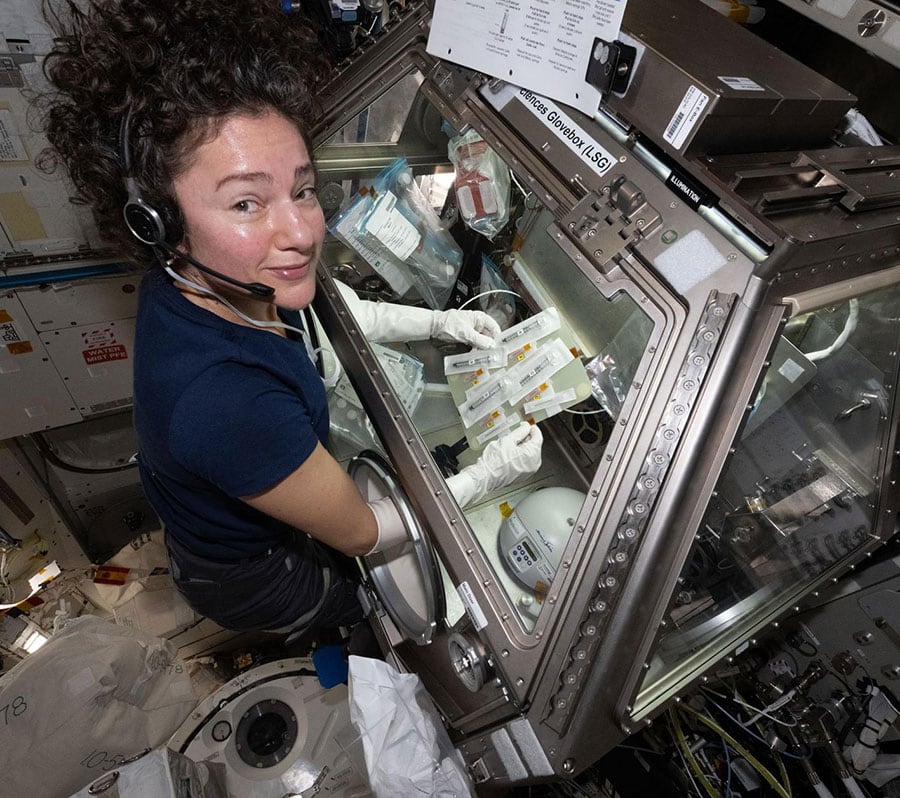
NASA astronaut Jessica Meir prepares samples in the Life Sciences Glovebox to study how weightlessness affects crew blood clotting and immune function in a project led by researchers at the University of Utah.
Media Credit: NASA
Continued advances in space biomedicine depend on cultivating space-focused physicians and establishing cross-disciplinary collaboration, he said.
“If we remain in different silos and don’t interact, we might miss opportunities to better understand disease processes,” Mayuga explained. “We can only fully understand how space affects health if we work together. Those interactions are where breakthroughs happen.”
Training the Next Generation
Looking to the future of the field, all three institutions are investing heavily in education and workforce development initiatives designed to train the next generation of space biomedicine researchers and clinicians.
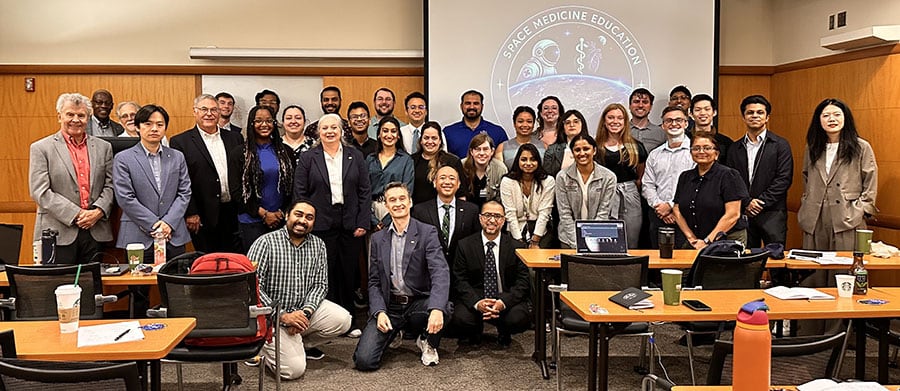
Kenneth Mayuga, Simon Evetts, and Virginia Wotring with students and lecturers on the final day of the Space Medicine for STEM Inspiration course funded by a grant from the ISS National Lab.
Media Credit: Image courtesy of Kenneth Mayuga
In collaboration with the International Space University, Mayuga developed a space medicine course through a grant from the ISS National Lab. More than 30 doctoral students, medical students, and postdoctoral researchers from multiple universities took part in the five-day course at Cleveland Clinic in June 2026. Students attended expert lectures, a specialized tour of NASA’s Glenn Research Center, and an event to meet with space industry leaders.
After the course, Mayuga said several students reached out to him about space research. “There are already tangible signs that the space medicine course sparked the curiosity and interest of these students to pursue space-related endeavors.”
At Cedars-Sinai, Sharma started a monthly seminar series that brings together researchers from around the world with students, faculty, and community members to discuss biomedical research in space. The first featured speaker was Rubins. Cedars-Sinai also offers space-related biomedical courses and is establishing a master’s program in space biosciences.
To integrate undergraduate students into space-based research, the University of Pittsburgh partners with the Student Spaceflight Experiments Program. By designing experiments and competing to send a project to the ISS, students learn about payload development and hardware for space research. Rubins said the university is also working to develop a global space biomedicine certificate program.
Making the Leap to Commercial Space Stations
The current pace of discovery in space biomedicine is inspiring, Sharma said. “The leadership at all our institutions have acknowledged that this is an area of significant growth and are willing to make investments not just by naming centers but by putting financial resources behind these centers to help them grow.”
For now, the focus is ensuring that progress achieved through biomedical research on the ISS is sustained through the transition to future commercial LEO platforms. “The value of space-based research has been demonstrated in so many ways, and we do not want to lose the opportunity to build on that,” Mayuga said.
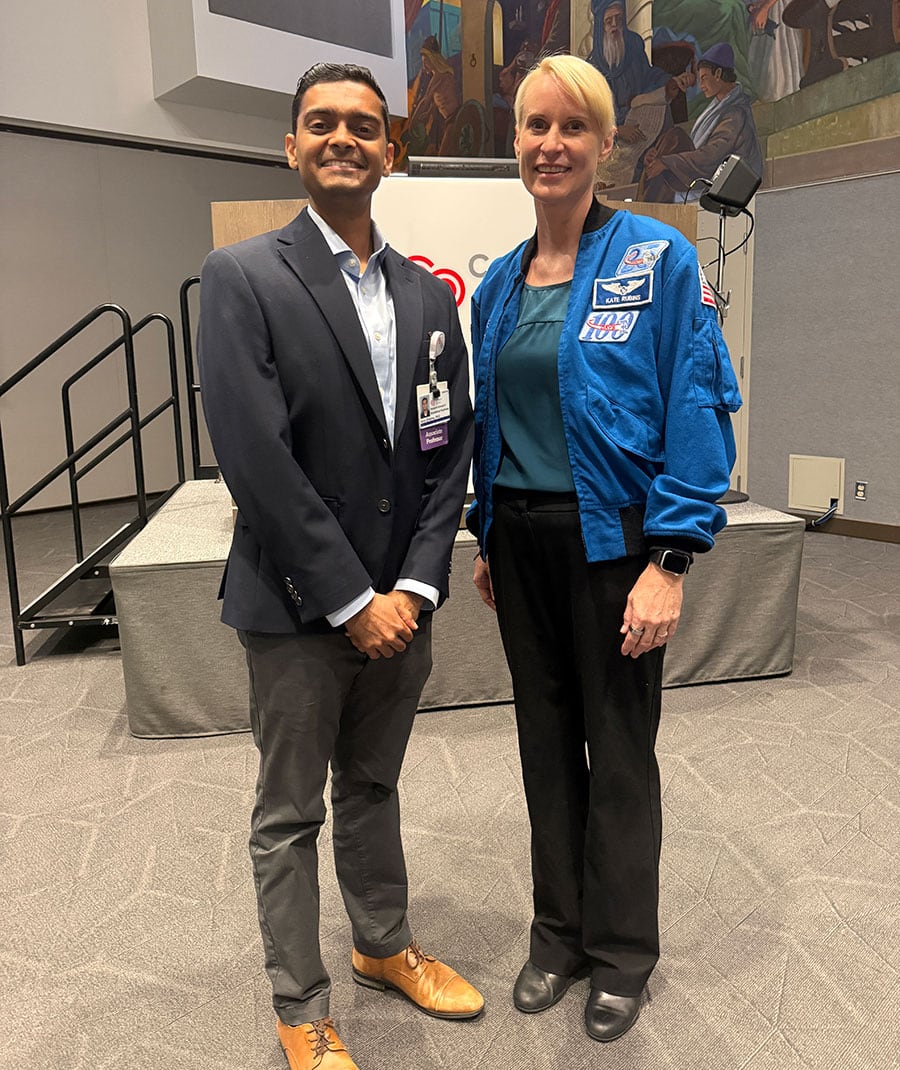
Arun Sharma with Kate Rubins at the kickoff for the Cedars-Sinai Center for Space Medicine Research.
Media Credit: Cedars-Sinai
Maintaining the expertise, partnerships, and pathways that have enabled academic, industry, and government researchers to conduct successful ISS research will also be key, Rubins added. “The ISS National Lab has a long history of getting people involved in spaceflight who have never done research on the space station,” she said. “We will need something like a national lab that can act as a central node to connect all of this research together and to bring in new researchers and help them fly experiments to space.”
The ISS is one of humanity’s greatest technological accomplishments and has served as an essential stepping-stone to the Moon and Mars. But it has done something more: It has redefined space as not just a destination to explore beyond our planet but also a powerful tool to advance human health and improve the lives of people back on Earth.