
« Back to Annual Report for Fiscal Year 2025
Educational Outreach and Workforce Development
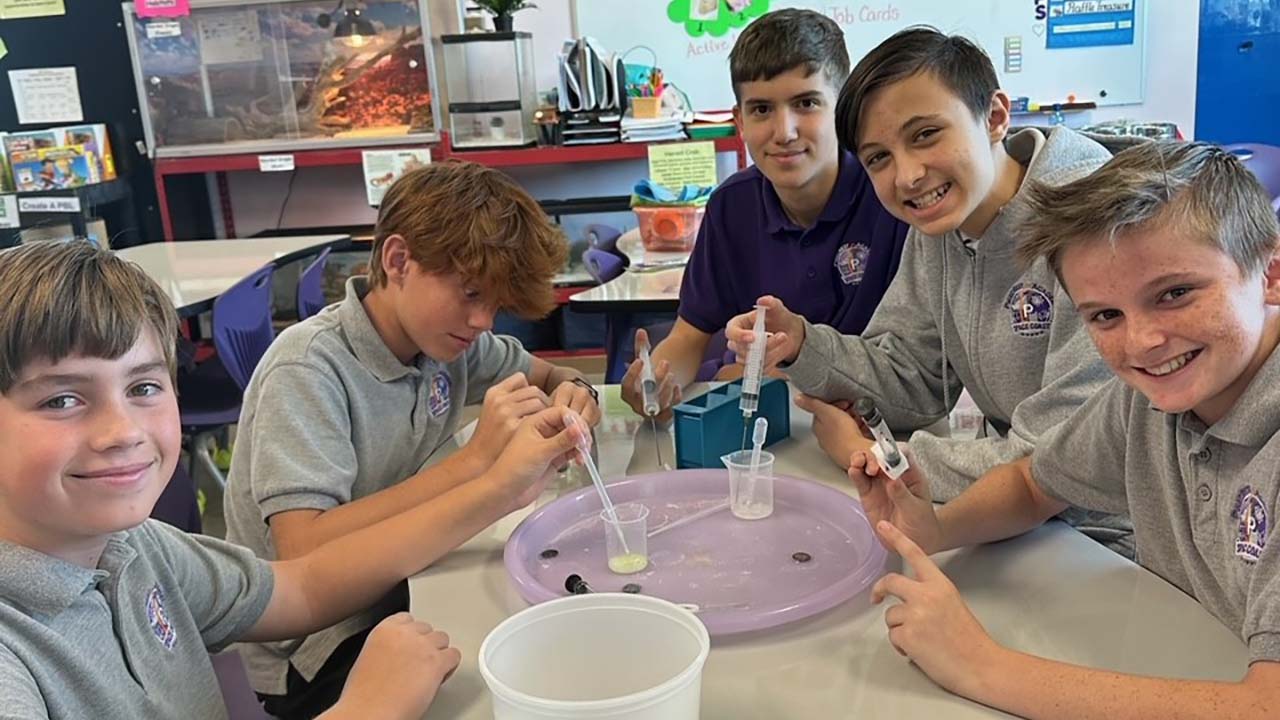
Pinecrest Academy Space Coast students Liam Hauser, Connor Santore, Eric Distasi, Evan Ireland, and Luke Costa optimizing experiment processes for E-coli and endotoxin detection in microgravityThe condition of perceived weightlessness created when an object is in free fall, for example when an object is in orbital motion. Microgravity alters many observable phenomena within the physical and life sciences, allowing scientists to study things in ways not possible on Earth. The International Space Station provides access to a persistent microgravity environment. via LAL- Horseshoe crab blood testing for future flight with the SSEP.
In FY25, the ISSInternational Space Station National Lab continued to enable students to engage with space-based research and emerging commercial space opportunities. However, in alignment with administration priority changes, the ISS National Lab began to wind down science, technology, engineering, and mathematics (STEM) education initiatives. The ISS National Lab will not begin any new initiatives and has stopped collecting outreach metrics from its education partner programs.
Despite these changes, the ISS National Lab will remain a hub for education partners, sharing STEM education resources and highlighting student accomplishments and opportunities across the broader space ecosystem. This year, through experiential learning programs, industry internships, and long-standing educational partnerships, students gained exposure to cutting-edge science in orbit and career pathways critical to the future LEO(Abbreviation: LEO) The orbit around the Earth that extends up to an altitude of 2,000 km (1,200 miles) from Earth’s surface. The International Space Station’s orbit is in LEO, at an altitude of approximately 250 miles. economy.
- The ISS National Lab facilitated industry-embedded internships, offering students work-based learning experiences with Commercial Service Providers and engaging them in career opportunities in the growing space economy. In FY25, 10 students were funded, each receiving $5,000, with participating companies (Rhodium Scientific, Aegis Aerospace, and Tec-Masters) providing matching support.
- Nearly 100 students contributed to ISS National Lab-sponsored science and technology projects through direct research participation and classroom programs.
- The ISS National Lab raised more than $5,700 to send nearly 100 STEM kits to U.S. classrooms, providing hands-on space science experiments that enhanced the curriculum and promoted active learning.
- The ISS National Lab continued to support previously awarded STEM education projects, including one from VRCORE Education, which debuted an immersive virtual reality lesson that lets students tour the ISS and conduct simulated experiments.
“For over a decade, miniPCR bio has been honored to work alongside Boeing, New England Biolabs, and the ISS National Lab to engage over 11,000 students from across the United States as participants in the Genes in Space™ competition. Their engagement highlights the enthusiasm for space-based research and creative potential of these science and engineering workforce leaders of tomorrow. Beyond opening new avenues for participants, this program has also yielded significant advancements in space-based biomedical research, including nine student-led peer-reviewed publications that contribute to the scientific community at large.”
– Kristin Hennessy-McDonald, Outreach and Community Engagement Lead at miniPCR
- The Genes in Space™ program celebrated its 10th anniversary. In collaboration with Boeing and miniPCR bio, the program engages students in grades 7-12 in space-based molecular biology research.
- Higher Orbits, which enables student-driven research and leadership development for grades 7-12, also marked its 10th anniversary. In partnership with Cook Inlet Region, Inc. (CIRI) and the ISS National Lab’s Orbital Edge Accelerator, Higher Orbits hosted a “Go for Launch! Stellar Space Experience” in Alaska, where students worked with retired NASANational Aeronautics and Space Administration astronaut Don Thomas to design ISS-bound experiments.
- Through the Amateur Radio on the International Space Station (ARISS) program, thousands of students connected with astronauts on the ISS in real time at ham radio events, building science communication skills and inspiring interest in space-related career pathways.