
« Back to Annual Report for Fiscal Year 2025
In-Orbit Activities: The ISS as a Research Platform
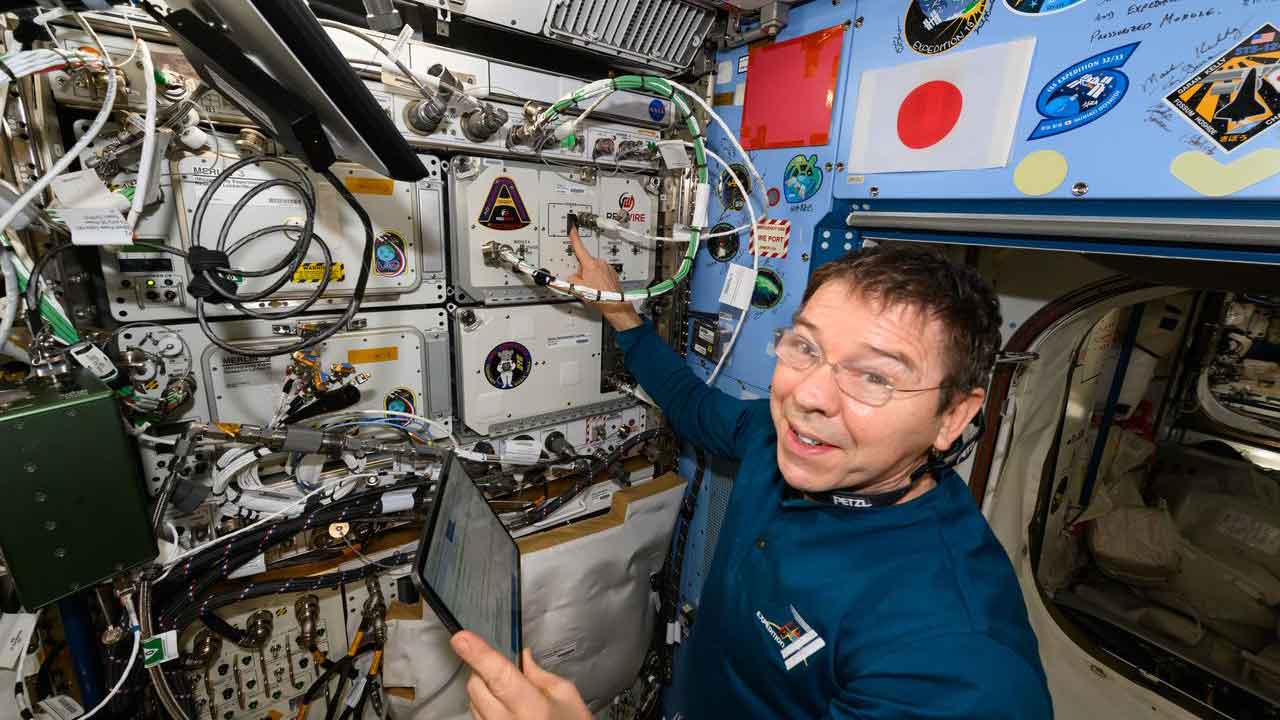
NASANational Aeronautics and Space Administration astronaut and Expedition 71 Flight Engineer Mike Barratt installs a new sample processor, also known as the Advanced Space Experiment Processor (ADSEP), inside the International Space Station's Kibo laboratory module. ADSEP can be packed with research samples and launched to space or returned to Earth aboard a Northrop Grumman Cygnus space freighter or a SpaceX Dragon cargo craft. ADSEP supports cell and tissue culturing, protein crystal growth, microorganism and bacteria studies, and materials science research.
Media Credit: NASA
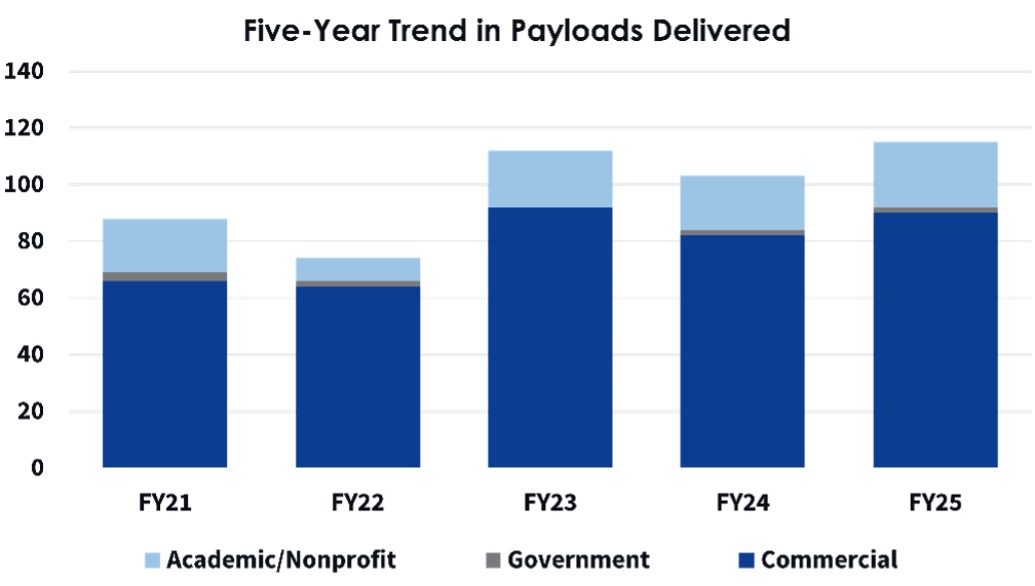
In FY25, a record 115 ISSInternational Space Station National Lab-sponsored payloads were delivered to the space station. Nearly 80% were research projects being done by commercial entities, underscoring the sustained demand from private industry for space-based R&D. The total number of ISS National Lab-sponsored payloads delivered since transition to CASIS(Abbreviation: CASIS™) The nonprofit organization that manages the ISS National Lab, which receives at least 50 percent of the U.S. research allocation on the International Space Station to facilitate research that benefits humanity (NASA manages the other 50% and focuses on research for space exploration purposes). management is now nearly 950, marking steady growth in both research and commercial innovation in LEO(Abbreviation: LEO) The orbit around the Earth that extends up to an altitude of 2,000 km (1,200 miles) from Earth’s surface. The International Space Station’s orbit is in LEO, at an altitude of approximately 250 miles..
- Seven missions (SpaceX-31, SpaceX-32, Axiom-4, SpaceX Crew-10, SpaceX Crew-11, SpaceX-33, and Northrop Grumman-23) carried ISS National Lab-sponsored research to station.
- Of the payloads delivered this year, 70% were sourced through Commercial Service Providers that own and operate facilities on the space station.
- More than 20% of the payloads delivered this year launched on Axiom’s fourth private astronaut mission to the ISS.
- ISS National Lab crew time utilization decreased by 27% this year (575 crew hours compared with 791 in FY24) due to the phase-out of rodent research and increased use of automation and commercial facilities. Additionally, the Alpha Magnetic Spectrometer upgrade, which will require several hundred crew hours, was planned for FY25 but did not occur this year due to resource constraints.
“With KMI’s focus on in-space capture, servicing, and relocation, demonstration on the ISS was of the utmost importance to prove out our capabilities in microgravityThe condition of perceived weightlessness created when an object is in free fall, for example when an object is in orbital motion. Microgravity alters many observable phenomena within the physical and life sciences, allowing scientists to study things in ways not possible on Earth. The International Space Station provides access to a persistent microgravity environment.. Support from the teams at the ISS National Lab, the Astrobee team, and the onboard crew helped lower the barrier of entry for our team to launch and successfully operate our complex hardware, even as a first-time payload developer. The ISS National Lab is a phenomenal partner to get payloads into space.”
– Austin Morris, Co-Founder and CTO of Kall Morris Inc (KMI)
Key in-orbit activities in FY25 include the following.
- R&D from large commercial companies:
- Bristol Myers Squibb and Redwire Space advanced pharmaceutical manufacturing by studying model small-molecule compounds using the PIL-BOX facility to improve drug stability and streamline therapeutic production.
- Booz Allen, Axiom Space, and Oura demonstrated edge computing capabilities for real-time biometric data processing, enabling crews to assess astronaut readiness for critical tasks without relying solely on ground support.
- Research from emerging companies and startups:
- Sachi Bioworks tested gene-targeting drugs on brain organoids to accelerate development of treatments for neurodegenerative diseases including Alzheimer’s, Parkinson’s, ALS, and aggressive brain tumors.
- Kall Morris Inc (KMI) evaluated its REACCH debris-capture system, which uses tentacle-like mechanical arms and gecko-inspired adhesive surfaces to collect and stabilize free-floating orbital debris.
- Studies funded through the U.S. National Science Foundation (NSF):
- The University of California, Santa Barbara examined active matter and its ability to influence the separation of unmixable fluids—research that may inform the development of self-healing and adaptive materials.
- The University of Alabama at Birmingham investigated the formation of ceramic composites to support aerospace, defense, and advanced energy applications.
- Research from academic and medical institutions:
- Mayo Clinic studied how microgravity affects bone marrow mesenchymal stem cells, deepening understanding of skeletal regeneration and bone loss associated with aging and long-duration spaceflight.
- Portland State University launched a holographic microscope to capture 3D images of cells and microbes, helping reveal how life adapts in extreme environments for advanced biomedical and astrobiological research.
- Commercial Service Provider-enabled research:
- Axiom Space and Burjeel Holdings PLC tested glucose monitoring accuracy and insulin stability in microgravity, advancing technologies that will enable astronauts with insulin-dependent diabetes to participate in future missions.
- Rhodium Scientific and the University of Puerto Rico at Mayagüez tested a new method for expanding small batches of mesenchymal stem cells, which could be used to treat immune disorders and other conditions.
- STEM education and workforce development:
- The Student Spaceflight Experiments Program flew 39 student-led experiments from more than 35 school communities, engaging students from grades 5-12 and undergraduates.
- Genes in Space™ flew a project from high school students that explored bacteriophage therapies to counter microbial infections in space, contributing to future astronaut health and biotechnology innovation.