

Contact: Solange Massa
Phone: +1 (857) 998-3663
Email: solange@ecoatoms.com
Website: https://www.ecoatoms.com/
Ecoatoms unites a world-class team from SpaceX, Stanford, and Berkeley to pioneer the future of edge computing and automated space experiments. With decades of combined expertise, from Starship missions to groundbreaking organ-on-a-chip research, Ecoatoms delivers seamless, high-throughput innovation for space-based science. Powered by our proprietary on-board computer A.N.I.M.A., our systems enable effortless scaling from suborbital demonstrations to orbital and lunar missions with full automation and zero additional engineering effort. We empower visionary researchers to conduct high-volume, high-impact experiments with optimal outcomes. Ecoatoms is leading the advancement of space life and physical sciences through cutting-edge, automated hardware solutions.
Scientific Areas of Support
- Edge computing capabilities
- Machine learning and artificial intelligence models
- Moon-to-Mars experiments and demonstrations
- High-throughput physical and biological science experiments
- In-space manufacturing at scale
- Chemical deposition and materials science experiments
- 3D tissue culture and organs-on-a-chip
- Sensor development and integration
Services
- Payload and experiment design
- In-house assembly, integration, and testing
- Payload integration and mission operations
- Custom hardware and software development
- Machine learning model development and deployment
- Engineering support and systems integration
- Structural analysis and flight qualification
- Environmental testing (vibration, shock, EMI/EMC)
- Scientific and technical guidance
- Technology demonstration and transition from suborbital to lunar missions
- 24/7 control center and remote payload operations
Select Hardware Solutions
A.N.I.M.A. (Apparatus for Nominal Integration with Minimal Adaptations)
- Universal Payload Interface compatible with 20+ launch vehicles and platforms
- Three-part system: on-board computer, universal connector, and integrated software platform
- Powerful edge computing and machine learning models when paired with customer-selected GPU/CPU
- Code or no-code mission software development options
- Enables Principal Investigators to independently develop and fly their missions
- Supports a wide range of peripherals: pumps, brushed/stepper motors, LEDs, Peltier devices, heaters, environmental sensors (CO₂, O₂, temperature, pressure, humidity), sequencers, USB3 devices, cameras, and actuators
- Self-triggering capability via built-in IMU
- Flexible power output: 5 V, 12 V, and 28 V
A.R.E.S. (Advanced Reinforced Engineering Structure)
- Fully automated, high-throughput chemical deposition chamber
- Over 400 individual experimental wells for precise, parallel procedures
- Easily reconfigurable for hundreds of independent biological experiments
- Ideal for large-n statistical studies and high-impact publications
- Quad-redundant imaging at four locations per experiment
L.E.T.O. (Lunar Ecosystem for Terrestrial Organisms)
- Optimized for Moon-to-Mars life science experiments
- Multispecies individual culture bags with isolated environments
- Dedicated camera monitoring for each microorganism culture
- Integrated CO₂, O₂, temperature, pressure, and humidity sensing
- Wide operating temperature range: –4 °C to +60 °C
H.E.R.M.E.S. (Hardware for Extraction and Reagent Mixing in Experimental Studies)
- Fully automated DNA/RNA extraction and PCR platform
- Dramatically reduces astronaut hands-on time for liquid handling and pipetting
- High-RPM centrifuge system
- Rapid heating to 98 °C in dedicated chambers
- Efficient active cooling modules
- Seamless post-PCR sequencing using the integrated A.N.I.M.A. on-board computer
Ecoatoms Facilities
- On-site BSL-2 laboratories
- Dedicated mechanical engineering lab
- Dedicated electrical and avionics engineering lab
- Local environmental testing: vibration, shock, EMI/EMC
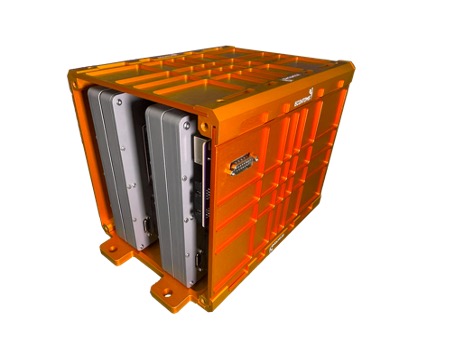
Lunar Ecosystem for Terrestrial Organisms (L.E.T.O.), designed for conducting biological experiments aimed at moon-to-Mars research.
Media Credit: ECOATOMS
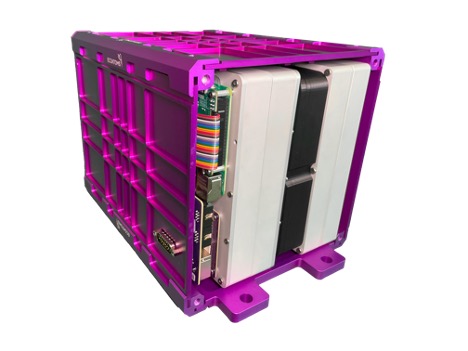
ECO-C, tailored for physical science experiments, particularly suited for precise monitoring of liquid-based studies.
Media Credit: ECOATOMS