
ISS National Lab’s Space-Tech Accelerator to Empower More Startups in 2026
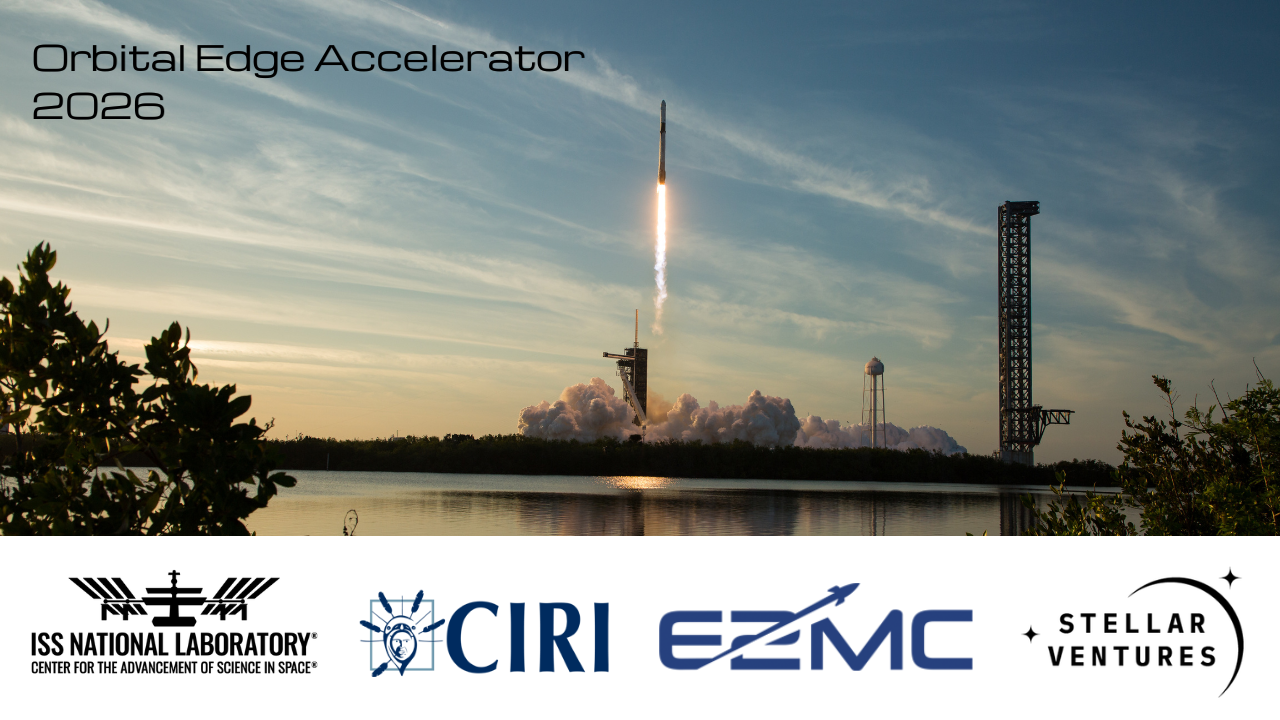
Orbital Edge Accelerator 2026 Partners
Orbital Edge Accelerator Builds on Successful First Year, Expanding Capital and Startup Resources
March 24, 2026
KENNEDY SPACE CENTER (FL), March 24, 2026 – The ISSInternational Space Station National Laboratory® is preparing to launch the 2026 Orbital Edge Accelerator program in partnership with returning global investors Cook Inlet Region, Inc., E2MC, and Stellar Ventures, as well as leading industry participants. Now entering its second year, the one-of-a-kind program expands access to orbital flight opportunities, venture capital, and business mentorship for early-stage startups developing market-changing products through the use of space.
The Orbital Edge Accelerator:
- Provides unrivaled resources for ambitious startups through significant venture capital investment and an opportunity to test and develop technologies on the ISS and other low Earth orbit(Abbreviation: LEO) The orbit around the Earth that extends up to an altitude of 2,000 km (1,200 miles) from Earth’s surface. The International Space Station’s orbit is in LEO, at an altitude of approximately 250 miles. platforms.
- Advances promising space-related ventures by equipping startups with strategic guidance, technical expertise, mentorship, and resources needed to accelerate product development and commercialization.
- Responds to growing interest in space-driven business models across industries ranging from AI and data centers to robotics, therapeutics, and materials.
By combining private capital with ISS National Lab-enabled access to space, Orbital Edge accelerates time to market for transformational technologies. As investment flows into deep tech and defense sectors, the accelerator attracts investors and industry partners focused on space, dual-use technologies, and other high-growth areas, including biotechnology, advanced materials, and manufacturing.
To learn more about how the Orbital Edge Accelerator program provides investment and industry partnership opportunities, email orbitaledge@ISSNationalLab.org.
Download a high-resolution image for this release: Orbital Edge Accelerator Partners
Media Contact: Amy Elkavich
Email: aelkavich@ISSNationalLab.org
# # #
About the International Space Station (ISS) National Laboratory:
The International Space Station (ISS) is a one-of-a-kind laboratory that enables research and technology development not possible on Earth. As a public service enterprise, the ISS National Laboratory® allows researchers to leverage this multiuser facility to improve quality of life on Earth, mature space-based business models, advance science literacy in the future workforce, and expand a sustainable and scalable market in low Earth orbit. Through this orbiting national laboratory, research resources on the ISS are available to support non-NASA science, technology, and education initiatives from U.S. government agencies, academic institutions, and the private sector. The Center for the Advancement of Science in Space® (CASIS®) manages the ISS National Lab, under a Cooperative AgreementA cooperative agreement is Federal assistance that establishes a relationship between the U.S. Government and a recipient in which the principal purpose of the relationship is to accomplish a public purpose of support or stimulation. Since 2011, the Center for the Advancement of Science in Space™ (CASIS™) has managed the National Laboratory® through a Cooperative Agreement with NASA. with NASANational Aeronautics and Space Administration, facilitating access to its permanent microgravityThe condition of perceived weightlessness created when an object is in free fall, for example when an object is in orbital motion. Microgravity alters many observable phenomena within the physical and life sciences, allowing scientists to study things in ways not possible on Earth. The International Space Station provides access to a persistent microgravity environment. research environment, a powerful vantage point in low Earth orbit, and the extreme and varied conditions of space. To learn more about the ISS National Lab, visit our website.
