
January 2026
Welcome to Space Station Spotlight, a monthly newsletter from the ISS National Laboratory®. Here’s where you can find all the latest R&D happenings on the space station, see what our partners are up to, and learn how to elevate your research to new heights by leveraging the unique space environment.

What’s new at the ISS National Lab?
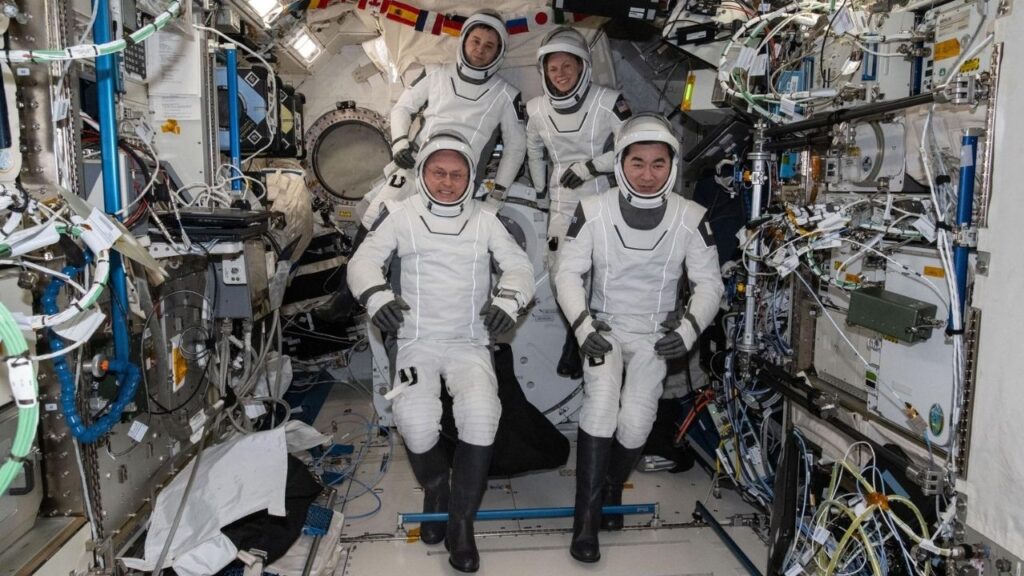
During their time on the space station, the Crew-11 astronauts worked on many ISS National Lab-sponsored investigations. These studies included biology and physical sciences research, in-space manufacturing, technology development, and student‑driven experiments. Read more.
Hear about space-grown tumors for personalized medicine, a new therapeutic for all cancers, a potential treatment for macular degeneration, brain organoids to test therapies for neurological disease, advances in in-space refueling technology, and more. Learn more.
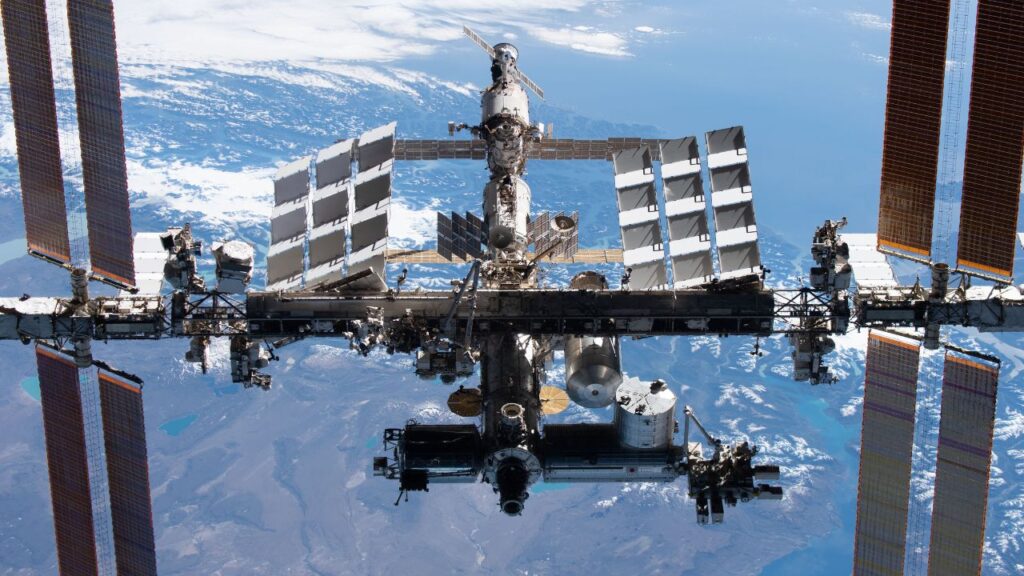
Read about the many successes from the last fiscal year—a record-breaking number of publications, patents, and products; more than 110 payloads delivered to station; the debut of the Orbital Edge Accelerator program; and more. Read the full Annual Report.
The investigation, done by researchers at Arizona State University, could lead to new ways to safeguard life-support systems in space and mitigate biofilm issues on Earth. Learn more.
Partner News
Congress passed a $24.4 billion NASA budget for fiscal year 2026. The president is expected to sign the bill, which rejects his previously proposed 24% reduction in NASA funding from 2025 levels.
Vast is delaying launch of its Haven-1 space station to the first quarter of 2027. The Haven-1 mission, which will demonstrate crewed operations in orbit, was originally slated to launch in May. Haven-1 is now in the clean room for integration and preparation for launch early next year.
Axiom Space’s commercial space station could be in orbit as early as 2028. The company plans for its initial space station to have two modules: the Payload Power Thermal Module (PPTM) and a habitat module. The PPTM is planned for launch in 2028, with the habitat module slated for a few months later.
Voyager Technologies was awarded a patent related to in-orbit manufacturing of materials for optical communications. The company’s patented method leverages microgravity to produce larger, purer crystals for high-performance optical communications technology, which will be critical to supporting the growth of AI and cloud computing. Voyager will validate the method in an upcoming ISS National Lab-sponsored project.
Voyager and the University of Connecticut are partnering to advance space-based innovation. The two will collaborate on academic research, technology commercialization, and product development. They are also establishing a new regional hub for the Voyager Institute for Science, Technology, and Advancement.
Blue Origin announced plans to deploy a new satellite communications network in LEO and medium Earth orbit. TeraWave, a constellation of more than 5,400 optically interconnected satellites, is designed to deliver data speeds of up to 6 terabits per second anywhere on Earth for use by enterprise companies, the government, and data centers.
Results
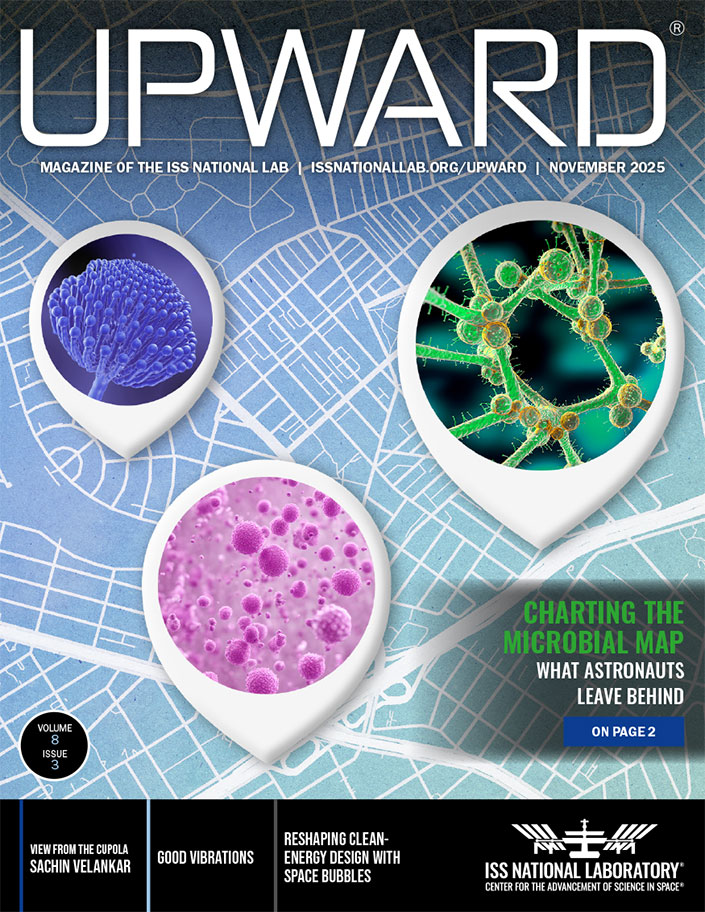
The most recent issue of Upward, official magazine of the ISS National Lab, is online. Explore valuable findings from space-based R&D—download the current and past issues here.
Researchers are using the ISS to study light-propelled bubbles. The team, from the University of California, Santa Barbara, engineered light-sensitive molecules that reshape under illumination, triggering fluid flows that nudge bubbles across liquids toward the light. Findings from this research could lead to new ways to precisely steer fluids for future spacecraft systems and clean energy on Earth. Learn more in the Upward feature “Reshaping Clean Energy Design With Space Bubbles.”
Scientists published results from a study of engineered E. coli on the ISS. The researchers, from the U.S. Naval Research Laboratory, discovered that microgravity disrupts how the microbes move nutrients and manage energy. This greatly reduces their ability to make melanin, a lightweight, radiation-absorbing material that could protect astronauts and spacecraft. The study, published in npj Microgravity, revealed that producing melanin in space will require redesigning both the microbes and the systems they grow in so the cells can function without gravity.
STEM Education and Workforce Development
Voyager was awarded a NASA contract to continue the Create Hardware (HUNCH) educational program. Through HUNCH, high school students design and fabricate hardware used by NASA, including hardware for the ISS. With the renewed contract, Voyager will build on its five-year history with the program to advance workforce development while supporting human spaceflight operations.