
Addressing the Problem of Space Debris With an Orbital Tow Truck
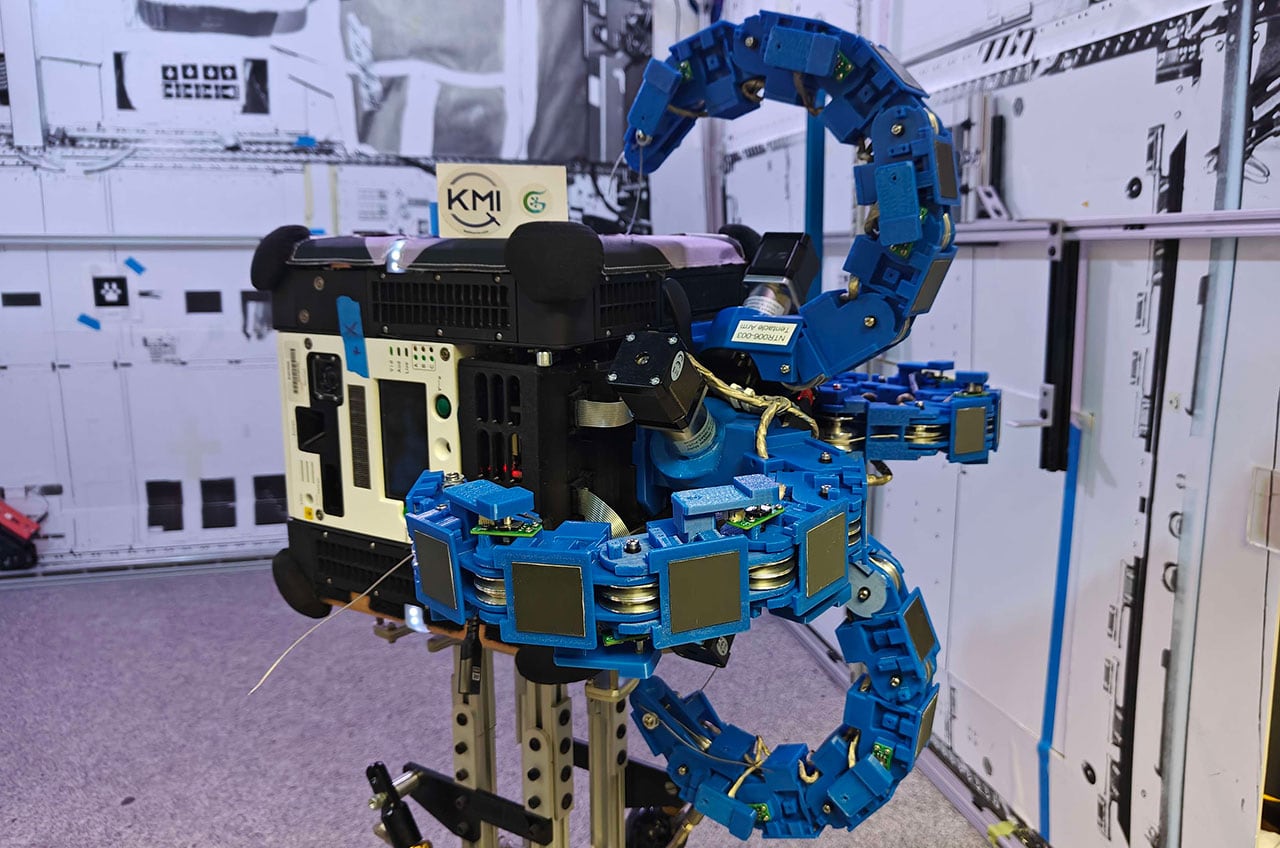
The REACCH system at NASA's Ames Research Center for preflight testing.
Media Credit: KMI
March 30, 2026 • By Amelia Williamson Smith, Managing Editor
It’s mesmerizing to watch its arms unfurl gracefully like an octopus’s tentacles. Micro-patterned pads on each arm allow it to adhere to surfaces, much like a gecko’s feet stick to a windowpane. And most amazing of all, it could be the key to keeping Earth’s orbit safe.
What is it? The REACCH capture system from startup Kall Morris Inc (KMI).
The REACCH (Responsive Engaging Arms for Captive Care and Handling) system can dock with an unprepared space object, latch on, and safely steer it to a new position or deorbit it, functioning as an orbital tow truck. This capability is especially important for addressing space debris, the millions of human-made objects in Earth’s orbit that are no longer useful. The debris could be nonfunctional satellites, parts from launched rockets, or pieces from old spacecraft—all moving at speeds up to 10 times faster than a bullet.
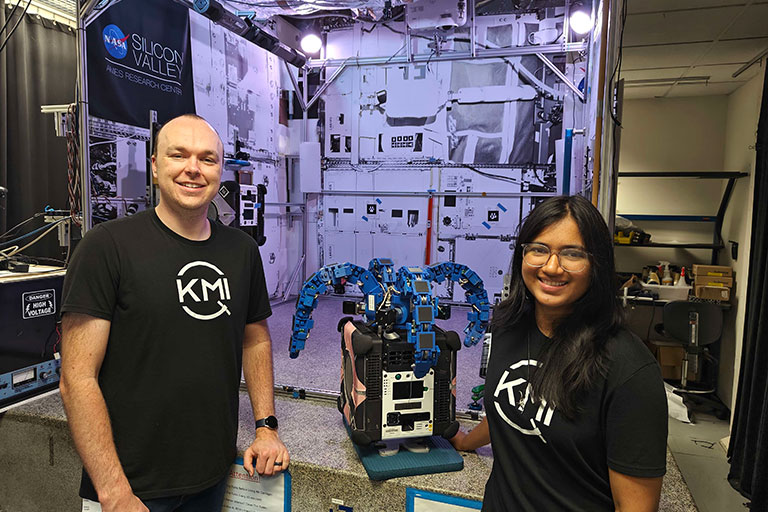
KMI engineers Sam Cassidy and Preksha Madhva at NASA's Ames Research Center for REACCH preflight testing.
Media Credit: KMI
Space debris is a growing problem that could lead to a paralyzing gridlock. The more debris in orbit, the higher the likelihood that pieces of debris collide, leading to a lot more debris and an even higher likelihood of collisions. It could have a runaway effect that would clutter Earth’s orbit so much that it would become impassable.
The impact would be significant. Not only would humanity be unable to operate spacecraft like the International Space Station (ISSInternational Space Station), but satellites for weather forecasting, communications, GPS, and national security would be destroyed. In such a scenario, it could take years, or even decades, to clear. Addressing this issue now is critical, and KMI is up for the challenge.
“We looked at it as young professionals and thought: if this problem isn’t solved, we won’t have careers in aerospace because the whole industry will just disappear. Something has to be done,” explained Adam Kall, KMI co-founder and chief strategy officer.
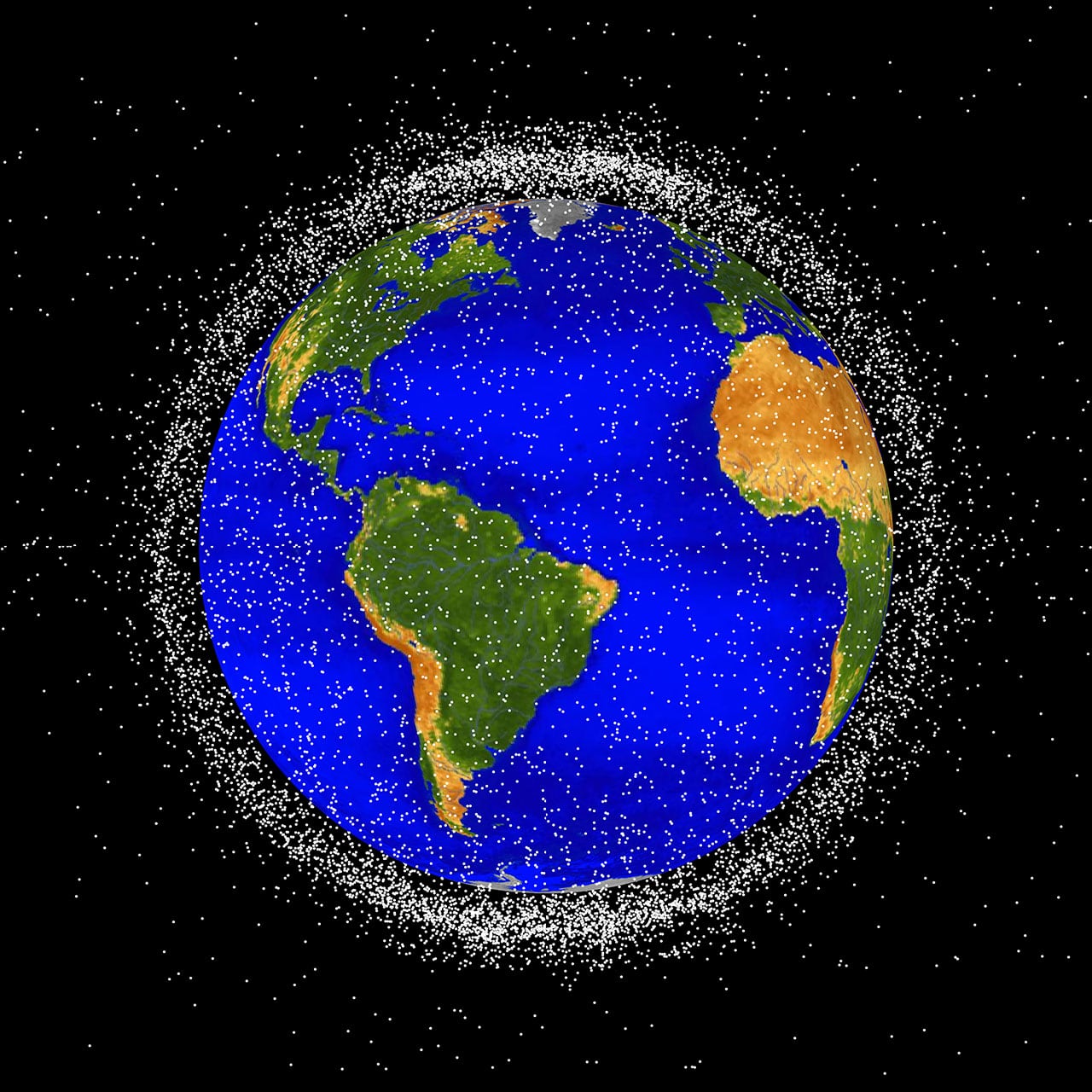
Low Earth orbit(Abbreviation: LEO) The orbit around the Earth that extends up to an altitude of 2,000 km (1,200 miles) from Earth’s surface. The International Space Station’s orbit is in LEO, at an altitude of approximately 250 miles. (LEO), the region of space within 2,000 km of the Earth’s surface, is the most concentrated area for orbital debris.
Media Credit: NASANational Aeronautics and Space Administration
The REACCH system could provide a solution by removing debris from the path of operational satellites or maneuvering satellites out of the way to avoid collisions that create more debris. But to advance the system, the company needed a way to test it in space. Kall and his team created physics simulations to model how the system would work without gravity, but couldn’t trust simulations alone. They needed results from a real-life microgravityThe condition of perceived weightlessness created when an object is in free fall, for example when an object is in orbital motion. Microgravity alters many observable phenomena within the physical and life sciences, allowing scientists to study things in ways not possible on Earth. The International Space Station provides access to a persistent microgravity environment. demo.
Launching a small satellite was an option, but it would be costly and allow only one test run. To really validate the system, they needed a space-based platform where they could do multiple runs, and the perfect test bed was orbiting overhead, available through the ISS National Laboratory®.
“I discovered the ISS when I was eight years old. I looked up at the sky and saw this bright dot flying over,” Kall recalls. “I never dreamed I would have an experiment on it.”
Clearing Space and Adding Value
KMI was founded in 2019 with a vision to clear space of the clutter. In addition to tackling the space debris problem, KMI’s REACCH system would also extend the life of satellites, providing substantial value for satellite operators.
“Most of the time, a satellite’s mission is not over because some clock runs out,” Kall explained. “The mission is over because a computer no longer works, a radio no longer receives a signal, or some other mission-critical problem occurs.”
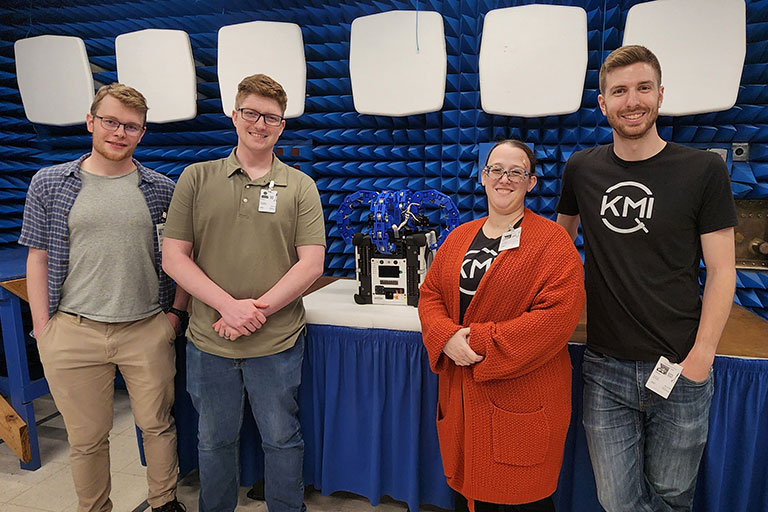
KMI team members preparing to conduct EMI (electromagnetic interference) testing at NASA's Johnson Space Center (left to right: Tom Ziegler, Zachery Champion, Corinne Moore, and Austin Morris).
Media Credit: KMI
But before a critical problem happens, the satellite must be deorbited. This means operators must determine when the risk of failure is high enough to call it quits, often prematurely ending the satellite’s life. But what if they didn’t have to worry about that? What if they could keep satellites going longer?
When a satellite finally loses its last drop of productivity, that’s when REACCH could come in, Kall said. “By providing de-orbiting services, we are allowing satellite operators to gain more from each satellite they launch, we’re limiting the number of launches that need to occur because satellites will last longer, and we’re increasing revenue for everyone involved, all while keeping space safe.”
What’s that in the background?
REACCH started out as a University of Southern California (USC) experiment funded by the Defense Advanced Research Projects Agency (DARPA). But in 2020, the COVID-19 pandemic hit, and the experiment stalled out. Dave Barnhart, who was leading the project, was left with a prototype of the system on his shelf collecting dust.
Right about that same time, KMI was starting to design its own space debris capture system and envisioned it having tentacle-like arms that could latch onto unprepared objects. They were trying to learn all they could about designing technology for space and signed up for a webinar that Barnhart was hosting.
As they watched the webinar, they couldn’t help but focus their attention on what was in the background. There, on the shelf behind Barnhart, they spotted exactly what they had been envisioning. “Thank goodness he didn’t have a virtual background on,” Kall said, still astounded by the serendipity. Through an agreement with USC, KMI was able to pick up where the project left off, making design changes to improve the technology.
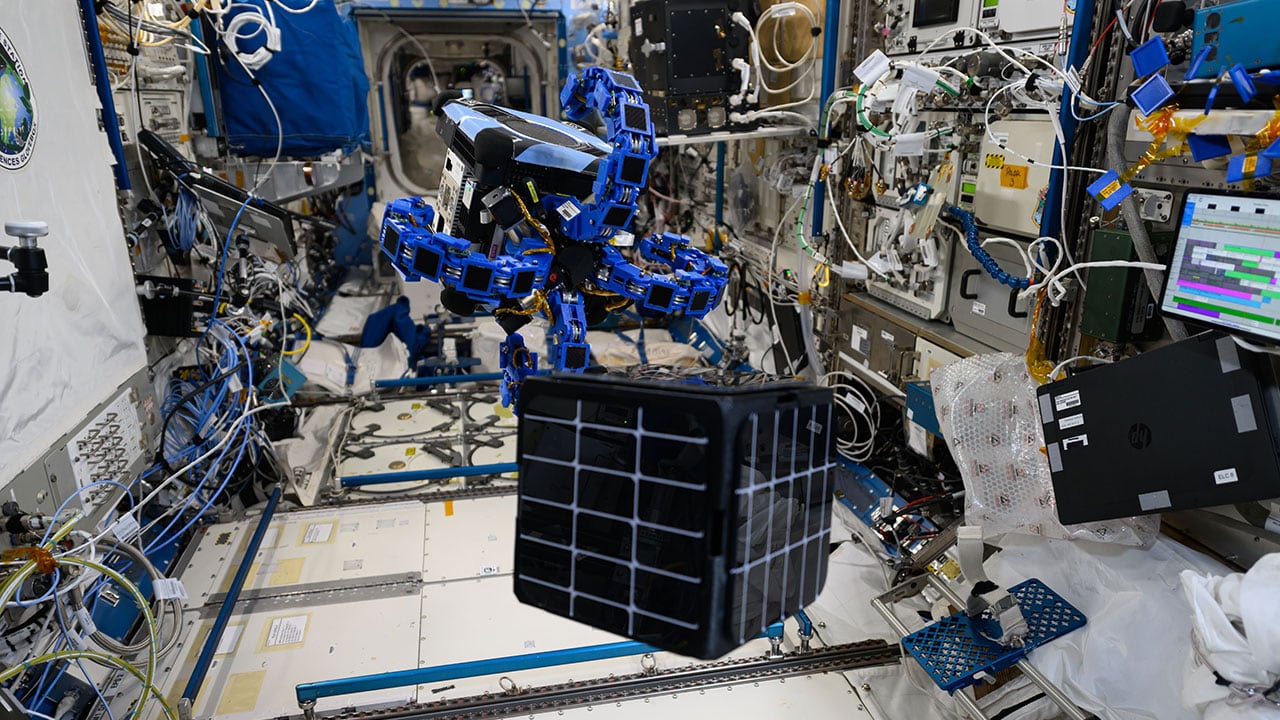
The REACCH system approaches a target object on the ISS during a capture test.
Media Credit: NASA
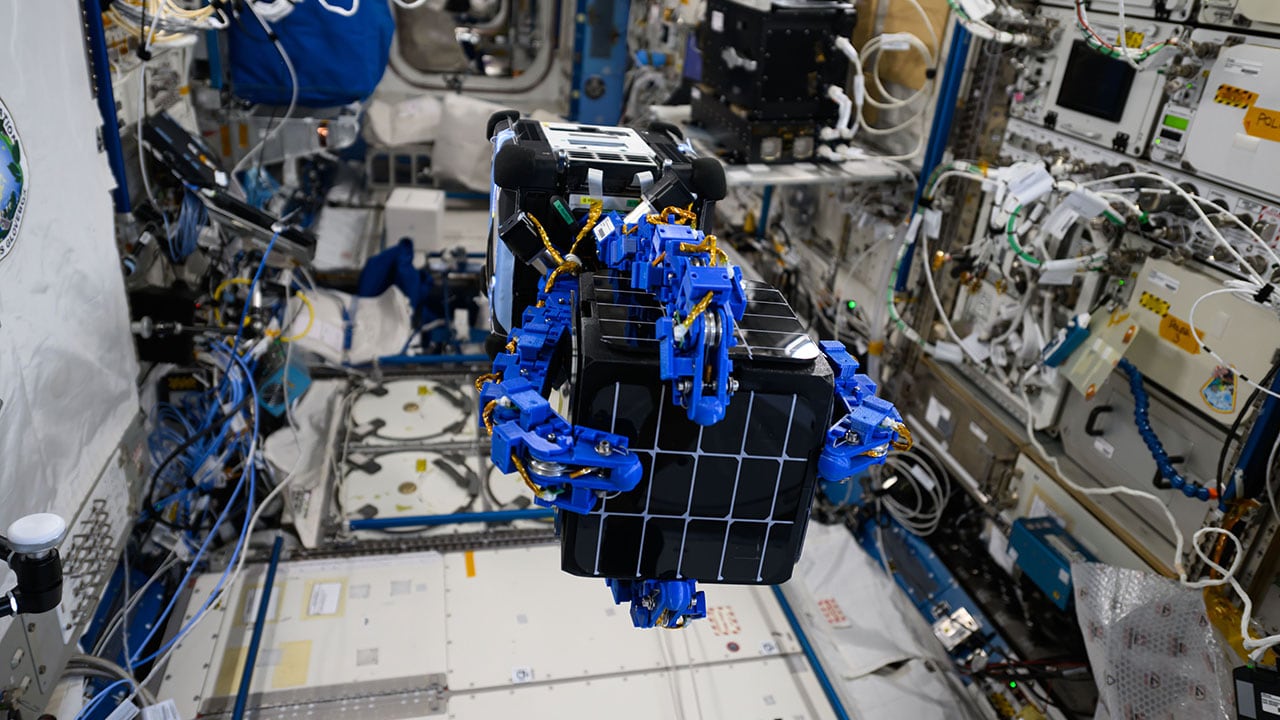
The REACCH system capturing a target object during testing on the ISS.
Media Credit: NASA
So how does REACCH capture debris? The system consists of a small hub with eight articulated metal arms that mechanically unfurl around an object, conforming to its surface. As soon as the first arm segments near the hub detect pressure, the motion cascades down the arms like falling dominoes.
“The complex mechanical engineering within the arms allows us to deploy them not as a bear hug, where the tips of the arm trace the outer path of the object, but instead as a kind of unrolling pattern very similar to what octopi do,” Kall said. “It doesn’t matter the geometry of what you’re grabbing, the arms will follow the surface.”
The arms also have a micro-patterned dry adhesive, a class of materials that imitate how gecko feet stick to things, explained Tom Ziegler, an electrical engineer at KMI. It may be surprising, but when two materials touch, most of their surface area is not making contact. Even for extremely smooth surfaces, the points where the surfaces actually touch are very minimal.
“When you zoom in at the atomic scale, it’s likened to jamming one mountain range on top of another,” Ziegler explained. “You’ll get a couple points of localized contact where individual atoms happen to be really close to each other, but for the most part, there’s a comparatively large gulf of space between them, even for precisely machined surfaces.”
So how can geckos grip a wall without falling? Their feet contain a bunch of tiny, flexible fibers that more closely conform to surfaces. This increases the amount of surface area making contact, allowing for a stronger hold.
The micro-patterned adhesive on REACCH’s arms contains tiny wedges that mimic the flexible fibers on geckos’ feet. The adhesive is directional, gripping the surface when pressed and slid one way and releasing when moved the opposite way. No residue is left behind, so REACCH won’t damage objects that it captures. The system’s gecko-like grip is especially useful for capturing satellites or tumbling pieces of debris.

Importantly, REACCH doesn’t have to wrap around an object and hold it—it just has to attach to the object and push it. This means it can relocate things much larger than itself. And with REACCH, objects do not need a docking adapter installed, allowing the system to capture almost anything.
It was beautiful engineering, Kall said, but the question was: how well would it work in space and on what types of objects?
A Second Trip to Station
KMI will soon conduct a second investigation through the ISS National Lab—this time outside of the space station. The company aims to test its micro-patterned adhesive and the material’s mechanisms in the harsh space environment to confirm that it retains its adhesion capabilities and grip strength over time. To do this, a sample of the adhesion material will be installed in the MISSE Flight FacilityThe Materials International Space Station Experiment Flight Facility is a hardware platform on the exterior of the ISS that provides exposure to the harsh space conditions for the accelerated testing of materials and technologies with important applications both in space and on Earth. This ISS National Lab commercial facility is owned and operated by Aegis Aerospace. on the exterior of the ISS, where it will remain for several months before returning to Earth for analysis.
This upcoming project was selected through the ISS National Lab’s Orbital Edge Accelerator program, which aims to connect innovative startups and global investment partners and integrate them into the growing space economy.
Preparing for Anything
Space surfaces can vary a lot. They may be rough and jagged or smooth and slick. They might be hard and solid, or they may have some give. They could be multilayer insulation, smooth acrylic, crumpled aluminum, or covered in solar panels. Because you never know what you’ll encounter in orbit, REACCH must be prepared for any scenario.
The KMI team wanted to run tests using many types of targets, but space on the ISS and launch vehicles is limited. So, they came up with a creative solution: a 28-centimeter cube with six sets of faceplates, each made of a different material that could be attached with Velcro and swapped.
“We wanted to study what the interaction looked like with different materials and how that changes the way we would approach an object we’re capturing with that type of surface,” said Austin Morris, KMI co-founder and chief technology officer.
For the spaceflight experiment, the team sent up a scaled-down version of REACHH with four arms instead of the full eight. Once REACCH arrived on station, it was attached to Astrobee, a small free-flying robot, as a stand-in for KMI’s future carrier spacecraft. Because the ISS is a crewed laboratory, instead of getting just one test run, the team got 172.
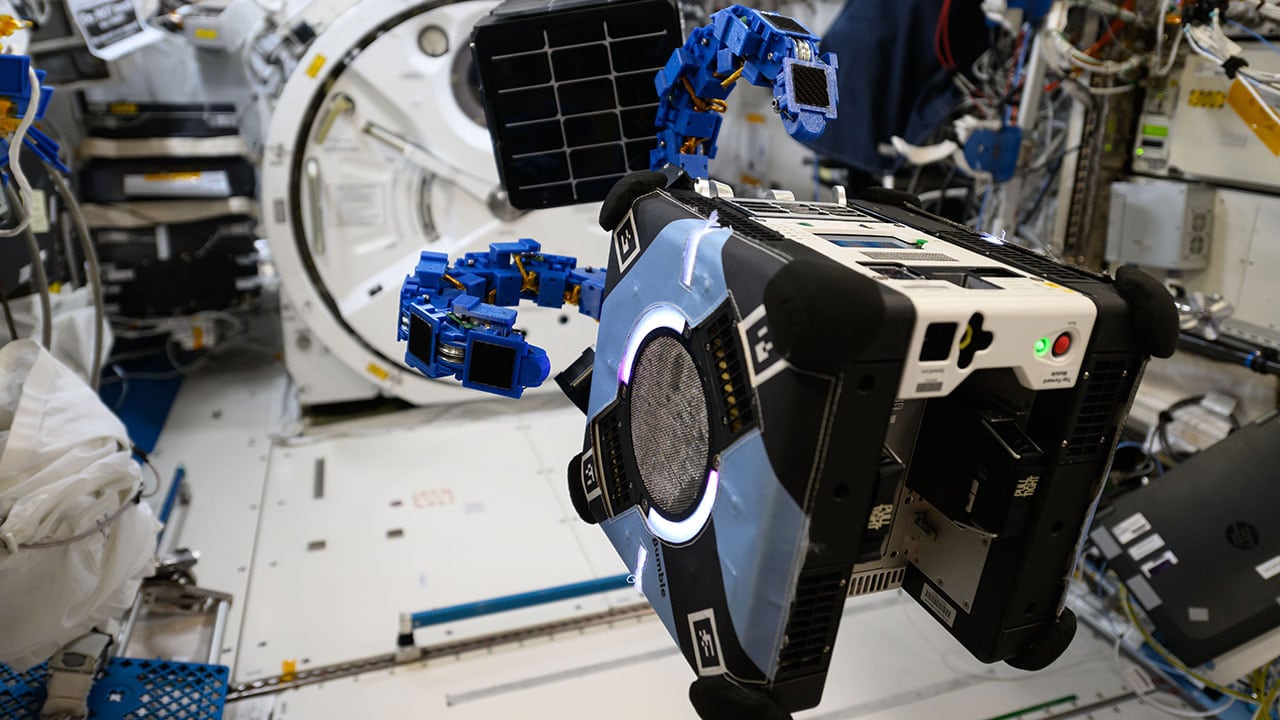
The REACCH system, attached to a free-flying Astrobee robot, maneuvers through the ISS to capture a test object.
Media Credit: NASA
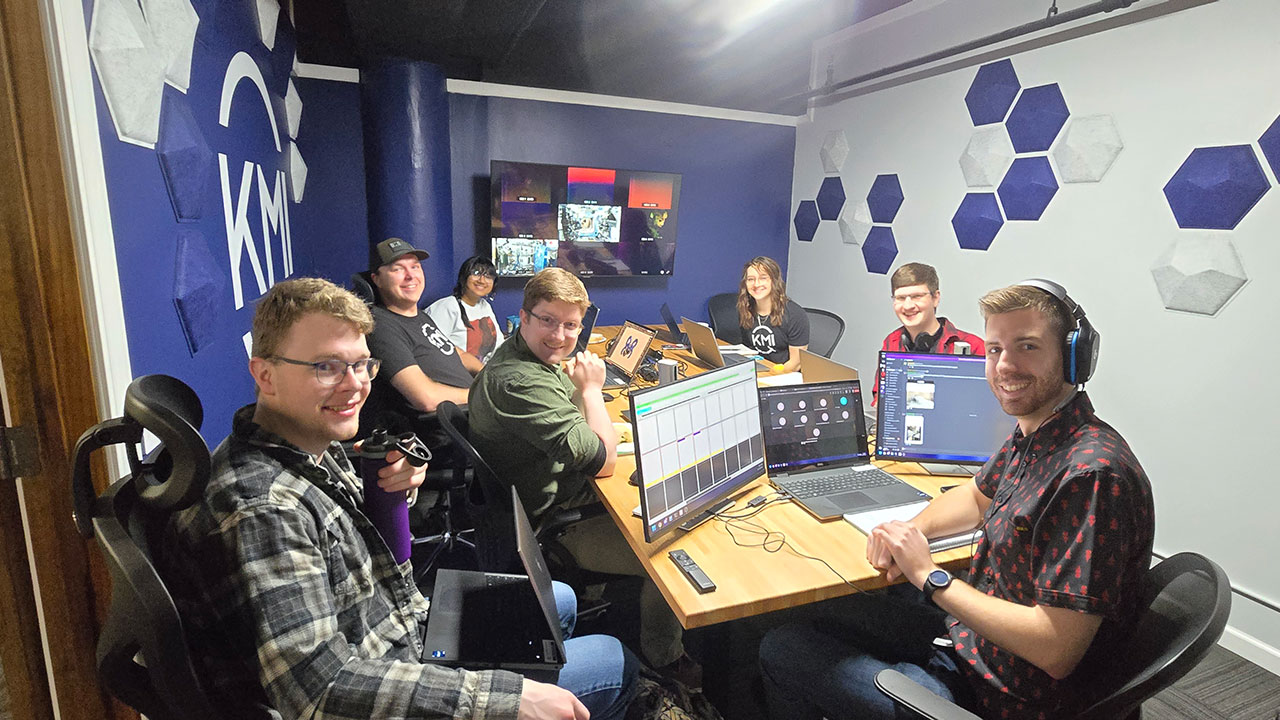
The KMI technical team set up to conduct REACCH testing on the ISS from their Michigan office (left to right: Tom Ziegler, Sam Cassidy, Preksha Madhva, Zachery Champion, Rose Schopfer, Adam Kall, Austin Morris).
Media Credit: KMI
“On the ISS, we got multiple repetitions, the astronauts giving us ideas, making adjustments, changing materials,” Kall explained. “That would have been 172 CubeSatSmall satellites that use a standard size and form factor, traditionally measuring 10 cm x 10 cm x 10 cm in size that may be deployed from the space station to conduct research and technology development. launches, and we got it all done in 200 days through a single launch to the space station. It’s hard to express the value because without it, we wouldn’t have been able to do this.”
In addition to swapping out materials, the crew tested several different scenarios: a stationary target, a tumbling target, and an approaching target. They also varied the approach angle and speed. While the astronauts ran tests on the ISS, KMI’s engineers watched from the ground in near real time, allowing them to see results and quickly adjust the experiment as needed. All in all, there were six test sessions over five months.
While REACCH was on station, the KMI team kept an ISS tracker app on their phones. Every time the space station passed overhead, they would go outside—even in the middle of the day when the ISS wasn’t visible. “We’d still go out because we knew our experiment and the astronauts running it were up there, and it was just this amazing moment,” Kall recalls.
From Demo to Debris Capture
The team anxiously watched the experiments, waiting for data confirming that REACCH was successful. After the first few captures, the relief was palpable. KMI could confidently say that REACCH worked well in most scenarios. However, even more important were the failures.
Media Credit: NASA
“It performed very well in the majority of cases, which was outstanding for us to see, but more valuable are the ones where it didn’t perform well because that highlights for us the areas we can further improve,” Morris said.
The team found that material type did affect REACCH’s capture performance. Surfaces with more texture or a little bit of give worked better than hard, slick surfaces, which REACCH had more difficulty securely grasping.
Using these results, KMI has been working on prototyping to improve REACCH’s design. The team now has the data to confirm their simulation models match the real performance observed on the ISS. This means they can use the simulation to validate larger-scale plans and be confident they will work without any further spaceflight testing, which is immensely valuable, Morris said.
“If the ISS National Lab didn’t exist, we would not have been able to do our experiment,” Kall emphasized. “We would have had to launch our technology and hope that it worked, and we wouldn’t have gained nearly as much valuable insight.”
Once the team has fully refined the design and confirmed that REACCH will work for all materials and scenarios, it will be ready to go back to space. This time, though, will be the real deal: a mission to deorbit existing objects from space.
The team sees endless possibilities for REACCH. It could be used for spacecraft end-of-life services or to relocate satellites. It could also be used to shuttle spacecraft to and from a refueling hub or distribute supplies for an in-space manufacturing plant.
In the future, Kall hopes his son will have the chance to go outside on a dark night and see not just one bright dot but many space stations flying overhead. “The ISS is a beautiful laboratory and starting point for expansion into space,” he said. “As the ISS reaches the end of its life, it’s because we’re ready to take that next step and grow into multiple space stations and endeavors.”
But to achieve this future, one thing is clear: we need to declutter space, Ziegler said. “The ability to move stuff around needs to be figured out to unlock some of the exciting next steps in the orbital economy.”
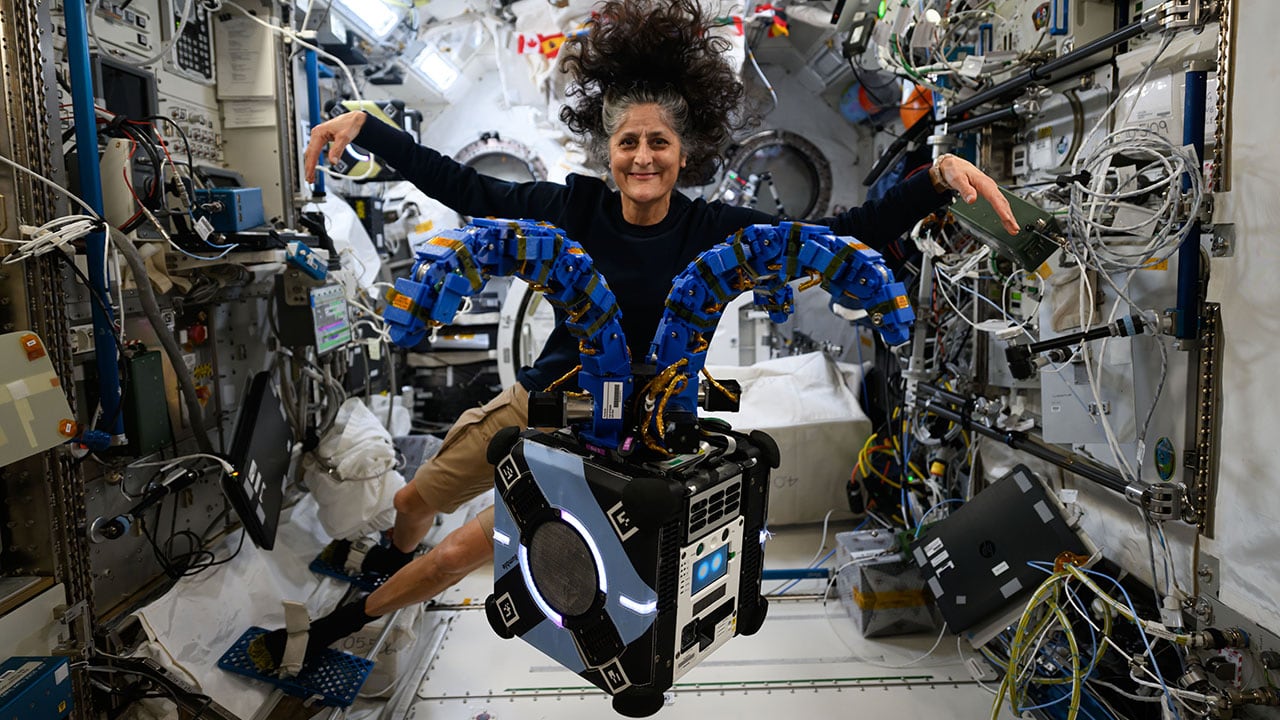
Retired NASA astronaut Suni Williams, who supported most of KMI's testing on the ISS, poses with the REACCH system.
Media Credit: NASA
Want to share this feature with a colleague or save it for later? Download a PDF version of this feature.

Amelia Williamson Smith, Upward Managing Editor
Letter From the Editor
Ten years ago, I sat at my computer brainstorming how best to share the amazing science enabled by the ISS National Lab. It was then that Upward was born.
We chose the magazine’s name for many reasons. We look upward to the ISS—our nation’s only orbiting laboratory—to solve some of humanity’s greatest challenges and to create things not possible on the ground. We endeavor upward in our pursuit of advancing science and technology in space to improve life on Earth. And we raise our aspirations upward beyond the ISS to a future where commercial space stations operate in a robust low Earth orbit (LEO) economy.
I hope you enjoy this 10th anniversary edition, in which we highlight how the idea of manufacturing products in space for use on Earth is no longer confined to science fiction. Studies enabled by the ISS National Lab over the past decade have shown that not only is this vision possible—it’s right around the corner.
As we look ahead to this exciting future, we also take a moment to look back on the road that brought us here. The ISS has served as an invaluable testbed for in-orbit production. It’s a place where companies can validate systems and facilities, refine and optimize production processes, and uncover ways to scale their manufacturing on future LEO platforms. It remains a critical step toward the next industrial revolution—in space.
I am so proud of how far Upward has come over the last 10 years and all the stories we’ve shared that showcase the value of conducting research and technology development in space. I am thankful for our amazing team that helped bring the idea of the magazine to life. And I am grateful to you, our readers, for joining us on this incredible journey of discovery. We hope you continue to follow along as we forever strive upward.