
Manufacturing Artificial Retinas in Space to Restore Sight on Earth
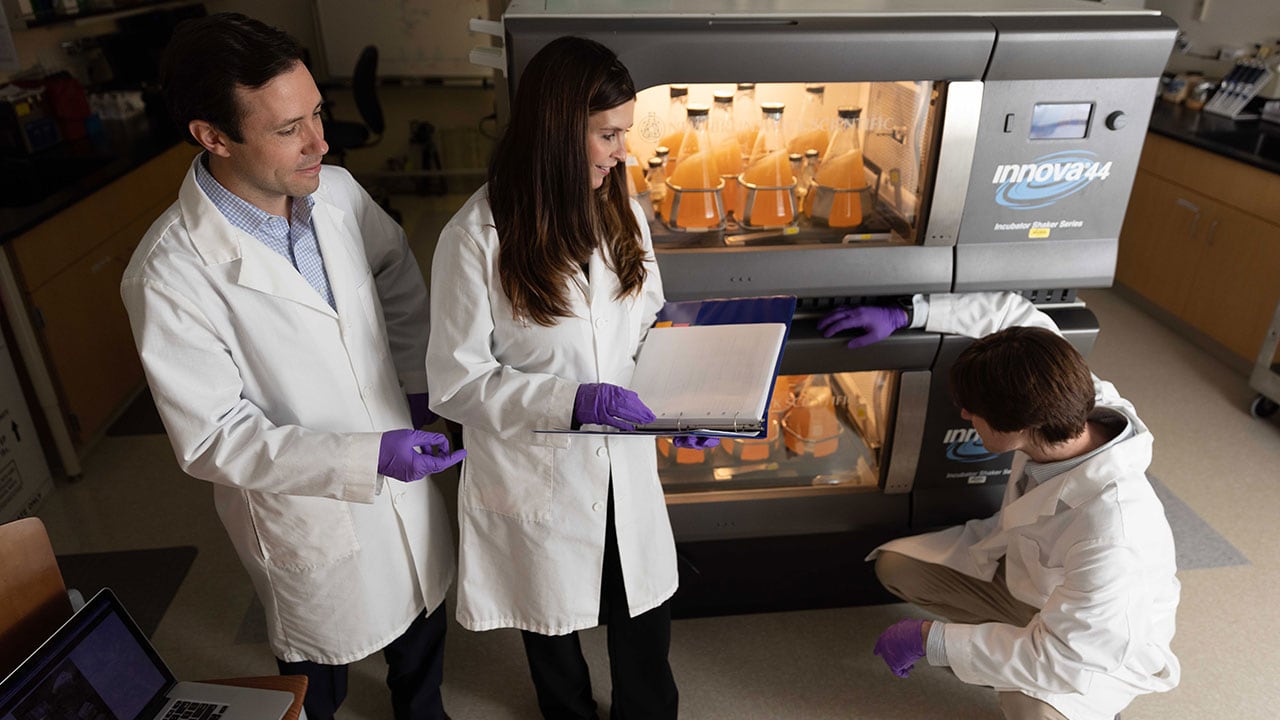
LambdaVision CSO Jordan Greco, CEO Nicole Wagner, and Lead Engineer Daniel Sylva working in the company's lab in Woodbridge, Connecticut.
Media Credit: LambdaVision
March 30, 2026 • By Amelia Williamson Smith, Managing Editor
Imagine an environment with saltwater four to five times saltier than the ocean. There are places on Earth where the water pools in shallow ponds with little oxygen, and the harsh sun beats down with brutally intense UV radiation. What’s more, the salty water amplifies the light, making it all the more punishing. There’s no way an organism could survive in that extreme environment, right?
Wrong. Halobacterium salinarum is a microscopic, single-celled organism that not only survives in these hypersaline ponds—it thrives.
This purple-tinted extremophile lives at the edge of what’s biologically possible for life on Earth. It can do this because of a light-activated protein called bacteriorhodopsin that turns light into chemical energy without oxygen or carbon through a proton-pumping process.
Scientists at LambdaVision are harnessing this unique mechanism to restore sight in those blinded by macular degeneration. The startup developed an artificial retina using hundreds of layers of bacteriorhodopsin.
To produce the artificial retinas, the protein is deposited onto a scaffold using a precise layer by layer assembly method. Small, oval-shaped artificial retinas are punched out of the thin film. But gravity-driven forces on Earth cause inconsistencies in the film’s layers that can make parts of it unusable.
To address this problem, LambdaVision decided to take bacteriorhodopsin from its extreme environment on Earth to another extreme environment: space. In microgravityThe condition of perceived weightlessness created when an object is in free fall, for example when an object is in orbital motion. Microgravity alters many observable phenomena within the physical and life sciences, allowing scientists to study things in ways not possible on Earth. The International Space Station provides access to a persistent microgravity environment., the team can produce artificial retinas with layers that are much more uniform. For this reason, the startup has set its sights on in-orbit manufacturing.
What is proton pumping?
When bacteriorhodopsin absorbs light, the protein changes shape and pushes protons out of the cell. Once there are more protons outside than inside, it creates a gradient that causes the protons to flow back in. When this happens, H. salinarum makes ATP—the molecule it uses for energy.
LambdaVision leveraged this proton-pumping mechanism in its artificial retinas. When light hits the artificial retina, the bacteriorhodopsin creates a proton gradient, and the charged particles stimulate retinal neurons connected to the optic nerve, restoring vision.
Space-based factories manufacturing products for Earth may sound like science fiction, but research leveraging the International Space Station (ISSInternational Space Station) National Laboratory is demonstrating that it could soon become a reality. Over the past 10 years, LambdaVision has conducted nine ISS investigations to develop and optimize a system to produce artificial retinas in orbit.
“Every launch, every opportunity to advance our artificial retinas on the ISS has been incredible for gaining greater understanding of what’s possible in low Earth orbit(Abbreviation: LEO) The orbit around the Earth that extends up to an altitude of 2,000 km (1,200 miles) from Earth’s surface. The International Space Station’s orbit is in LEO, at an altitude of approximately 250 miles.,” said Jordan Greco, chief scientific officer at LambdaVision. “And to be at the forefront of in-space production as one of the first to potentially have a product manufactured in microgravity is really exciting.”
Replacing Rods and Cones
The retina is a light-sensitive tissue in the back of the eye that converts light into signals the brain interprets as images. Photoreceptor cells called rods and cones contain light-activated proteins—much like bacteriorhodopsin—that turn the light into electrical signals. These signals are transmitted through a neural network to the optic nerve, which leads to the brain’s visual cortex. If a person’s photoreceptor cells become damaged, the system cannot function, leading to vision loss.
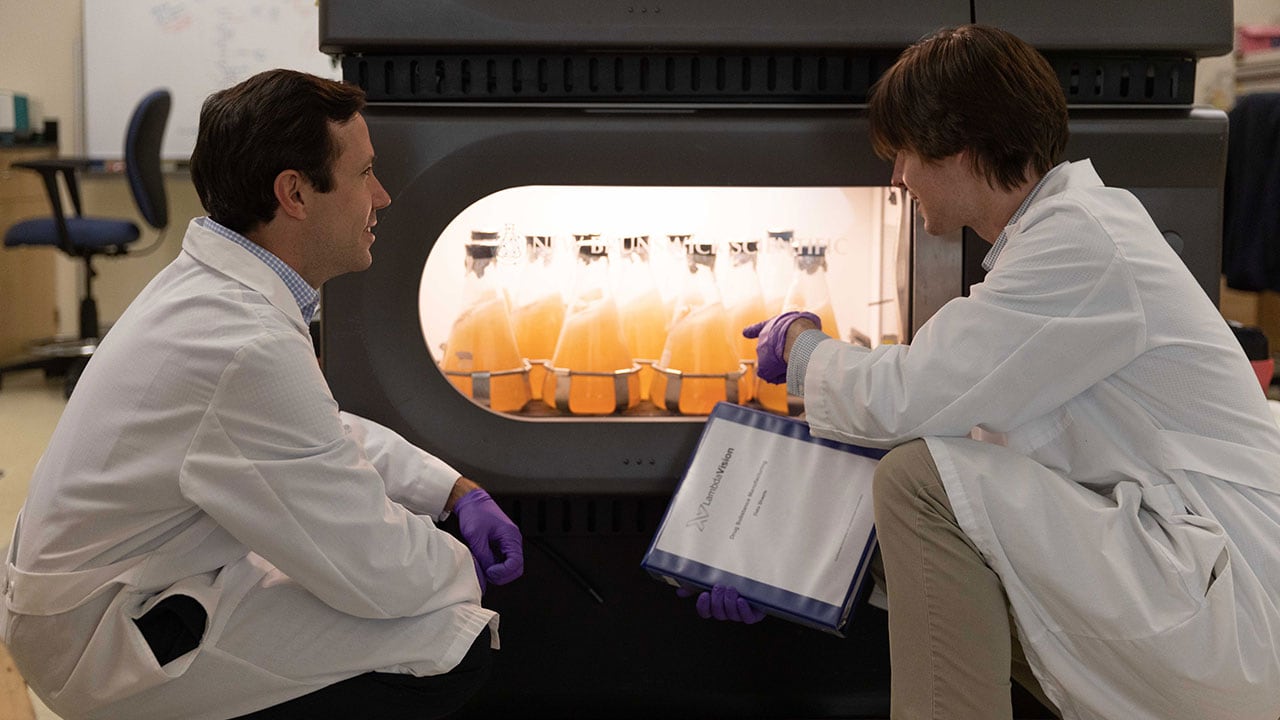
LambdaVision CSO Jordan Greco and Lead Engineer Daniel Sylva checking on shaker flasks containing a super-saline solution to grow bacteriorhodopsin.
Media Credit: LambdaVision
Age-related macular degeneration (AMD), a condition affecting nearly 20 million Americans over the age of 40, causes photoreceptor cells to break down. In these patients, central vision is lost, often rendering the faces of loved ones unrecognizable and making daily tasks like reading and driving nearly impossible.
A rare genetic disorder called retinitis pigmentosa also damages photoreceptor cells, but in the opposite way. Vision starts to fade from the outer edges inward, leading to tunnel vision and eventual blindness. This condition occurs in roughly one in 4,000 people, and vision loss can begin as early as age 10.
LambdaVision’s goal is to one day provide a solution for patients with these devastating disorders that currently have no cure. The company’s artificial retina, composed of multiple layers of bacteriorhodopsin, can be put in the eye in place of lost photoreceptor cells, Greco explained.
“Our film aims to essentially function as an artificial photoreceptor cell layer that can absorb light and generate a signal that stimulates the retina’s remaining neural circuitry, leading to functional vision for patients,” he said. “It is designed to be placed in the back of the eye with a surgery that retinal surgeons are already familiar with.”
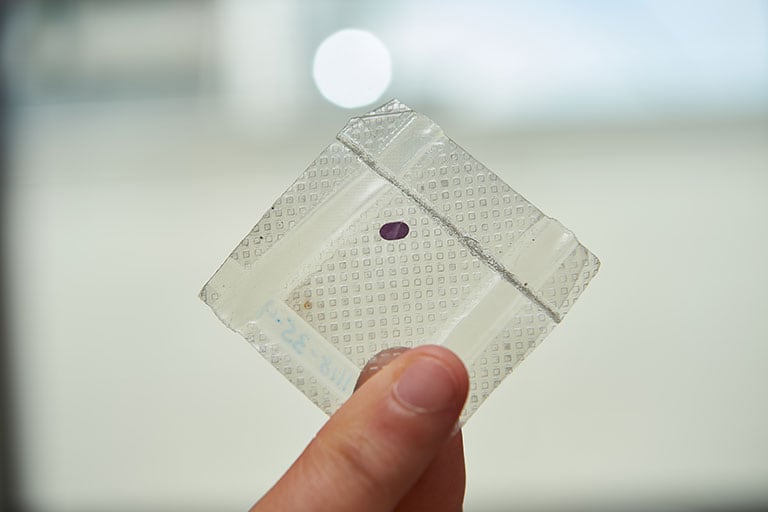
LambdaVision’s protein-based artificial retina, the small purple dot, is about the size of a paper hole punch.
Media Credit: Peter Morenus/UConn Photo
In their lab on Earth, LambdaVision scientists developed a process to manufacture artificial retinas using automated dipping machines. The base layer is a scaffold that is dipped into a series of beakers, which alternate between bacteriorhodopsin, a polycation binder, and wash solutions.
But the solutions are subject to the effects of gravity, and just as sugar settles at the bottom of a teacup, sedimentation occurs in the beakers. Buoyancy-driven convection also creates turbulent flows that can cause uneven coating. These factors can lead to inconsistent layering.
“It’s not such a big deal when you’re dipping it 10 or 20 times, but when you do this 50 to 200 times, any imperfection at an earlier layer is going to be compounded,” explained Nicole Wagner, LambdaVision CEO. “What that means for our current artificial retina is that in our terrestrially manufactured process, we have a tremendous amount of waste.”
The team must carefully select the most uniform sections of the films and discard the rest. Not only is the process wasteful, it also limits scalability. By taking the process to a microgravity environment, sedimentation, buoyancy, and inconsistencies are significantly reduced.
“In space, we have very even coating and a much more uniform thin film, so it takes the guesswork out of finding the areas of the greatest homogeneity, and it’s a lot less waste,” Wagner said.
Microgravity Manufacturing
LambdaVision’s artificial retinas could benefit greatly from microgravity, but to manufacture them in space, the company had to develop a whole new coating process.
“We needed to change the design entirely to support that environment,” Greco said. “But also from a quality standpoint, we always knew we needed to transition to a closed-loop fluidic chamber approach because it’s more appropriate for the regulations around manufacturing.”
To do this, the startup worked with ISS National Lab Commercial Service ProviderImplementation Partners that own and operate commercial facilities for the support of research on the ISS or are developing future facilities. Space Tango. Together, they designed a small system that fits into Space Tango’s CubeLab hardware.
“It’s amazing that we get to help LambdaVision and similar companies at this early stage of research and development,” said Space Tango mechanical engineer Chess Necessary. “Hopefully, one day it will lead to actually manufacturing these products in space and sending them back to Earth.”
The system contains fluid bags of solution and a chamber with a scaffold. The solutions are pumped into the chamber in an alternating fashion. As each solution flows over the scaffold, it forms a uniform thin layer. This process is repeated to build the artificial retina layer by layer.
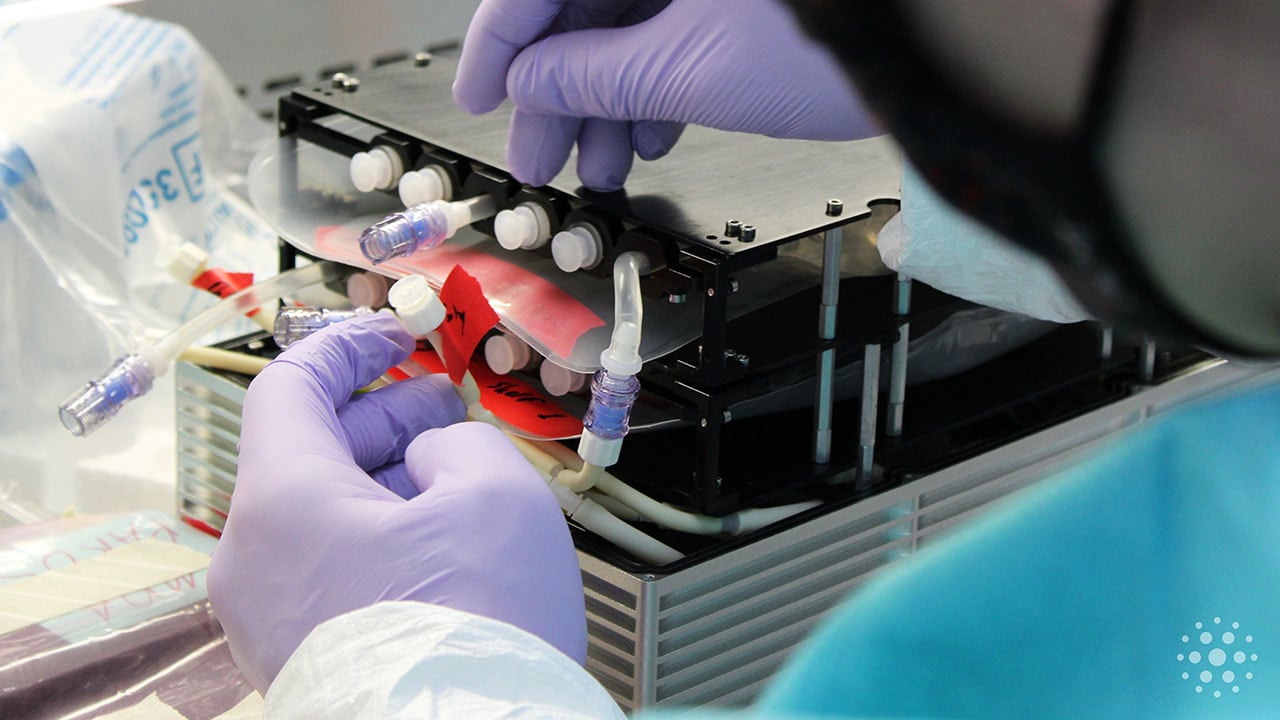
Deintegration of a CubeLab containing LambdaVision’s artificial retinas produced in microgravity.
Media Credit: Space Tango
Once the CubeLab-based system is installed on the ISS, it is completely automated, requiring little to no astronaut intervention. “We’re completely autonomous, which gives us a lot of flexibility in terms of the kind of platforms we can move to in the future,” Wagner said. “We’re also a low-mass payload, so we can create many artificial retinas using a very small footprint, which is valuable.”
However, the system isn’t just a black box in space. Cameras and flow sensors monitor each layer as it forms.
“If something doesn’t go quite right in the protocol, the system stops and sends us a message, and we can take actions to correct it from the ground,” said Zach Jacobs, director of software engineering at Space Tango.
With each ISS investigation, the team continues to hone and optimize the production process. Every time the system flies, an exact replica remains at NASA’s Kennedy Space Center to run in parallel as a ground control. When the system returns from the ISS, the thin films in both systems are removed at the same time so the only variable is gravity. LambdaVision can then run analyses on both sets to determine microgravity’s effects.
The ability to utilize the ISS as a testbed has been critical, Jacobs said. “If you’re going to manufacture at scale, you have to be able to flesh out your production process by going to space multiple times and iterating to figure out what works in microgravity and what doesn’t.”
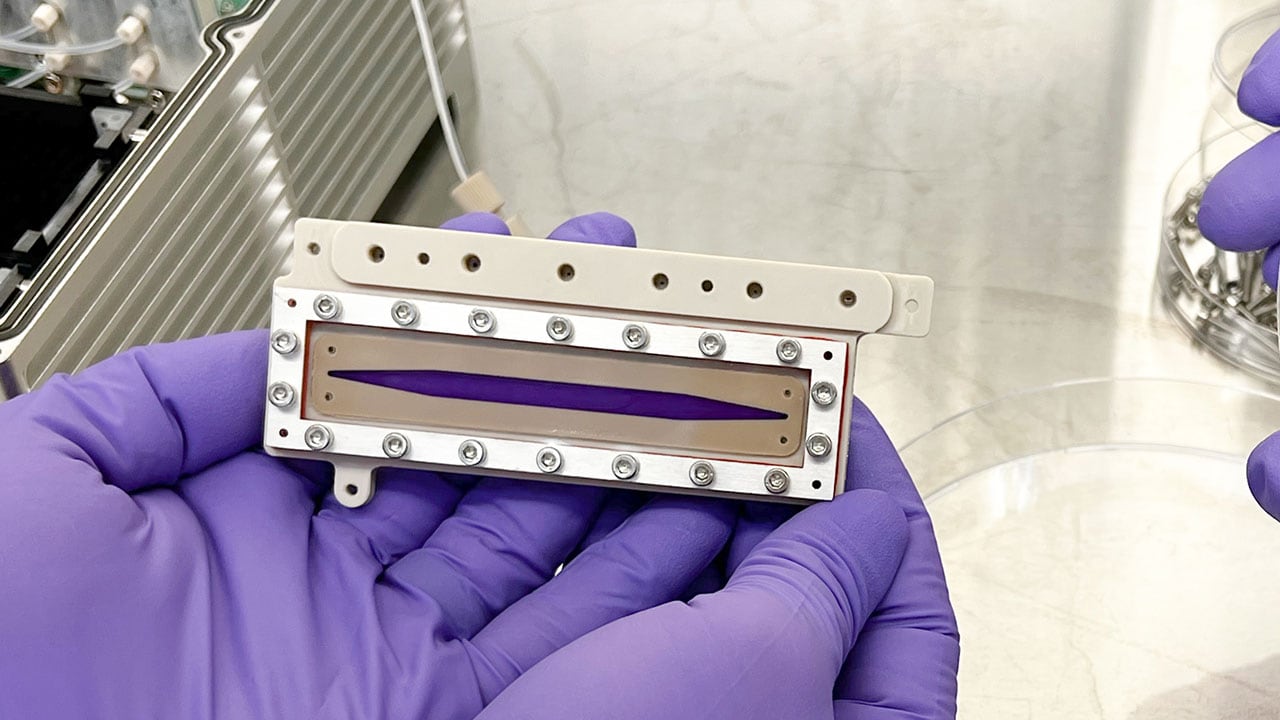
The thin film development chamber for in-space production of LambdaVision’s artificial retinas.
Media Credit: Space Tango
Upward and Onward
Over the course of nine flights, some sponsored by the ISS National Lab and some by NASANational Aeronautics and Space Administration, LambdaVision has made exceptional progress. The startup has produced four 50-layer films and six 200-layer films with a precision that is difficult to achieve on the ground. Analysis revealed that the space-produced films had better homogeneity, optical performance, and biocompatibility than those manufactured on Earth. The artificial retinas made in space were also more stable and reproducible, and the production process used less raw material.
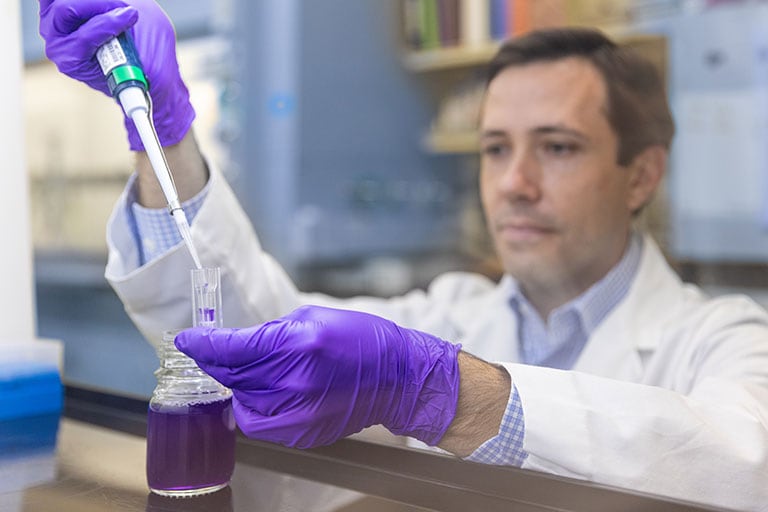
LambdaVision CSO Jordan Greco pipetting bacteriorhodopsin, the light-activated protein used in the company’s artificial retinas.
Media Credit: LambdaVision
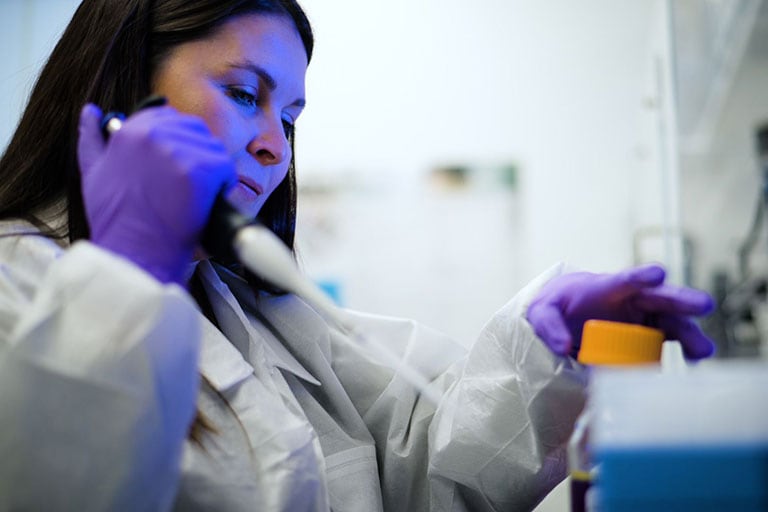
LambdaVision CEO Nicole Wagner purifying the protein bacteriorhodopsin for the production of artificial retinas.
Media Credit: LambdaVision
Additionally, ISS testing allowed LambdaVision and Space Tango to validate the fluidics in their production system and improve automation, fault detection, uptime, and imaging capabilities. LambdaVision has also made significant strides toward establishing good manufacturing practices, standardizing procedures, and developing environmental monitoring and contamination mitigation protocols.
The startup’s next ISS investigation is scheduled to launch later this year. The mission will focus on increasing the number of films produced to further explore production parameters. The team will continue advancing the hardware and analytical methods for improved quality.
“Through our flight projects on the ISS, we’ve taken a lot of the risk out of demonstrating the value of manufacturing in space,” Wagner said. “We’re now thinking about how we scale in orbit and what’s next as we transition from the ISS to other platforms in the future.” LambdaVision recently reserved space on the Starlab commercial space station, currently in development, to continue space-based production of its artificial retinas after ISS retirement.
LambdaVision’s ISS research has also allowed the startup to attract additional funding. So far, the company has leveraged capital and support from NASA and the ISS National Lab to raise around $23 million to further develop its technology. Wagner hopes to begin preclinical trials in late 2027 or early 2028 and then progress to the FDA review process.
The advances that LambdaVision and Space Tango have made also extend beyond the production of artificial retinas. “We are pioneering solutions in space that will pave the way for many future industries,” Wagner said.
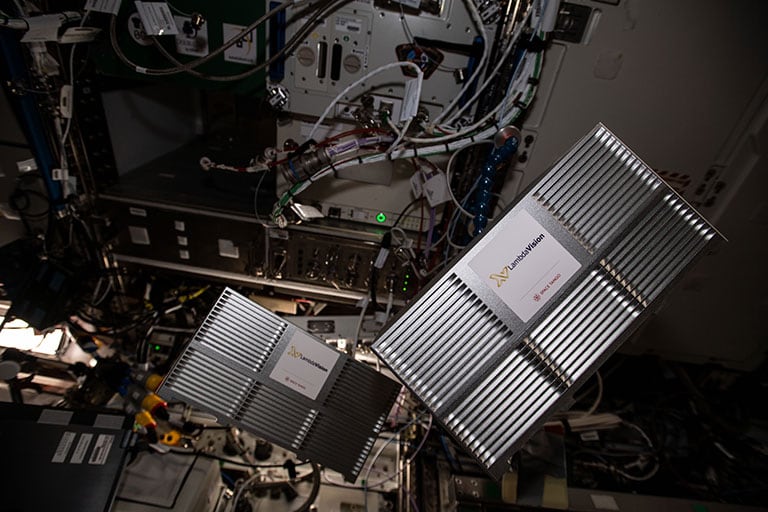
LambdaVision’s artificial retina production system in a CubeLab on the ISS.
Media Credit: NASA
At the end of the day, though, Greco says it’s really about helping people. “We’re excited about what the next couple of years will bring as we advance our production methods, perform further experiments in microgravity, and collect more data on the efficacy of our artificial retina. But to be able to someday help restore vision in a person experiencing blindness—that would be an amazing outcome.”
Want to share this feature with a colleague or save it for later? Download a PDF version of this feature.

Amelia Williamson Smith, Upward Managing Editor
Letter From the Editor
Ten years ago, I sat at my computer brainstorming how best to share the amazing science enabled by the ISS National Lab. It was then that Upward was born.
We chose the magazine’s name for many reasons. We look upward to the ISS—our nation’s only orbiting laboratory—to solve some of humanity’s greatest challenges and to create things not possible on the ground. We endeavor upward in our pursuit of advancing science and technology in space to improve life on Earth. And we raise our aspirations upward beyond the ISS to a future where commercial space stations operate in a robust low Earth orbit (LEO) economy.
I hope you enjoy this 10th anniversary edition, in which we highlight how the idea of manufacturing products in space for use on Earth is no longer confined to science fiction. Studies enabled by the ISS National Lab over the past decade have shown that not only is this vision possible—it’s right around the corner.
As we look ahead to this exciting future, we also take a moment to look back on the road that brought us here. The ISS has served as an invaluable testbed for in-orbit production. It’s a place where companies can validate systems and facilities, refine and optimize production processes, and uncover ways to scale their manufacturing on future LEO platforms. It remains a critical step toward the next industrial revolution—in space.
I am so proud of how far Upward has come over the last 10 years and all the stories we’ve shared that showcase the value of conducting research and technology development in space. I am thankful for our amazing team that helped bring the idea of the magazine to life. And I am grateful to you, our readers, for joining us on this incredible journey of discovery. We hope you continue to follow along as we forever strive upward.