
« Back to Annual Report for Fiscal Year 2025
LEO Economic Development: Demand
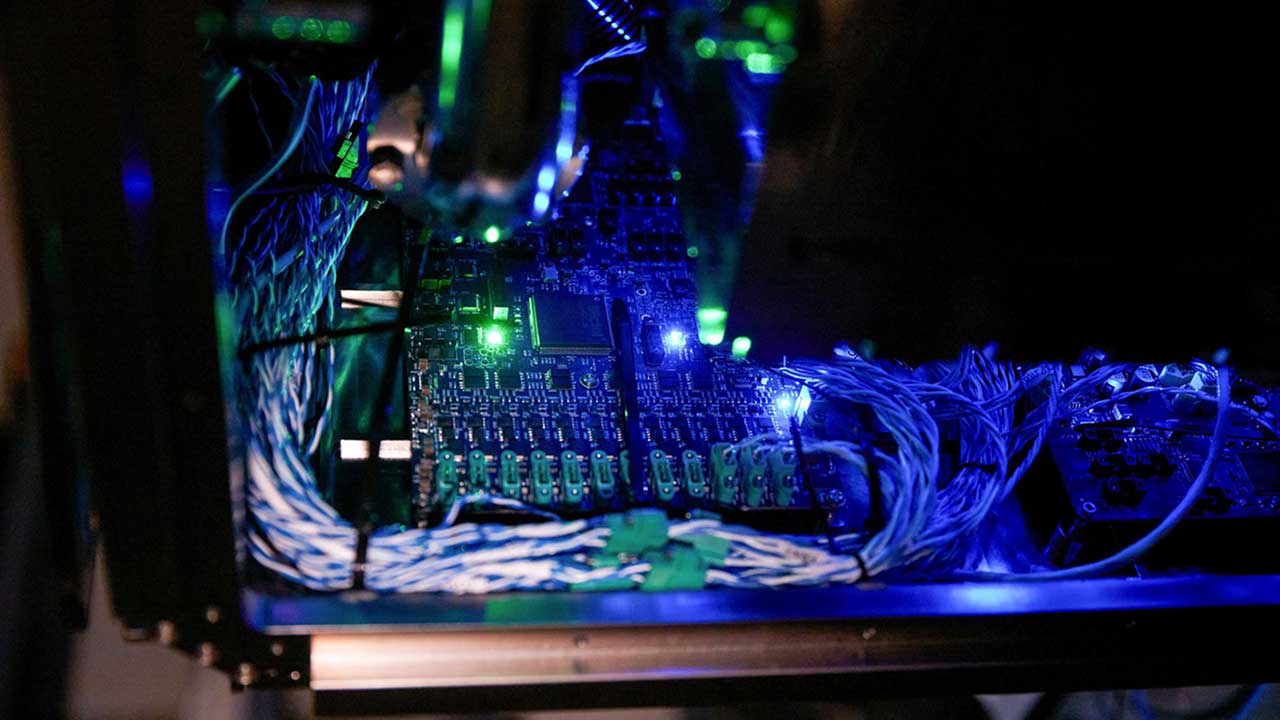
The Turbine Superalloy Casting Module (Turbine SCM) is a commercial in-space manufacturing device designed to provide proof-of-principle for polycrystal superalloy part manufacturing in microgravityThe condition of perceived weightlessness created when an object is in free fall, for example when an object is in orbital motion. Microgravity alters many observable phenomena within the physical and life sciences, allowing scientists to study things in ways not possible on Earth. The International Space Station provides access to a persistent microgravity environment. for terrestrial use.
Media Credit: Redwire Space
In FY25, the ISSInternational Space Station National Lab continued to build demand for space-based R&D among diverse users, helping to establish a robust and sustainable LEO(Abbreviation: LEO) The orbit around the Earth that extends up to an altitude of 2,000 km (1,200 miles) from Earth’s surface. The International Space Station’s orbit is in LEO, at an altitude of approximately 250 miles. economy. In particular, demand remained strong among commercial entities, demonstrating the value private industry finds in conducting research in space. However, resource constraints led to the cancellation of several planned solicitations (see Appendix A) and a pause in Resource Request Forms (RRFs) that enable customer access to facilities Commercial Service Providers own and operate on the ISS.
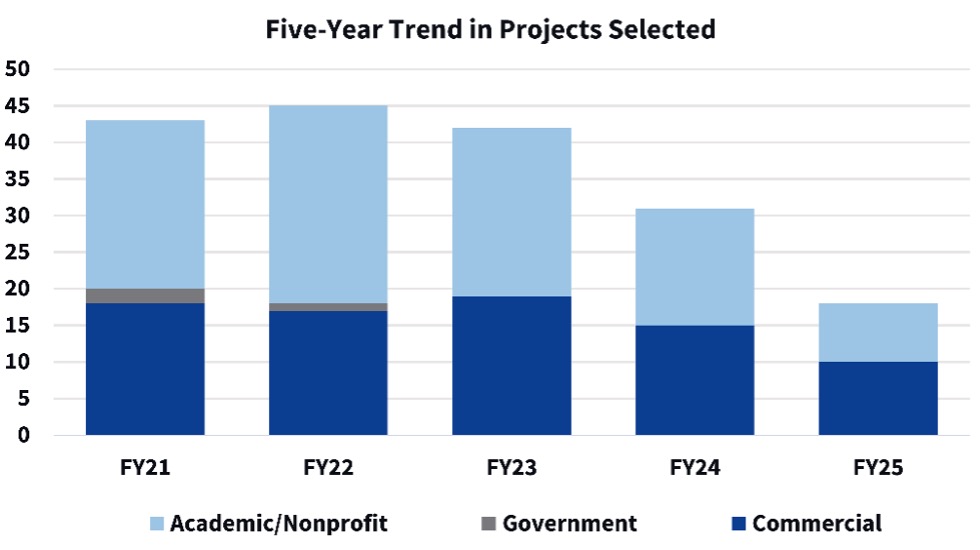
- CASIS(Abbreviation: CASIS™) The nonprofit organization that manages the ISS National Lab, which receives at least 50 percent of the U.S. research allocation on the International Space Station to facilitate research that benefits humanity (NASA manages the other 50% and focuses on research for space exploration purposes). selected 18 new projects (a little less than half as many as last year) through a variety of solicitations in strategic focus areas. For a full list of all selected ISS National Lab-sponsored projects, see the ISS National Lab Project Pipeline.
- This year, more than $10 million in external, non-NASA funding (down nearly 60% from last year due to the selection of fewer projects) was committed to support ISS National Lab-sponsored R&D projects, bringing the total amount committed to date to more than $325 million.
- CASIS funding for newly selected projects was matched 2.5:1 by committed funding from non-NASA, third-party entities, and the institutions themselves. Nearly two-thirds of the external funding committed this year was from private-sector organizations.
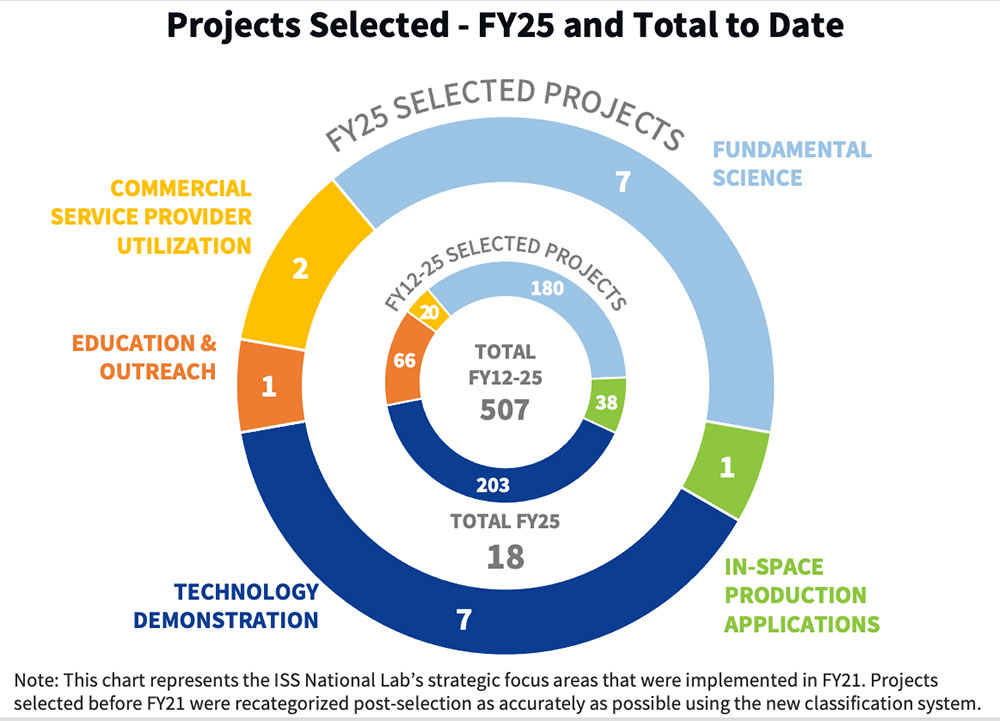
- Of the projects selected in FY25, nearly three-fourths were from new-to-space users, and more than half were from commercial entities.
- Examples of selected projects from new-to-space users:
- RedPoint Oncology will use tumor organoids to test antibody-drug conjugates, a new class of drugs targeting cancers resistant to conventional treatments. This project was selected through the Technology in Space PrizeA prize that provides grant funding for business startups participating in the MassChallenge startup accelerator program to conduct innovative research and technology development utilizing the ISS National Lab. The prize is funded by the Center for the Advancement of Science in Space, which manages the ISS National Lab, and Boeing., funded by CASIS and Boeing in partnership with MassChallenge.
- SQUID3Space will test a new thermal control system for satellites that can be easily adjusted using software to manage heat in changing orbits and mission environments.
- The University of Kentucky will examine how alloys melt and flow in microgravity, which is important for applications that involve joining two metals in space, such as in-orbit spacecraft repair or assembly. This investigation is funded by NSF.
- Examples of selected projects from return users:
- Rensselaer Polytechnic Institute will expand on prior research studying protein solution flow and clumping to improve pharmaceutical manufacturing processes. This project is funded by NSF.
- Skycorp Incorporated will validate a 100-terabyte-class computing server in space, measuring wear and tear on the server’s storage devices and testing software in the harsh space conditions.
“One way that NSF promotes scientific and technological advances is by providing research infrastructure beyond the capabilities of a single investigator or institution. The NSF-CASIS partnership to conduct microgravity experiments on the ISS represents the ultimate example of exceptional infrastructure—a laboratory that is, quite literally, beyond this world.”
– Sachin Velankar, NSF Program Director
CASIS continued its multi-year partnerships with the U.S. National Science Foundation and the National Institutes of Health (NIH) through solicitations leveraging the ISS National Lab to advance fundamental science. This year, CASIS also partnered with global investors Cook Inlet Region, Inc. (CIRI), E2MC Ventures, and Stellar Ventures on the inaugural Orbital Edge Accelerator program solicitation. The program aims to bridge the gap between early-stage companies and innovation in space.
- CASIS issued two joint solicitations with NSF, one on tissue engineering and one on the physical sciences area of transport phenomena, and three projects were selected through each.
- As part of the ISS National Lab’s renewed partnership with NIH’s National Center for Advancing Translational Science (NCATS) on the Tissue Chips in Space initiative, NIH awarded grants for six projects to improve the development of tissue chips as model systems to study, diagnose, treat, and prevent aging-related functional decline and age-related diseases.
- CASIS received more than 150 applications for the Orbital Edge Accelerator solicitation, and six startups were selected for the initial cohort: Kall Morris Inc, Magma Space, Melagen Labs, Olfera, Quantum Qool, and Raptor Dynamix.
- Due to resource constraints in FY25, the ISS National Lab was unable to issue the Technology in Space Prizesolicitation and select projects through the Igniting Innovation solicitation. The Technology in Space Prize, which CASIS has co-funded with Boeing for more than a decade, supports startups through the MassChallenge Accelerator program. Igniting Innovation, issued in collaboration with NASA’s Division of Biological and Physical Sciences, sought research addressing some of the most pressing diseases of our time. Prior to its cancellation, the Igniting Innovation solicitation had a robust response, with 73 concept submissions and 11 proposals.
In FY25, the ISS National Lab continued its legacy of bringing together thought leaders and subject matter experts from industry, academia, and government to inform and advance strategic focus areas.
- Prior to the 2024 American Society for Gravitational and Space Research (ASGSR) conference, the ISS National Lab hosted a workshop on biomanufacturing and advanced materials.
- In collaboration with the Air Force Office of Scientific Research, the ISS National Lab organized a symposium highlighting ISS capabilities for biological and physical sciences R&D and capabilities on future commercial space platforms.
- The ISS National Lab organized a webinar with the Cancer Prevention & Research Institute of Texas (CPRIT) on accelerated cancer models in space.