
« Back to Annual Report for Fiscal Year 2025
R&D Progress and Successes
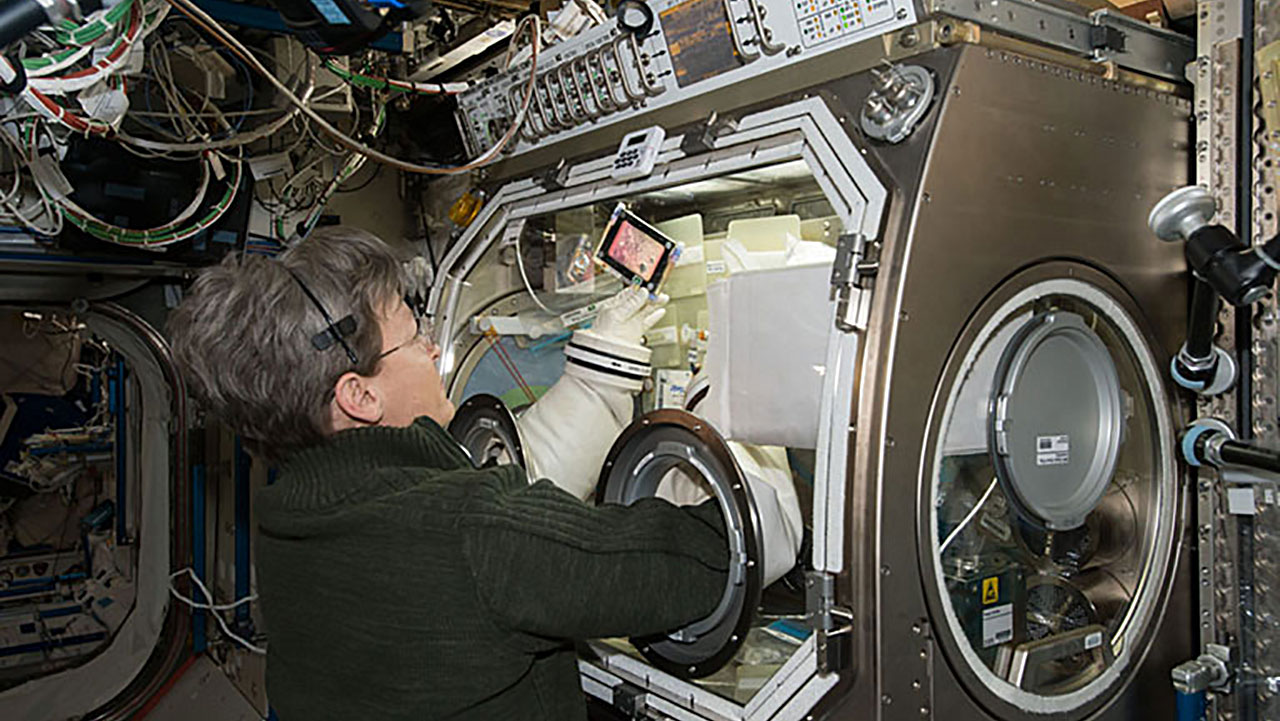
NASANational Aeronautics and Space Administration astronaut Peggy Whitson during MicrogravityThe condition of perceived weightlessness created when an object is in free fall, for example when an object is in orbital motion. Microgravity alters many observable phenomena within the physical and life sciences, allowing scientists to study things in ways not possible on Earth. The International Space Station provides access to a persistent microgravity environment. Expanded Stem Cells (MESC) clean up, in the Microgravity Science Glovebox (MSG). Microgravity Expanded Stem Cells observes cell growth and morphological characteristics in microgravity and analyzes gene expression profiles of cells grown in microgravity.
Media Credit: NASA
FY25 marked a record-breaking year of results from ISSInternational Space Station National Lab-sponsored research, with the highest number of publications, patents, and products in a single fiscal year. These achievements highlight the growing impact of space-based R&D on the scientific community and commercial development.
A total of 76 peer-reviewed articles were published (citations in Appendix C)—up from last year’s record of 51. Of this year’s publications, 15 are in top-tier journals, underscoring the significance of the findings and their impact on national and scientific priorities. This brings the cumulative total to nearly 630 peer-reviewed publications, more than 22% of which appeared in top-tier journals. Examples of FY25 publications include:
- University of California, San Diego researchers published results from four ISS National Lab-sponsored flights that affirm the use of stem cells in space as an accelerated model for the study and treatment of aging and diseases like cancer.
- Mayo Clinic researchers published results on critical “master regulator” genes activated in microgravity that could be used to identify health risks and develop preventative measures to ensure astronaut safety on future long-duration missions.
- Arizona State University researchers published findings on a new method to improve water treatment using UV light.
- University of Alabama Birmingham researchers published results that could guide the development of specialized ceramics for spacecraft design, insulation, and lightweight building materials for use on Earth.
- University of California, Berkley researchers published findings on an enhanced hydrogen sensor that would be valuable in factories and other industrial settings where hydrogen must be carefully monitored.
- The Alpha Magnetic Spectrometer research team published measurements of two types of lithium atoms in cosmic rays, showing that these atoms are created when cosmic rays collide with space dust rather than originating from the Big Bang as previously assumed.
“The ISS National Lab has been instrumental in transforming low Earth orbit(Abbreviation: LEO) The orbit around the Earth that extends up to an altitude of 2,000 km (1,200 miles) from Earth’s surface. The International Space Station’s orbit is in LEO, at an altitude of approximately 250 miles. from a research frontier into an economic engine, and nowhere is that transformation more evident than in Texas. We’re now seeing the return on our investments in this ecosystem through new companies, products, and technologies that benefit every American. The ISS National Lab continues to showcase the power of public-private partnerships and the advancement of R&D in microgravity.”
– Brian Freedman, President of the Bay Area Houston Economic Partnership
Thirteen patents related to ISS National Lab-sponsored research were identified this year. Examples include:
- Orbit Fab was granted a patent for its system to transfer and store fuel or propellants in space to refuel spacecraft and satellites.
- MicroQuin filed a patent for a new peptide therapeutic to treat cancer.
- Encapsulate was granted a patent for the nCapsule biochip, a tumor-on-a-chip system that allows cancer cells to grow in a 3D environment that more closely resembles tumor growth in the body. The startup filed a second patent for nVasive, a novel method for predicting the metastatic potential of cancer cells recovered from patient biopsies.
- Orbital Sidekick was granted a patent for a space-based hyperspectral imaging system and method to detect and identify leaks in underground oil and gas pipelines.
- The New Jersey Institute of Technology filed a patent for a method and apparatus to fabricate complex reflective structures for optical applications like lasers.
- Researchers at the Massachusetts Institute of Technology filed a patent for a novel spacecraft material with integrated sensors capable of detecting impacts, electrical charge, temperature fluctuations, and radiation.
- Oregon State University was granted a patent on a cardiac tissue chipA tissue chip, or organ-on-a-chip or microphysiological system, is a small engineered device containing human cells and growth media to model the structure and function of human tissues and/or organs. Using tissue chips in microgravity, researchers can study the mechanisms behind disease and test new treatments for patients on Earth. The National Institutes of Health (NIH) has a multiyear partnership with the ISS National Laboratory® to fund tissue chip research on the space station. platform that mimics human cardiac tissue structures. The university filed two additional patents: one on bio-compatible scaffolds to support tissues and organoids, and one on systems, methods, and devices related to microstructure characterization of 3D printed tissues.
Six products and services related to ISS National Lab-sponsored research were identified in FY25:
- Sen is providing 24/7 views of Earth from the ISS through a live 4K video, expanding the ability to experience the beauty of our planet from space.
- miniPCR added commercial content to its free online learning tool that immerses students in a virtual ISS environment during a lab activity.
- Orbital Sidekick developed two products: SIGMA Monitor is an integrated platform for global monitoring that captures and analyzes hyperspectral data to provide real-time insight reporting. SIGMA Data enables users to send the company’s fleet of satellites to collect hyperspectral imaging on-demand and receive calibrated data for analysis.
- Orbit Fab began delivering hydrazine to satellites in geosynchronous orbit and signed a contract with the U.S. Space Force to deliver fuel to satellites.
- VRCORE Education offers a virtual reality lesson that allows students to tour the ISS and conduct experiments to learn how microgravity research advances science and engineering.
This year also included two important successes related to pharmaceutical research through the ISS National Lab:
- Earlier this year, the U.S. Food and Drug Administration (FDA) approved a new injectable form of a cancer therapeutic from Merck & Co. that combines the active ingredient in Keytruda® with an enzyme to treat a wide range of solid tumors. Previous research on the ISS by Merck explored the effects of microgravity on the production of highly uniform protein crystals with properties that would allow its Keytruda® cancer therapeutic to be given as an injection instead of a lengthy IV infusion delivered in a clinical setting.
- Researchers from UCSD’s Sanford Stem Cell Institute discovered that an enzyme linked to cancer spread was activated during spaceflight and tested therapies that halt the enzyme’s activity. One of these drugs was recently approved by the FDA to start clinical trials.
“Our time onboard the ISS gave us the critical data and validation to strengthen our precision oncology technology and accelerate its path to market. Microgravity testing results directly informed several patent applications and helped refine our cancer-cell analysis platform, underscoring its potential for truly personalized medicine and paving the way for our next-generation biochips aimed at predicting metastasis.”
– Armin Rad, CEO and President of Encapsulate Inc
Additionally, in FY25, the ISS National Lab published three issues of Upward® magazine, highlighting successful results from ISS National Lab-sponsored R&D:
- Issue 7.3 detailed MicroQuin’s research that could lead to a way to treat all types of cancer, Axonis’ brain organoid study testing a new treatment for neurological conditions, and AstroRad’s innovative radiation shielding vest for astronauts.
- Issue 8.1 showcased Oculogenex’s research to treat macular degeneration, Eascra Biotech’s in-space manufacturing of nanomaterials to treat disease, and Emory University’s heart cell studies to advance regenerative heart therapies.
- Issue 8.2 highlighted Spatiam’s technology for interplanetary Internet, Encapsulate’s space-grown tumors that could lead to personalized cancer treatment, and how the Genes in Space™ student research program is shaping the workforce of tomorrow.
“MicroQuin’s ISS National Lab research revealed cancer cells depend on regulating their chaotic intracellular environment (ICE) to survive and spread. This discovery extended beyond cancer, as ICE dysregulation underlies several diseases and injuries. Using these insights, MicroQuin developed targeted therapies for cancer, Parkinson’s, Alzheimer’s, TBI, and viral infections. The ISS National Lab has been indispensable, allowing us to observe cellular mechanisms impossible to study on Earth and accelerating our path from basic science to transformative treatments.”
– Scott Robinson, Founder and CEO of MicroQuin