Case Study
Advancing Artificial Retinas
Microgravity improves production of artificial retina to restore vision
ISS NATIONAL LAB OPPORTUNITY
In space, the reduction in gravity-driven forces enables the production of artificial retinas with much more uniform protein layers, improving quality and reducing waste.
LambdaVision developed an artificial retina to restore vision in patients with blindness from macular degeneration. The company creates thin films made of hundreds of layers of a light-sensitive protein, and small, oval-shaped artificial retinas are punched out of the film. During manufacturing on Earth, sedimentation and buoyancy-driven convection cause inconsistencies in the layers, which can render parts of the film unusable. In space, these gravity-driven forces are greatly reduced, making it the ideal environment for manufacturing the films. LambdaVision has conducted nine ISSInternational Space Station investigations to advance an automated production system, developed in collaboration with ISS National Lab Commercial Service ProviderImplementation Partners that own and operate commercial facilities for the support of research on the ISS or are developing future facilities. Space Tango, to produce artificial retinas in space.
Industries:
Ophthalmology,
Biotechnology,
Pharmaceutical
Strategic Focus Area:
In-Space Production Applications(Abbreviation: InSPA) InSPA is an applied research and development program sponsored by NASA and the ISS National Lab aimed at demonstrating space-based manufacturing and production activities by using the unique space environment to develop, test, or mature products and processes that could have an economic impact.
Research Area:
Advanced Materials
Institution:
LambdaVision
IMPACTFUL OUTCOME
The space-made artificial retinas had better homogeneity, optical performance, and biocompatibility than those produced on Earth, and the manufacturing process required less raw material.
Leveraging microgravityThe condition of perceived weightlessness created when an object is in free fall, for example when an object is in orbital motion. Microgravity alters many observable phenomena within the physical and life sciences, allowing scientists to study things in ways not possible on Earth. The International Space Station provides access to a persistent microgravity environment., LambdaVision has produced four 50-layer films and six 200-layer films with a precision that is difficult to achieve on the ground. The films manufactured in space were of higher quality, more stable, and more reproducible. ISS testing also allowed LambdaVision and Space Tango to validate the fluidics in their production system and improve automation, fault detection, and imaging capabilities. In addition, the space station studies have helped LambdaVision make significant progress toward establishing good manufacturing practices, standardized procedures, and protocols for environmental monitoring. LambdaVision’s ISS research has also helped attract additional funding, and the startup has raised around $23 million to further develop its technology.

INVESTIGATOR
Nicole Wagner
CEO, LambdaVision
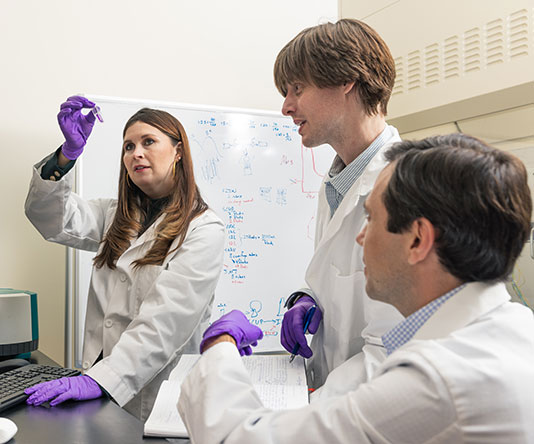
LambdaVision CEO Nicole Wagner, Lead Engineer Daniel Sylva, and CSO Jordan Greco refining their research strategy for space-based production of the company's artificial retinas.
Media Credit: Juan Patino Photography
Through our flight projects on the ISS, we’ve taken a lot of the risk out of demonstrating the value of manufacturing in space. We’re now thinking about how we scale in orbit and what’s next as we transition from the ISS to other platforms in the future.
– Nicole Wagner, LambdaVision
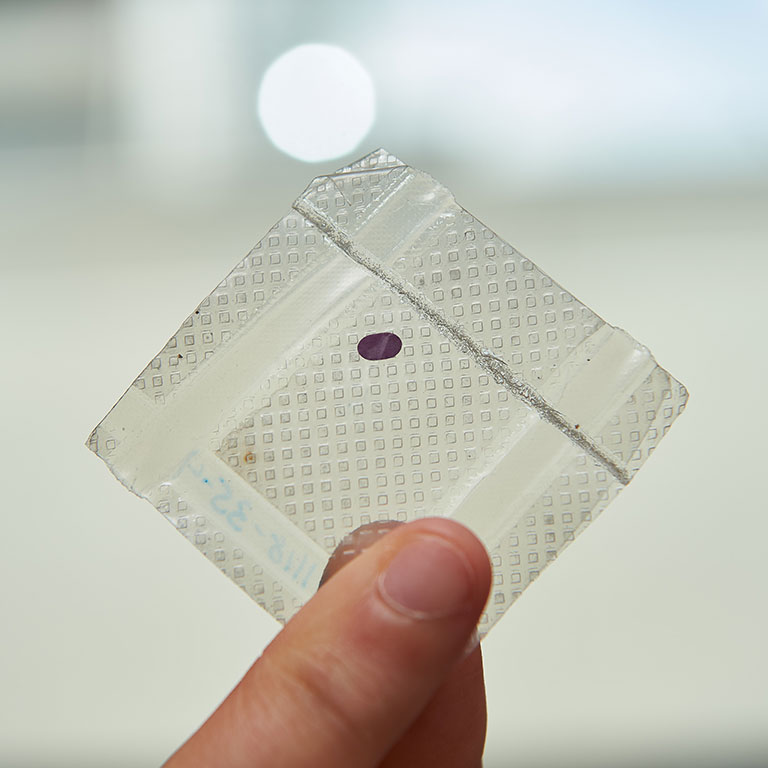
LambdaVision’s protein-based artificial retina, the small purple dot, is about the size of a paper hole punch.
Media Credit: Peter Morenus/UConn Photo
APPLICATION
LambdaVision’s artificial retina could restore meaningful vision to patients with age-related macular degeneration and the rare disorder retinitis pigmentosa.
Age-related macular degeneration affects nearly 20 million people in the U.S. over age 40. The condition causes patients to lose central vision, making it nearly impossible to recognize faces and perform daily tasks like driving and reading. Retinitis pigmentosa, a disorder affecting about one in 4,000 people, causes tunnel vision and eventual blindness, with vision loss starting as early as age 10. These conditions currently have no cure, and LambdaVision hopes its artificial retina could someday provide a solution for patients. The company aims to begin preclinical trials in late 2027 or early 2028.
This content is abridged from an article originally published in Upward,
official magazine of the ISS National Lab.