Case Study
Harnessing Microbes for Space Manufacturing
ISS research informs the design of microbial manufacturing systems for space
ISS NATIONAL LAB OPPORTUNITY
The ISSInternational Space Station provides a unique environment to study how microgravityThe condition of perceived weightlessness created when an object is in free fall, for example when an object is in orbital motion. Microgravity alters many observable phenomena within the physical and life sciences, allowing scientists to study things in ways not possible on Earth. The International Space Station provides access to a persistent microgravity environment. alters microbial metabolism and material production.
To support future space missions, researchers are exploring whether microbes can serve as miniature factories that produce materials, medicines, and other resources on demand. An investigation led by the U.S. Naval Research Laboratory leveraged the ISS National Laboratory® to test whether engineered E. coli bacteria could reliably produce melanin, a pigment that absorbs radiation and may help protect astronauts and equipment from space radiation. The investigation examined how microgravity affects microbial growth, nutrient transport, and melanin production in space.
Industries:
Biotechnology, Advanced Materials
Strategic Focus Area:
Fundamental Science
Research Area:
Microbiology & Biomanufacturing
Institution:
U.S. Naval Research Laboratory
IMPACTFUL OUTCOME
The investigation revealed that successful manufacturing with microbes in space will require systems designed specifically for microgravity.
Although the engineered bacteria could still produce melanin, researchers found that microgravity made it harder for cells to absorb nutrients and function normally. As a result, the microbes shifted energy away from production and toward survival. Chemical analyses showed that much of the material needed to make melanin remained unused outside the cells after spaceflight. The findings suggest future space manufacturing systems may need bioreactors that improve nutrient flow and help microbes stay productive in microgravity. The study also identified fungi as promising candidates for space-based production, as fungal samples continued to produce melanin after exposure to the ISS environment.

INVESTIGATORS
Zheng Wang
Research Biologist, U.S. Naval Research Laboratory
Tiffany Hennessa
Research Biologist, U.S. Naval Research Laboratory
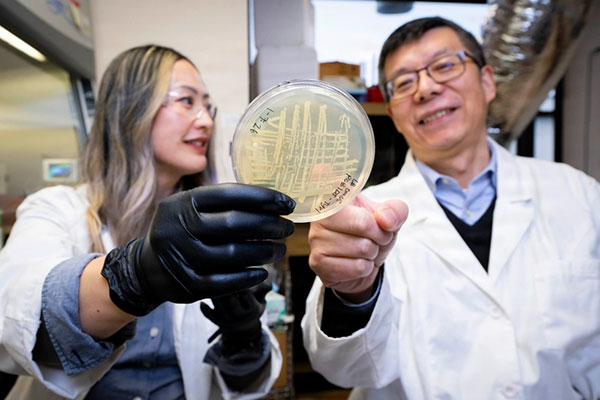
Tiffany Hennessa (left), U.S. Naval Research Laboratory (NRL) research biologist, and Zheng Wang, NRL research biologist, analyze a microbial sample in Washington, D.C. Scientists at NRL sent microbial samples to the ISS to investigate how microgravity affects microbial metabolism and biomaterial production.
Media Credit: Sarah Peterson, U.S. Navy
“Our long-term goal is to make materials where they’re needed, in space, rather than transporting everything from Earth.
– Zheng Wang, U.S. Naval Research Laboratory
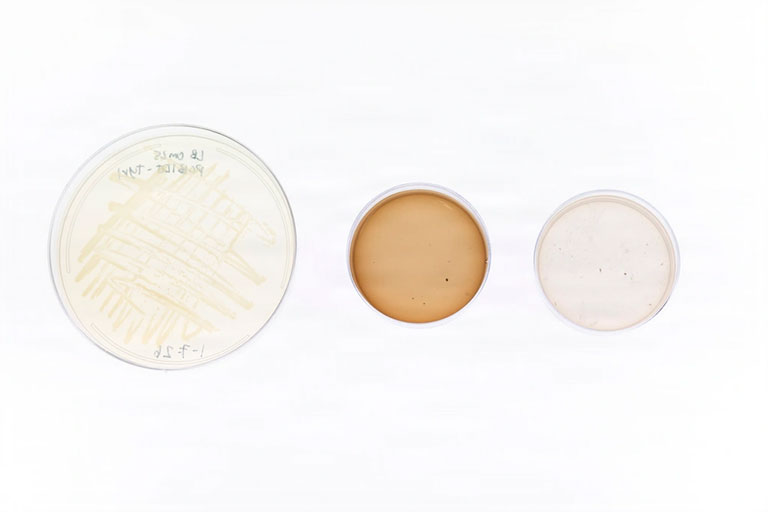
Microbial samples for the experiment sit on display in Washington, D.C.
Media Credit: Sarah Peterson, U.S. Navy
APPLICATION
The findings could help researchers design more reliable biological manufacturing systems for future Moon and Mars missions.
Future long-duration missions may depend on microbes to produce materials such as radiation-shielding compounds, food ingredients, medicines, and biomaterials on demand. This investigation showed that successful space biomanufacturing will require more than genetic engineering alone. Researchers may also need to develop specialized bioreactors that actively circulate nutrients, manage cellular stress, and compensate for the absence of gravity. Beyond space exploration, insights into how microbes respond to stress, nutrient limitations, and extreme environments may help researchers engineer more resilient biological systems for biotechnology and advanced materials production on Earth and in space.
This content is abridged from an article originally published in Upward,
official magazine of the ISS National Lab.