
A New Spin on the adidas World Cup Ball
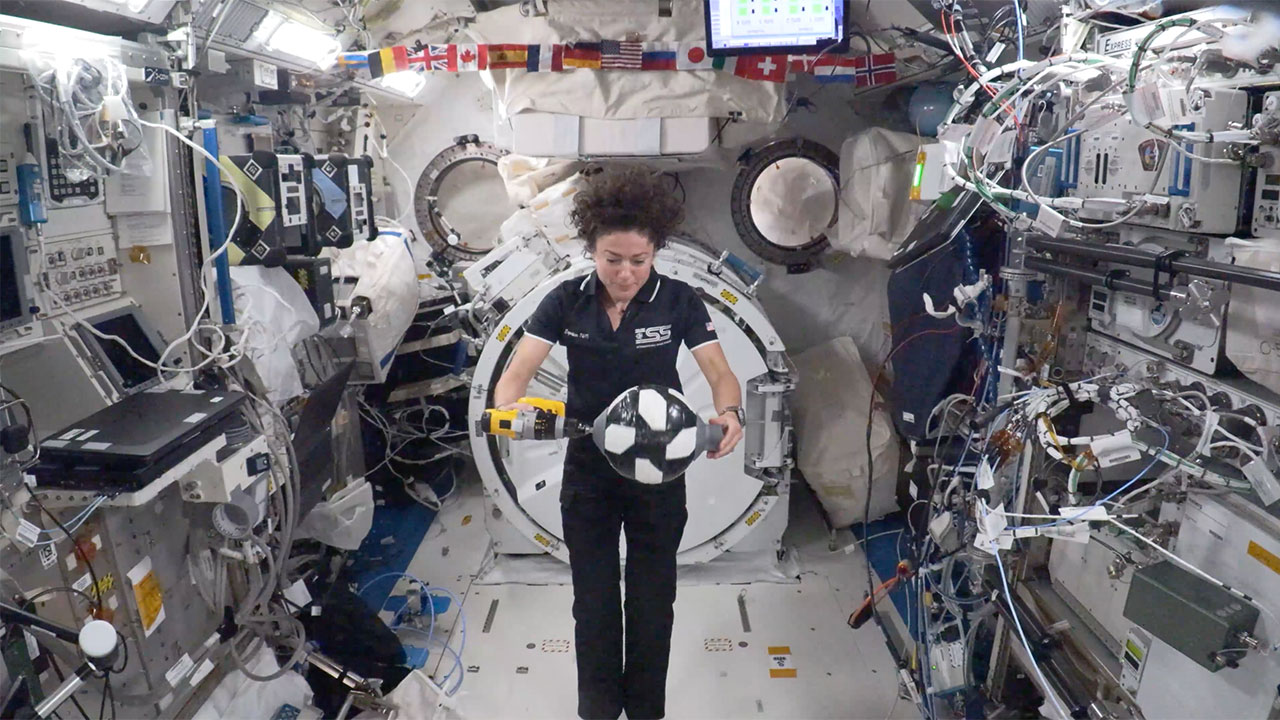
The adidas experiment examining the rotational stability of the company’s soccer ball on the ISS in 2019.
Media Credit: NASA
July 14, 2026 • By Ryan Reeves, ISS National Lab Deputy Chief Scientist
This summer, attention across the globe has been focused on the world’s most popular sport and the ultimate competition: the 2026 FIFA World Cup. The last World Cup finals in 2022 drew more than a billion viewers worldwide. The 2026 World Cup is being hosted by the United States, Canada, and Mexico. It has been a very exciting tournament so far. However, fans may notice something interesting if they closely watch the official ball of the World Cup, the adidas Trionda. As the ball bends through the air, you may be able to detect a spin flip—physics that adidas first observed on the International Space Station (ISSInternational Space Station) seven years ago.
A Surprising Discovery
In 2019, the ISS National Laboratory® sponsored an adidas investigation on the rotation stability of soccer balls. On Earth, there is a limited time a ball can remain spinning in the air before gravity pulls it to the ground. But in the microgravityThe condition of perceived weightlessness created when an object is in free fall, for example when an object is in orbital motion. Microgravity alters many observable phenomena within the physical and life sciences, allowing scientists to study things in ways not possible on Earth. The International Space Station provides access to a persistent microgravity environment. environment of the ISS, researchers can study the rotation of balls for much longer periods of time. In July of 2019, multiple adidas soccer balls with different panel patterning launched to the ISS on SpaceX’s 18th Commercial Resupply Services mission(Abbreviation: CRS mission) A CRS mission is a cargo resupply mission contracted by NASA to deliver supplies and research to the International Space Station on commercial spacecraft as part of the CRS contract with three commercial companies. As part of CRS missions, experiments currently return to Earth on SpaceX Dragon spacecraft that splash down in the ocean. for NASANational Aeronautics and Space Administration.
Once onboard the ISS, the crew used a modified cup attached to a handheld drill to generate the rotation of the balls while cameras studied the rotation stability and aerodynamic properties such as drag. When the ball was allowed to spin for prolonged periods, as shown in the video below, adidas researchers were able to better study the rotational stability. However, they also observed something unexpected. Given enough time and the necessary spin rate, the balls displayed something best described as a spin flip, or a sudden change in the rotational axis.
Old Physics to New Technology
Scientists have been aware of the physics behind this spin flip for more than 150 years. It is a phenomenon known by several names, including the intermediate axis theorem, the tennis racket theorem, and the Dzhanibekov effect. The latter took its name from Soviet cosmonaut Vladimir Dzhanibekov, who unexpectedly observed the spin flip of a wing nut while in orbit in 1985. You can also see this spin flip phenomenon in action using a T-handle on the ISS in this YouTube short from the European Space Agency.
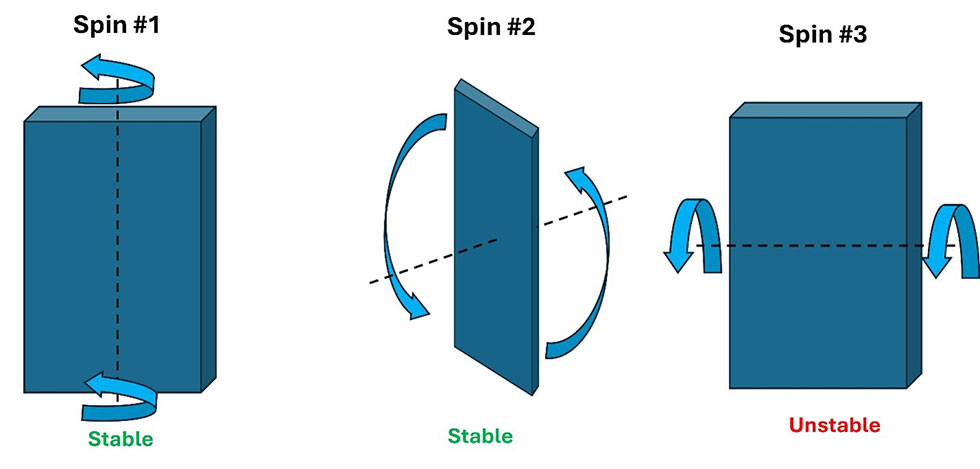
In a simplified manner, the spin flip happens when a rigid object is not symmetrical in mass across the three dimensions. In more technical terms, the phenomenon occurs when the object has three different moments of inertia. This can be seen on Earth depending on how you twirl an object like a cell phone or book (see the sidebar). Two of the axis rotations will be stable, but the rotation about the middle moment of inertia (intermediate axis) will be unstable. This presents as a spin flip in the T-handle on the ISS, while it presents as an extra twist in phone or book rotations on Earth.
But why then would any of this apply to a soccer ball? A ball or sphere is, by definition, symmetric across three axes, so none of this should apply. Manufacturers like adidas take great care to properly balance their soccer balls, including internal features opposite the valve to keep the center of mass at the center of the ball. Though a ball can have perfect static balance (i.e., no wobble), a subtle difference in mass balance is amplified with high enough spin rate and enough time to produce the spin flip. Since soccer balls are more symmetric and stable than flipping books, it took the prolonged observation possible in microgravity to see the effect clearly.
NASA worked with adidas to send up a second demonstration of this spin flip to the ISS for educational purposes. NASA astronaut Jessica Meir demonstrates and explains this phenomenon in more detail using adidas soccer balls.
At-Home Party Trick
Want to amaze the guests at your next party, impress your family, or generally try to show off how smart you are? Demonstrate the intermediate axis theorem at home with nothing more than a book.
- Hold the book parallel to the ground with the cover facing up, such that the top of the cover is in your left hand and the bottom of the cover in your right hand. Now gently toss and spin the book so that the cover rotates from face up to face down. Spin the book fast enough to allow it to rotate several times in the air. Notice that the top of the book always stays in your left hand. This is because the spin about the long axis of the book is stable.
- Now hold the book by the spine with the cover facing right. Spin the book end over end in the air. You will notice that the cover always faces the right. This spin about the short axis of the book is also stable.
- Lastly, hold the book in one hand parallel to the ground with the cover facing up, so that you are holding the bottom of the book and the spine of the book is facing left. Flip the book end over end in the air so that the cover rotates face up and down several times. Did you notice the book twist? As the book rotates, the spine switches back and forth from left to right. This is because you are now spinning the book about the intermediate axis, which is unstable, thereby causing an extra twist in the rotation.
This effect is even more noticeable when done with a tennis racket (hence the name “tennis racket theorem”). Now you can show off how smart you are to all your friends and family.
Translating the Unexpected Physics in Space to the Pitch
After observing this unexpected phenomenon, adidas went on to patent the design for a ball that is weighted specifically to produce the spin flip effect. While originally written in German, the patent is titled “Ball with weight elements to produce a Dzhanibekov effect” and is still pending in Germany at the time of writing.
The understanding of the physics needed to cause the spin flip effect gained through experiments on the ISS supported the development of the adidas Trionda ball in play at the 2026 World Cup.
Each ball has an electronics system sending data to referees during the match. The mass and balance of the ball had to be engineered precisely, accommodating for the electronics, so the impact and flight properties are consistent and indistinguishable from a standard top-level ball. The knowledge gained through the space experiment prepared adidas to manage the extra mass and balance implications of the electronic sensor system, ensuring that the “connected ball” for the tournament behaves like any other top-level adidas soccer ball.
Athletes and fans can rest easy knowing that the World Cup ball has been designed with full knowledge of the intermediate axis theorem, and a spin flip in a long kick won’t affect the trajectory. Due to the balance and symmetry of the Trionda, it would take very high spin rates and long flight times to see a spin flip. However, if anyone is able to make it happen, it will be the best footballers in the world competing this summer.
So, keep an eagle eye out for the spin flip on the ball as you watch the rest of the games this year.