
How ISS Research Is Shaping the Future of the LEO Economy
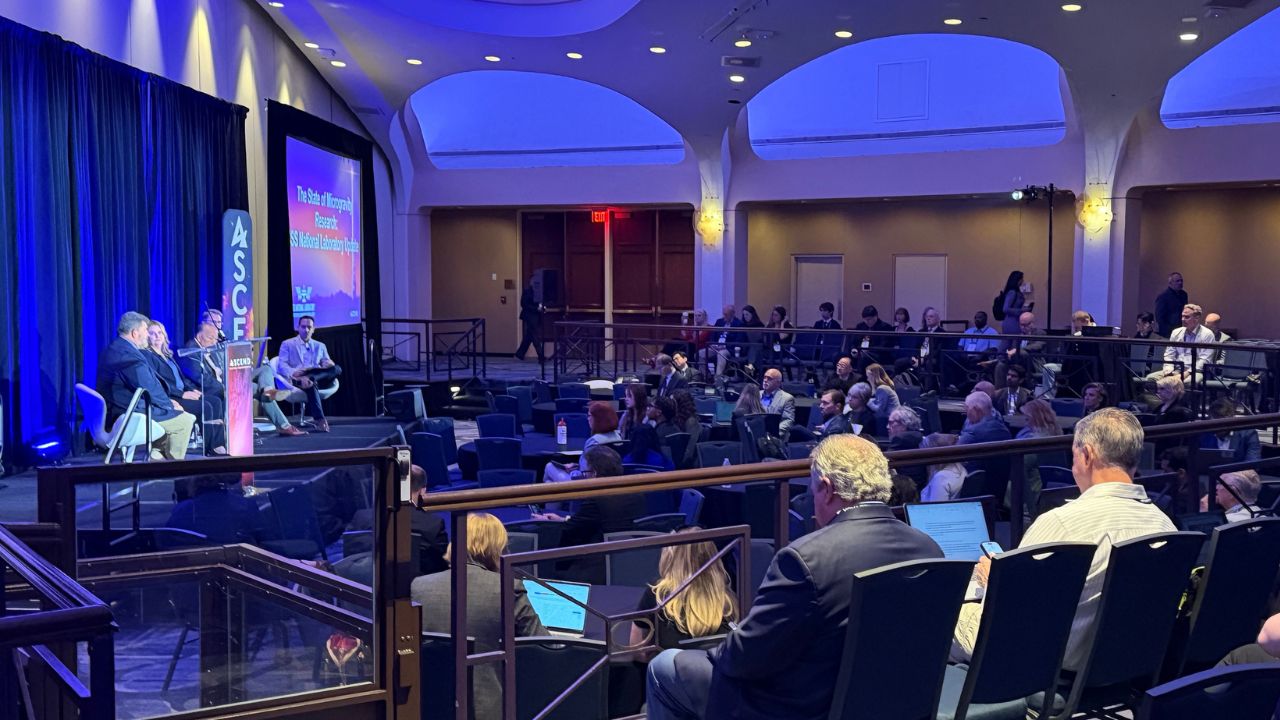
ISS National Lab track at ASCEND 2026 in Washington, D.C.
June 10, 2026 • By Amelia Williamson Smith, Sr. Manager, Scientific Communications & Content
This article is part of a series highlighting sessions from the ISSInternational Space Station National Lab track at the 2026 ASCEND conference in Washington, D.C. The ISS National Lab hosted a full day of programming highlighting advances in space-based R&D, how the ISS National Lab enables innovation in orbit, and the growing low Earth orbit(Abbreviation: LEO) The orbit around the Earth that extends up to an altitude of 2,000 km (1,200 miles) from Earth’s surface. The International Space Station’s orbit is in LEO, at an altitude of approximately 250 miles. economy.
Research conducted on the International Space Station (ISS) does not just advance science—it also provides value to the nation and fuels the low Earth orbit (LEO) economy. During a session at the 2026 ASCEND conference, leaders from the ISS National Laboratory® and NASANational Aeronautics and Space Administration discussed how outcomes from studies conducted on the ISS are driving progress in biomedical science, technology development, and materials science, while laying the foundation for a growing commercial marketplace in orbit.
“Through the auspices of having a continuous human presence in space, we have been able to transform our exploration of space into real world applications here on Earth,” said ISS National Lab Chief Scientific Officer Michael Roberts.
Space-based research has enabled scientists to develop better cell-based models to study the onset and progression of diseases and to grow protein crystals with novel structural features that improve the effectiveness, safety, and stability of therapeutics. Researchers have also leveraged microgravityThe condition of perceived weightlessness created when an object is in free fall, for example when an object is in orbital motion. Microgravity alters many observable phenomena within the physical and life sciences, allowing scientists to study things in ways not possible on Earth. The International Space Station provides access to a persistent microgravity environment. to advance the bioprinting of human tissues that could someday help alleviate Earth’s organ shortage. In addition, scientists have produced important new materials for use in space and on the ground. And engineers have validated hardware and technologies to support future space-based R&D and manufacturing.
“The whole idea was not to build a space station as a science project, but to build a space station to do science, and I think that’s really what we’ve achieved,” said Ray Lugo, CEO of the Center for the Advancement of Science in Space®, which manages the ISS National Lab.
Jennifer Buchli, NASA’s chief scientist for the ISS Program, noted the growing demand among commercial entities to utilize space for R&D. “We have companies who have done pioneering research on the ISS but are now looking to move into the next phase, and they’re bringing matching funding.”
Highlighting the ISS National Lab’s role as an honest broker, Roberts discussed the importance of working with academic researchers, industry leaders, and other government agencies to identify specific areas where space-based research can move the needle. “Space doesn’t make everything better, but it can offer innovation and pathways to discovery that are not possible here on Earth.”
The panel discussed how the ISS National Lab has evolved over time, transitioning from relying solely on government funding to engaging with venture capital firms that recognize the value of space in accelerating businesses, products, and services. “We’re now at a point that we have private capital coming in to fund [research] awards, and the government doesn’t have to spend [taxpayer] money,” said Francisco Cordova, COO for the ISS National Lab.
Looking to the future, NASA’s acting ISS Director Jacob Keaton stressed the importance of maintaining the valuable capabilities we’ve built over the past 25 years of living and working on the ISS. It’s not just the ability to operate a space station, he said, but also the international partnerships we’ve forged, the research community we’ve built, and the knowledge we’ve gained along the way. “We want to transition those lessons to the next generation of space stations.”
Together, the discussion underscored how the ISS has evolved from a government-led research platform into a catalyst for commercial innovation in orbit. As the space community prepares for the transition to privately operated space stations, panelists emphasized the importance of continuing to fully leverage the ISS as both a valuable national asset and a critical steppingstone toward a robust LEO economy.