
Antarctic Microbes Put Survival to the Test in Space
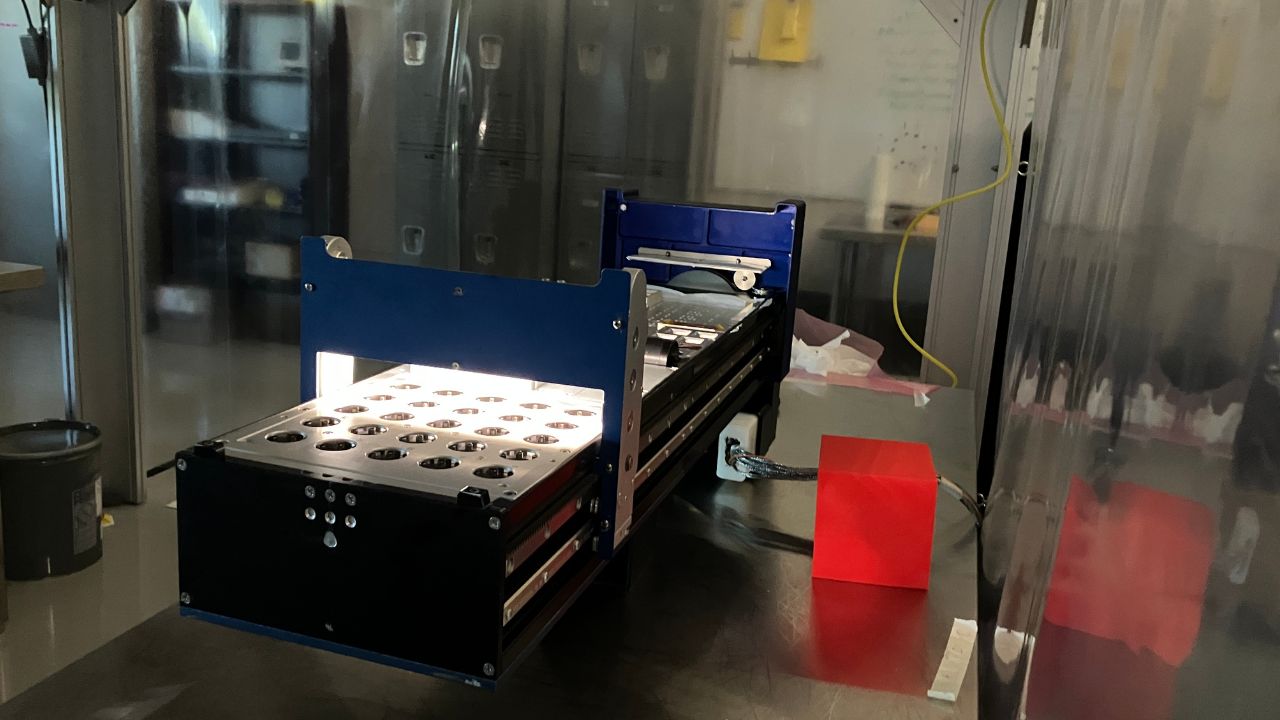
The POLARIS experiment undergoes ground-based testing ahead of integration with the MISSE Flight Facility outside the ISS.
Media Credit: Credit: Aegis Aerospace and the U.S. Government
ISS National Lab-enabled research studies how life withstands the space environment, informing space exploration and biomanufacturing
May 13, 2026
KENNEDY SPACE CENTER (FL), May 13, 2026 – An international team is sending microbes from Antarctica and Chile to the International Space Station (ISSInternational Space Station) to study how they withstand radiation and other spaceflight stressors. The ISS National Laboratory®-sponsored investigation will leverage the MISSE Flight FacilityThe Materials International Space Station Experiment Flight Facility is a hardware platform on the exterior of the ISS that provides exposure to the harsh space conditions for the accelerated testing of materials and technologies with important applications both in space and on Earth. This ISS National Lab commercial facility is owned and operated by Aegis Aerospace., a permanent platform mounted externally on the space station, to expose the organisms to space for approximately six months.
The Polar Organisms Launched for Astrobiology Research in Ionizing Space (POLARIS) project will study six extremophiles, microorganisms naturally equipped to endure some of Earth’s most unforgiving environments. Funded by the Air Force Office of Scientific Research (AFOSR), the project brings together the Department of Defense Space Test Program, the U.S. Air Force Academy, Aegis Aerospace, Radix‑Lucis, and Biociencia Fundación Científica y Cultural, in collaboration with the U.S. Embassy in Chile and AFOSR’s Southern Office of Aerospace Research and Development.
Previous ISS National Lab-sponsored research has shown that spaceflight alters how microbes grow and function. Building on this work, POLARIS will expose three types of bacteria and three types of archaea, a group of single-celled organisms distinct from bacteria and known for thriving in harsh environments. After the organisms return to Earth, researchers will analyze them for genetic, structural, and protein-level changes.
“Extremophiles have evolved remarkable ways to survive radiation, dryness, low oxygen, and other harsh conditions on Earth,” said the project’s principal investigator Jenny Blamey, scientific director at Fundación Científica y Cultural Biociencia and an associate professor at the Universidad de Santiago de Chile. “By exposing these organisms to space and bringing them back for analysis, we hope to learn more about how life survives in extreme environments and how those survival mechanisms could support future space exploration and industrial applications.”
By comparing space-exposed microbes with Earth-based controls, researchers aim to identify biological traits linked to radiation resistance and survival under stress. These insights could help scientists develop more resilient biological systems for space while advancing applications in pharmaceuticals, materials science, and other industries on Earth.
The research is scheduled to launch no sooner than May 13, 2026, on NASA’s SpaceX Commercial Resupply Services 34 mission from Cape Canaveral Space Force Station in Florida. The mission will carry more than 25 ISS National Lab-sponsored investigations to the space station.
These projects span a wide range of scientific disciplines and could help improve cancer therapeutics, develop new materials, and move new stem cell research toward clinical use.
For more information about the research launching on this mission, visit the SpaceX CRS-34 launch page at ISSNationalLab.org.
Download a high-resolution image for this release: SpaceX CRS-34
Media Contact: Amy Elkavich
Email: aelkavich@ISSNationalLab.org