
What a Spacefaring Arctic Microbe Reveals About Life in Alien Oceans
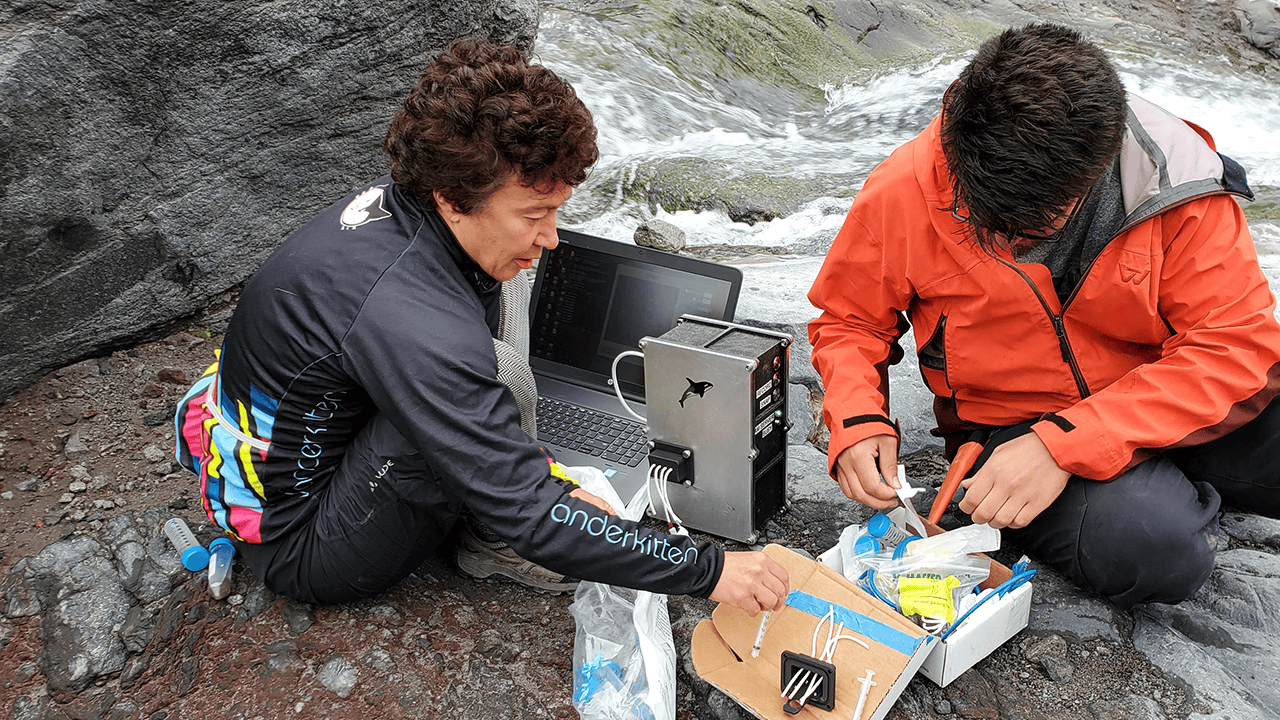
Before sending it to space, Jay Nadeau tested early versions of the holographic ELVIS microscope in harsh environments on Earth alongside student teams, including Carl Snyder, pictured at right.
Media Credit: Jay Nadeau
July 28, 2026 • By Stephenie Livingston, Senior Staff Writer
It lives in places where life should not exist. In the brine channels that thread through Arctic sea ice, it survives temperatures that would freeze most bacteria solid. Scientists have kept it at negative twenty degrees Celsius for eight months and watched it resume swimming the moment it thawed, as though nothing had happened—it may hold the record for low-temperature swimming among known bacteria. Colwellia psychrerythraea is, as organisms go, almost aggressively hard to kill.
Which makes what happened to it onboard the International Space Station (ISSInternational Space Station) in 2025 genuinely strange. The bacterium had everything it needed, afloat in nutrient-rich water at a temperature it could tolerate. Yet for weeks, it acted as if it were paralyzed and starving to death.
In a lab at Portland State University (PSU), physicist Jay Nadeau watched through a recorded feed and saw mostly nothing. She had spent a decade building versions of the microscope now orbiting Earth on the ISS, an instrument designed, ultimately, to search for life in the hidden oceans of distant moons. C. psychrerythraea was supposed to be the easy part. She had chosen it precisely because she trusted its resilience. Now she was beginning to wonder if it was even alive.
Then, one morning, three weeks after launch, a single cell appeared on the screen and began to swim. It moved through the instrument’s imaging volume in small, purposeful bursts, unmistakably alive.
Colored tracks trace Colwellia psychrerythraea bacteria swimming in footage captured with ELVIS, a new holographic microscope.
Video courtesy of Jay Nadeau
“It was really active and kind of sniffing around,” said Nadeau, a professor in the physics department at PSU.
The grainy footage lasted only minutes. On the ISS, where experiments are run by many agencies and partners, a first is hard to prove absolutely. But the instrument that captured it had just done something Nadeau says no microscope is known to have done before: watched bacteria move freely in three dimensions while in space.
The microscope, called the Extant Life Volumetric Imaging System, or ELVIS, was built for far stranger places than the ISS. The research team has its sights set on the hidden oceans believed to exist beneath the ice shells of Jupiter’s moon Europa and Saturn’s moon Enceladus. Scientists suspect these alien seas may harbor the ingredients for life but searching them poses an enormous technical challenge. Any spacecraft exploring such worlds would need to autonomously detect microscopic organisms, without astronauts nearby or real-time guidance from Earth.
ELVIS was designed as a prototype for exactly that task. Unlike a conventional microscope, which captures a single thin plane of focus at a time and requires mechanical adjustment to move through a sample, ELVIS is holographic. It records the interference pattern of light waves passing through an entire volume of liquid at once, creating a three-dimensional fingerprint of everything present. That recording can then be computationally refocused on any depth, after the fact, back on Earth. There are no motors or moving parts, and there is no waiting for commands that, on Saturn, would take around 80 minutes to arrive.
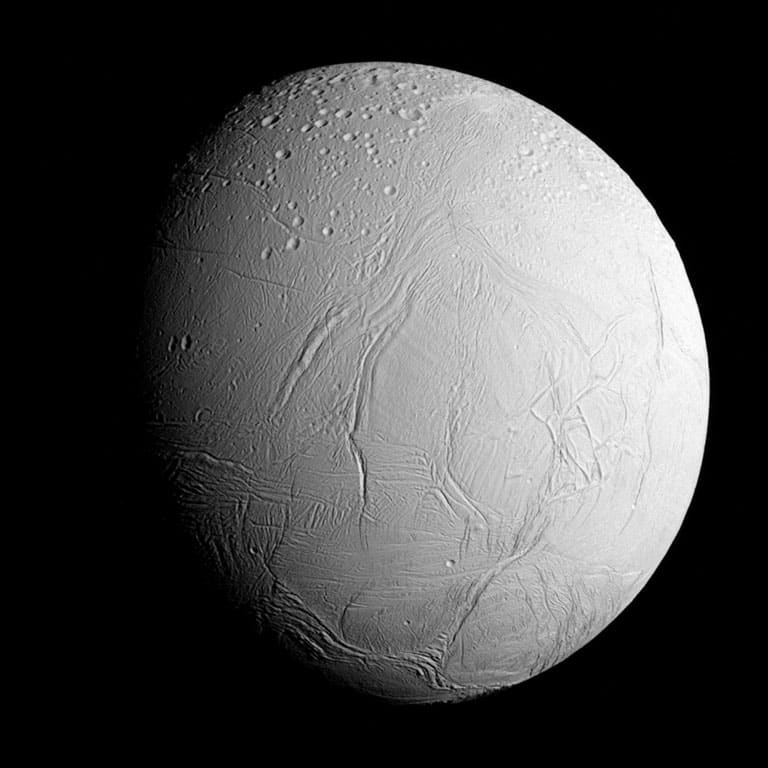
NASA's Cassini spacecraft captured this view as it neared icy Enceladus for its closest-ever dive past the moon's active south polar region.
Media Credit: NASA's Jet Propulsion Laboratory (JPL)
Back in low Earth orbit(Abbreviation: LEO) The orbit around the Earth that extends up to an altitude of 2,000 km (1,200 miles) from Earth’s surface. The International Space Station’s orbit is in LEO, at an altitude of approximately 250 miles., an investigation sponsored by the ISS National Laboratory® tested the technology’s performance in space for the first time. Designed with dark, hostile extraterrestrial oceans in mind, ELVIS is destined for places where a tiny cell floating through a void may be the first sign of life.
The Long Road to Space
Nadeau grew up in Hawaii, in the shadow of the Kilauea volcano, with lava flows, sulfur vents, and black rock cooling at the edge of the ocean—an unforgiving landscape where life persists. It is not surprising that she became someone who has spent her career asking where else that might be true.
She started as a biology undergraduate, pivoted to a Ph.D. in physics, then spent her postdoctoral years in a Caltech neuroscience lab learning molecular biology and fluorescence imaging. When NASA’s Jet Propulsion Laboratory began recruiting for its Center for Life Detection, looking for people who could build instruments to search for life on distant worlds, Nadeau was a natural fit. Her mantra for the search for extraterrestrial life became: just look.
Then, in 2015, the Gordon and Betty Moore Foundation funded ELVIS. From the start, the goal was spaceflight, particularly the icy moons of the outer solar system. But before ELVIS could search for life in an alien ocean, it had to prove it could survive rougher treatment closer to home. For nearly a decade, the team hauled versions of the microscope into the field: Mount St. Helens, the Canadian High Arctic, lakes and fjords where a submersible version pumped water directly into the imaging chamber.
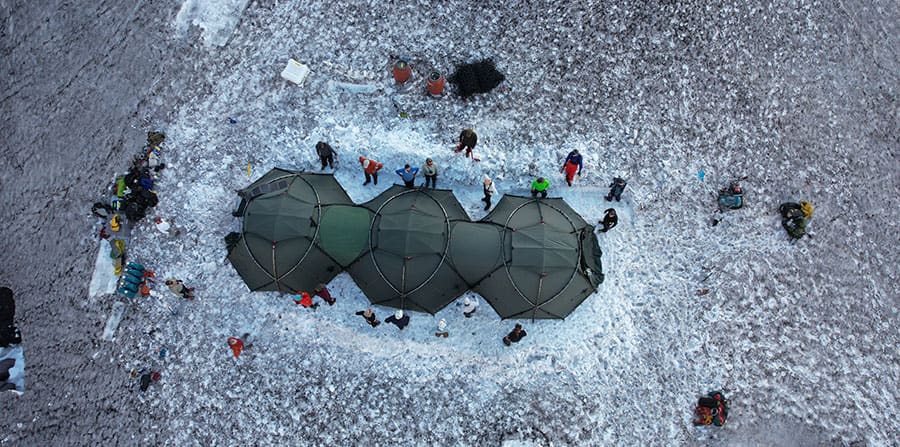
The research team’s base camp at Mount St. Helens, where Jay Nadeau and colleagues field-tested an early version of their microscope.
Media Credit: Jay Nadeau
In the spring of 2015, Nadeau’s team carried a larger predecessor called SHAMU to Greenland, whose frozen extremes stand in for the conditions they expect on worlds like Europa and Mars.
On another trip up Mt. St. Helens, a predecessor tumbled out of the car trunk. “Accidental stress testing,” said Nikki Johnston, a graduate student in Nadeau’s lab. Even then, it worked, battery-powered, on the side of a volcano.
The hardware that eventually flew to the ISS was a system that had been jolted, frozen, and carried into places where ordinary microscopes would crumble. The logic is that if life can hold on in a place that is punishing on Earth, it might do the same on an alien one.
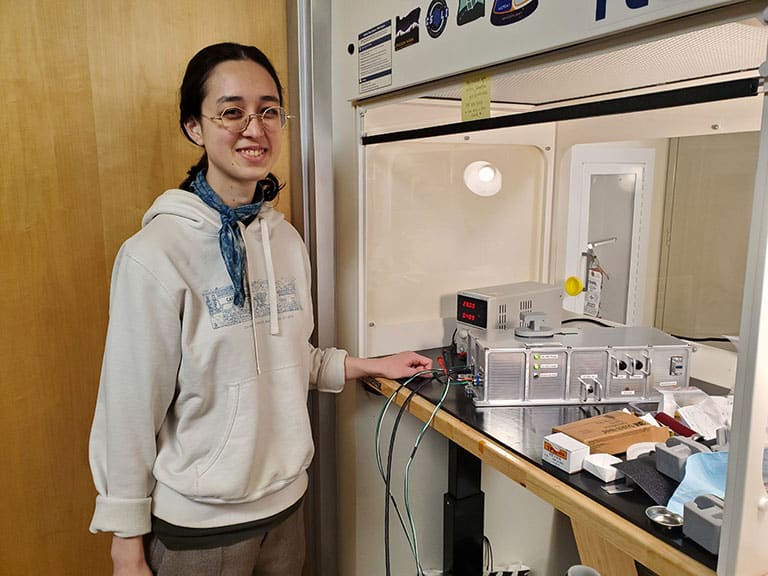
Nikki Johnston, a Ph.D. student at Portland State University, stands next to the Extant Life Volumetric Imaging System (ELVIS). This innovative system aims to advance how we study cellular processes in space.
Media Credit: Jay Nadeau
Once ELVIS was on station, Johnston watched a live feed from the ground and commanded the microscope from their desk. If something looked wrong, they could ask the crew to intervene and then wait. There was no picking up the slide or tapping the tube, none of the small corrective gestures so automatic in a lab that you don’t notice them until they’re gone.
In its first weeks on station, “there was a time when we just couldn’t see anything,” Johnston said. “We didn’t know if the slide was correctly seated or if it was even in place. And we just had no way of telling.”
Weeks passed. C. psychrerythraea was growing so slowly. Space research is notoriously hard, but “there’s something addicting about how difficult it is,” Johnston said.
Gravity Shapes Earth’s Micro-World
On Earth, C. psychrerythraea multiplies quickly in nutrient-rich water. The team’s ground control cultures expanded so rapidly that researchers had to dilute them almost immediately, while the space-grown samples barely thickened over the same interval. When the organism did swim, its motion resembled a starvation pattern. It moved erratically, searching in bursts associated with nutrient scarcity, even though it was surrounded by nutrients. An instrument calibrated only to flag abundance, rapid growth, or obvious metabolic activity might have missed C. psychrerythraea.
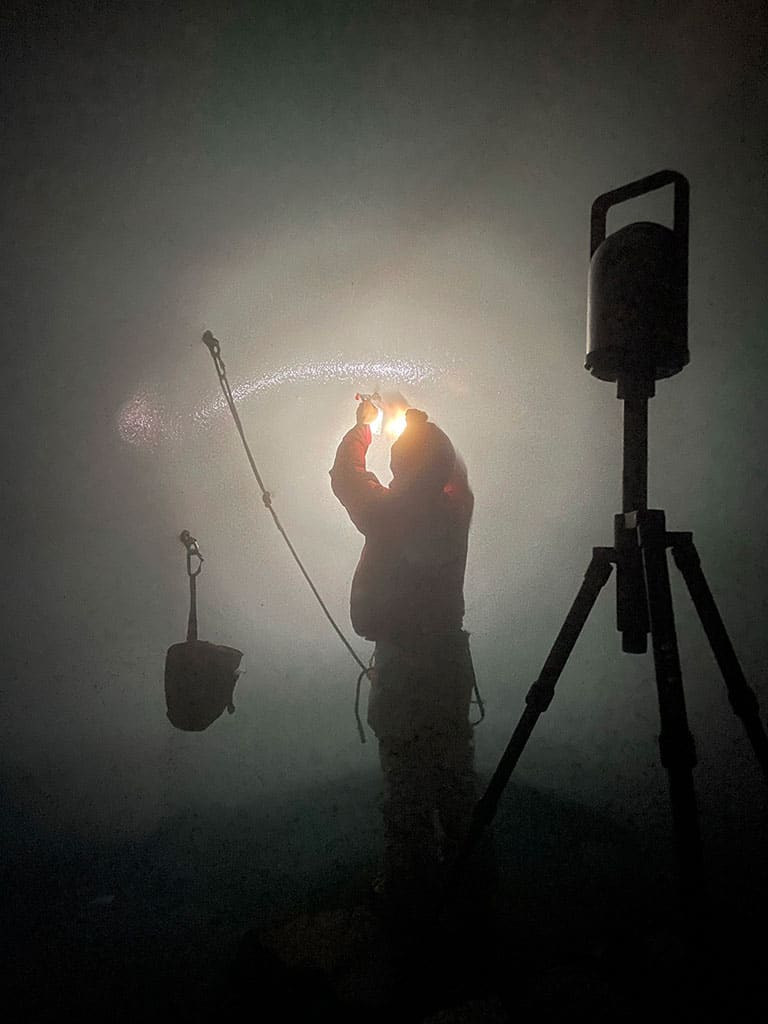
The team tested early versions of ELVIS in extreme environments on Earth before it went to space, including a glacial cave.
Media Credit: Jay Nadeau
That paradox points to a role gravity plays in how fluids and biology interact that scientists are only beginning to understand. On Earth, gravity causes particles and solutes to settle, forming gradients, or microdomains, that are richer or poorer in nutrients, where chemistry changes. Microbes exploit this structure; many swim by detecting and following gradients toward favorable regions. In microgravityThe condition of perceived weightlessness created when an object is in free fall, for example when an object is in orbital motion. Microgravity alters many observable phenomena within the physical and life sciences, allowing scientists to study things in ways not possible on Earth. The International Space Station provides access to a persistent microgravity environment., those gradients fade, and everything floats in a near-uniform soup.
The resources are there, but the bacterium is deprived of the landscape that tells it where they are.
Brook Nunn, a professor of genome sciences and astrobiology at the University of Washington who focuses on the proteomics of marine and extremophilic bacteria and has worked with C. psychrerythraea as a model extremophile, was not shocked that the cells struggled in space. Nunn wondered whether microgravity altered the cells’ ability to “bump into or swim towards a particular nutrient,” though she said proteomics (protein analysis) would be needed to understand what was happening physiologically, and decipher what the cells were doing and why. The cells may have failed to activate the transporters needed to pull in nutrients, she said, or something broader may have affected their growth over time.
ELVIS was conceived as a first-pass imager, a way to flag possible moving lifeforms for follow-up by biochemical instruments. Meaningful motion can be a powerful clue, and ELVIS was built to capture it in three dimensions. But a moving speck is not, by itself, enough to prove biology, and life in cold, low-energy environments may be present without moving much at all. A microscope’s value, Nunn argues, is broader: it can show where cell-like structures are located, whether they cluster near minerals or particles, what shapes they take, and whether molecular evidence has a visible counterpart.
That is close to how Nadeau imagines ELVIS working on a future mission: not as the final judge, but as a screening instrument that could identify something suggestive, then send it on to tools capable of analyzing its chemistry. If such a mission found compelling molecular signs of life, Nunn said, scientists and the public would still want an image of what those signals were associated with.
“If we found definite signs of life and didn’t take a photo,” she said, “it would be heartbreaking.”
ELVIS is the first witness. It cannot prove alien life on its own, but it can show scientists where to look.
What Comes Next
The microscope spent six weeks in the Life Sciences Glovebox on the ISS and successfully did the thing it was sent up to do: it imaged living cells in microgravity, clearly, over and over. But it did encounter a few unexpected challenges.
Bubbles, for instance. Holography hates air, as even a small pocket wrecks the reconstruction, and a bubble in microgravity doesn’t float up out of the way. It just sits there. Worse, bubbles find each other and merge into bigger, more stubborn bubbles. So, the crew dealt with it by hand, spinning the sample bags and tapping the syringes to chase the air out before filling the chamber. It worked. But it isn’t going to work on a lander 40 minutes of light-speed away from anyone who could spin a bag, which is exactly the reason you run the experiment on the ISS first.
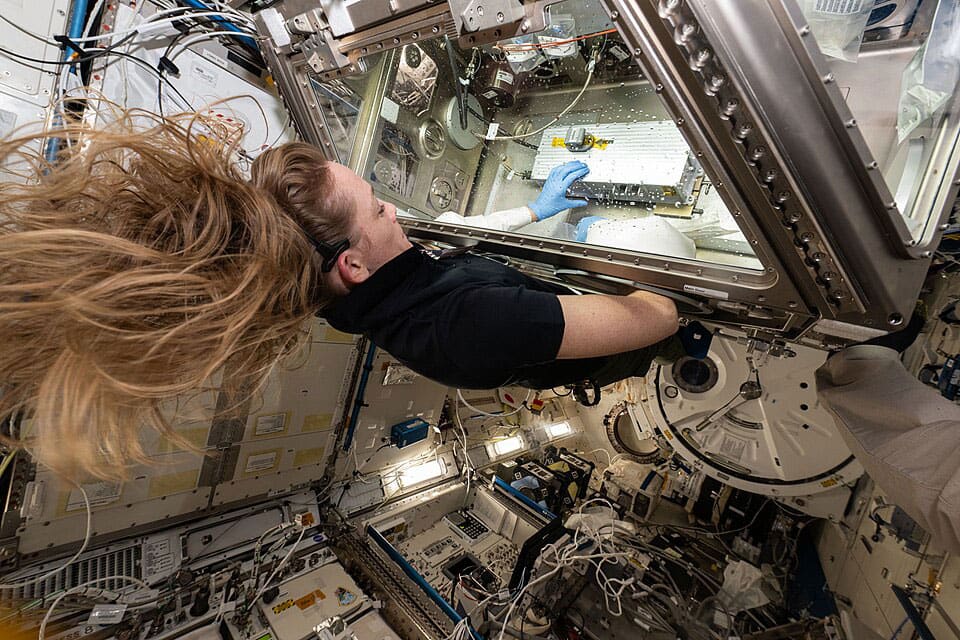
NASANational Aeronautics and Space Administration astronaut Nichole Ayers works with the ELVIS investigation at the Life Sciences Glovebox onboard the ISS.
Media Credit: NASA
Then there was the matter of how few cells came home. The space cultures were orders of magnitude less concentrated than expected, leaving the team with too few cells for straightforward RNA extraction. Nadeau had expected 50 milliliters of cell-rich culture to provide plenty of biomass. But not enough is not the same as nothing, so the team is going after the cells with ultra-low-input sequencing, which can read genes from a small sample. The question they want to answer is what C. psychrerythraea was actually doing up there. Starving, maybe. Or rationing.
“If we could do it again, we’d just send a bigger bag,” she said.
The hard problem was always the optics—how do you look through a drop of liquid without refocusing every time something drifts into the frame—and that is now solved and demonstrated in space, says Nadeau.
The team continues to look back through the microscope’s footage, watching as a single bacterium a few micrometers long swims in a drop of seawater onboard a space station orbiting Earth at 17,000 miles an hour. It was chosen because it’s tough. Tough enough to go to hostile places and live to tell us something about it. What it told us, instead, was something about itself: that it needs the physics of this planet to naturally thrive.
Whatever life we find in an alien ocean, if we find it at all, will have found its sea legs in entirely different physics.